
Informatyka
Zajrzyj do kategorii Informatyka w księgarni internetowej Ebookpoint. Znajdziesz tutaj bestsellerowe książki, ebooki i kursy video z branży IT. Sięgnij po najlepszą literaturę dla specjalistów i rozwijaj doświadczenie, które już posiadasz, lub rozpocznij swoją przygodę z programowaniem, cyberbezpieczeństwem lub grafiką komputerową. Pogłębiaj swoją wiedzę tak, jak Ci wygodnie - z tradycyjną książką, wygodnym ebookiem lub nowoczesnym videokursem. Sprawdź, jakie tytuły znajdziesz w kategorii Informatyka!
Puppet: Mastering Infrastructure Automation
Jaime Soriano Pastor
Puppet is a configuration management tool that allows you to automate all your IT configurations, giving you control. It was written for and by system administrators to manage large numbers of systems efficiently and prevent configuration drifts. Puppet gives you control of what you do to each node, when you do it, and how you do it.This Learning Path will take you from the basics of Puppet to extending it and then mastering it. We will start off with a primer on Puppet, its installation and get a sneak peek under its hood. We will then move on to designing and deploying your Puppet architecture, learning best practices for writing reusable and maintainable code, and executing, testing, and deploying Puppet across your systems. Finally, we will deal with problems of scale and exceptions in your code, automate workflows, and support multiple developers working simultaneously.This course is based on the following books: 1)Puppet 4 Essentials - Second Edition 2)Extending Puppet - Second Edition 3)Mastering Puppet - Second Edition
pytest Quick Start Guide. Write better Python code with simple and maintainable tests
Bruno Oliveira
Python's standard unittest module is based on the xUnit family of frameworks, which has its origins in Smalltalk and Java, and tends to be verbose to use and not easily extensible.The pytest framework on the other hand is very simple to get started, but powerful enough to cover complex testing integration scenarios, being considered by many the true Pythonic approach to testing in Python.In this book, you will learn how to get started right away and get the most out of pytest in your daily work?ow, exploring powerful mechanisms and plugins to facilitate many common testing tasks. You will also see how to use pytest in existing unittest-based test suites and will learn some tricks to make the jump to a pytest-style test suite quickly and easily.
Mike Ohlson de Fine
Python is a great object-oriented and interactive programming language that lets you develop graphics, both static and animated, using built-in vector graphics functions that are provided with Python.Python 2.6 Graphics Cookbook is a collection of straightforward recipes and illustrative screenshots for creating and animating graphic objects using the Python language. This book makes the process of developing graphics interesting and entertaining by working in a graphic workspace without the burden of mastering complicated language definitions and opaque examples.If you choose to work through all the recipes from the beginning, you will learn to install Python and create basic programs for making lines and shapes using the built-in Tkinter module. The confusing topic of color manipulation is explored in detail using existing Python tools as well as some new tools in the recipes. Next you will learn to manipulate font size, color, and placement of text as placing text exactly where you want on a screen can be tricky because font height, inter-character spacing, and text window dimensions all interfere with each other. Then you will learn how to animate graphics, for example having more than one independent graphic object co-exist and interact using various Python methods.You will also learn how you can work with raster images, such as converting their formats using the Python Imaging Library. Next you will learn how you can combine vector images with raster images so that you can animate the raster images with ease. You will also walk through a set of recipes with the help of which you can handle and manipulate blocks of raw data that may be hundreds of megabytes in size using datastreams, files, and hard drives. You will also learn how you can use Inkscape to dismantle existing images and use parts of them for your own graphics and Python programs. At the end of the book you will learn how you can create GUIs for different purposes.
Mercury Learning and Information, Oswald Campesato
This book bridges the gap between theoretical knowledge and practical application in Python programming, machine learning, and using ChatGPT-4 in data science. It starts with an introduction to Pandas for data manipulation and analysis. The book then explores various machine learning classifiers, from kNN to SVMs. Later chapters cover GPT-4's capabilities, enhancing linear regression analysis, and using ChatGPT in data visualization, including AI apps, GANs, and DALL-E.The journey begins with mastering Pandas and machine learning fundamentals. It progresses to applying GPT-4 in linear regression and machine learning classifiers. The final chapters focus on using ChatGPT for data visualization, making complex results accessible and understandable.Understanding these concepts is crucial for modern data scientists. This book transitions readers from basic Python programming to advanced applications of ChatGPT-4 in data science. Companion files with source code, datasets, and figures enhance learning, making this an essential resource for mastering Python, machine learning, and AI-driven data visualization.
Dusty Phillips
Object-oriented programming (OOP) is a popular design paradigm in which data and behaviors are encapsulated in such a way that they can be manipulated together. This third edition of Python 3 Object-Oriented Programming fully explains classes, data encapsulation, and exceptions with an emphasis on when you can use each principle to develop well-designed software.Starting with a detailed analysis of object-oriented programming, you will use the Python programming language to clearly grasp key concepts from the object-oriented paradigm. You will learn how to create maintainable applications by studying higher level design patterns. The book will show you the complexities of string and file manipulation, and how Python distinguishes between binary and textual data. Not one, but two very powerful automated testing systems, unittest and pytest, will be introduced in this book. You'll get a comprehensive introduction to Python's concurrent programming ecosystem.By the end of the book, you will have thoroughly learned object-oriented principles using Python syntax and be able to create robust and reliable programs confidently.
Python 3. The Comprehensive Guide
Rheinwerk Publishing, Inc, Johannes Ernesti, Peter Kaiser
This in-depth guide to Python 3 begins by helping readers install the language and understand its core syntax through interactive exploration. Early chapters cover variables, control structures, functions, and data types like lists, tuples, dictionaries, and sets. Readers then move into file handling, error management, and object-oriented programming, building a solid foundation for real-world development.As the journey continues, the book introduces advanced concepts including decorators, generators, type hints, structural pattern matching, and context managers. It thoroughly explores the Python standard library, with practical applications in math, file systems, logging, regular expressions, parallel processing, and debugging. Readers also learn how to manage packages, virtual environments, and distributions.Later chapters shift to applied development—building GUIs with tkinter and PySide6, creating web applications with Django, and working with scientific tools like NumPy, pandas, and SciPy. The book concludes with insights on using alternative interpreters, localization, and migrating from Python 2 to 3. This resource grows with the reader, from basics to expert-level Python programming.
Python 3 Using ChatGPT / GPT-4. Harnessing AI for Efficient Python Programming
Mercury Learning and Information, Oswald Campesato
This book is for people who want to learn Python 3 and how to use ChatGPT with Python. It starts with an introduction to Python programming, covering data types, number formatting, Unicode handling, and text manipulation. The book then covers loops, conditional logic, reserved words, user input, exception management, and command-line arguments.The journey continues into Generative AI, discussing its distinction from Conversational AI. Popular platforms like ChatGPT and GPT-4 are explored, along with their strengths, weaknesses, and potential applications. The book shows how to generate Python 3 code samples via ChatGPT using the “Code Interpreter” plugin.Understanding these concepts is crucial for navigating Python and AI. This book transitions readers from basic Python programming to advanced AI applications, blending theory with practical skills. Companion files with code samples and figures enhance learning, making this an essential resource for mastering Python and ChatGPT.
Giuseppe Bonaccorso, Rajalingappaa Shanmugamani
This Learning Path is your complete guide to quickly getting to grips with popular machine learning algorithms. You'll be introduced to the most widely used algorithms in supervised, unsupervised, and semi-supervised machine learning, and learn how to use them in the best possible manner. Ranging from Bayesian models to the MCMC algorithm to Hidden Markov models, this Learning Path will teach you how to extract features from your dataset and perform dimensionality reduction by making use of Python-based libraries. You'll bring the use of TensorFlow and Keras to build deep learning models, using concepts such as transfer learning, generative adversarial networks, and deep reinforcement learning. Next, you'll learn the advanced features of TensorFlow1.x, such as distributed TensorFlow with TF clusters, deploy production models with TensorFlow Serving. You'll implement different techniques related to object classification, object detection, image segmentation, and more. By the end of this Learning Path, you'll have obtained in-depth knowledge of TensorFlow, making you the go-to person for solving artificial intelligence problemsThis Learning Path includes content from the following Packt products:• Mastering Machine Learning Algorithms by Giuseppe Bonaccorso• Mastering TensorFlow 1.x by Armando Fandango• Deep Learning for Computer Vision by Rajalingappaa Shanmugamani
Ashish Kumar, Joseph Babcock
Social Media and the Internet of Things have resulted in an avalanche of data. Data is powerful but not in its raw form; it needs to be processed and modeled, and Python is one of the most robust tools out there to do so. It has an array of packages for predictive modeling and a suite of IDEs to choose from. Using the Python programming language, analysts can use these sophisticated methods to build scalable analytic applications. This book is your guide to getting started with predictive analytics using Python.You'll balance both statistical and mathematical concepts, and implement them in Python using libraries such as pandas, scikit-learn, and NumPy. Through case studies and code examples using popular open-source Python libraries, this book illustrates the complete development process for analytic applications. Covering a wide range of algorithms for classification, regression, clustering, as well as cutting-edge techniques such as deep learning, this book illustrates explains how these methods work. You will learn to choose the right approach for your problem and how to develop engaging visualizations to bring to life the insights of predictive modeling.Finally, you will learn best practices in predictive modeling, as well as the different applications of predictive modeling in the modern world. The course provides you with highly practical content from the following Packt books:1. Learning Predictive Analytics with Python2. Mastering Predictive Analytics with Python
Python. An Introduction to Python Programming
Mercury Learning and Information, James R. Parker
This book introduces programming concepts using Python 3, designed for beginners and hobbyists with no prior programming experience. It covers loops, strings, functions, files, graphics, multimedia, algorithms, classes, and more. Many examples are based on video game development, making learning engaging and practical. The book uses a just-in-time presentation style, providing material when it's needed, and includes companion files with source code, exercises, projects, and figures.The course starts with an overview of modern computers and basic programming concepts. It progresses through topics like repetition, sequences, functions, file input/output, classes, graphics, data manipulation, and multimedia. The latter chapters focus on basic algorithms, programming for the sciences, writing good programs, parsing, and communicating using graphics and Pygame.By the end of the course, students will have a solid understanding of programming fundamentals, enhanced by practical applications in video game development. This approach not only makes learning enjoyable but also equips students with the skills needed for further studies in computer science and programming.
Cuantum Technologies LLC
Embark on a transformative journey with this course designed to equip you with robust Python and SQL skills. Starting with an introduction to Python, you'll delve into fundamental building blocks, control flow, functions, and object-oriented programming. As you progress, you'll master data structures, file I/O, exception handling, and the Python Standard Library, ensuring a solid foundation in Python.The course then transitions to SQL, beginning with an introduction and covering basics, and proceeding to advanced querying techniques. You'll learn about database administration and how Python integrates seamlessly with SQL, enhancing your data manipulation capabilities. By combining Python with SQLAlchemy, you'll perform advanced database operations and execute complex data analysis tasks, preparing you for real-world challenges.By the end of this course, you will have developed the expertise to utilize Python and SQL for scientific computing, data analysis, and database management. This comprehensive learning path ensures you can tackle diverse projects, from basic scripting to sophisticated data operations, making you a valuable asset in the tech industry. You'll also gain hands-on experience with real-world datasets, enhancing your problem-solving skills and boosting your confidence.
Dr. Joshua Eckroth
Artificial Intelligence (AI) is the newest technology that’s being employed among varied businesses, industries, and sectors. Python Artificial Intelligence Projects for Beginners demonstrates AI projects in Python, covering modern techniques that make up the world of Artificial Intelligence.This book begins with helping you to build your first prediction model using the popular Python library, scikit-learn. You will understand how to build a classifier using an effective machine learning technique, random forest, and decision trees. With exciting projects on predicting bird species, analyzing student performance data, song genre identification, and spam detection, you will learn the fundamentals and various algorithms and techniques that foster the development of these smart applications. In the concluding chapters, you will also understand deep learning and neural network mechanisms through these projects with the help of the Keras library.By the end of this book, you will be confident in building your own AI projects with Python and be ready to take on more advanced projects as you progress
Jaime Buelta
Have you been doing the same old monotonous office work over and over again? Or have you been trying to find an easy way to make your life better by automating some of your repetitive tasks? Through a tried and tested approach, understand how to automate all the boring stuff using Python. The Python Automation Cookbook helps you develop a clear understanding of how to automate your business processes using Python, including detecting opportunities by scraping the web, analyzing information to generate automatic spreadsheets reports with graphs, and communicating with automatically generated emails. You’ll learn how to get notifications via text messages and run tasks while your mind is focused on other important activities, followed by understanding how to scan documents such as résumés. Once you’ve gotten familiar with the fundamentals, you’ll be introduced to the world of graphs, along with studying how to produce organized charts using Matplotlib. In addition to this, you’ll gain in-depth knowledge of how to generate rich graphics showing relevant information. By the end of this book, you’ll have refined your skills by attaining a sound understanding of how to identify and correct problems to produce superior and reliable systems.
Python Data Analysis Cookbook. Clean, scrape, analyze, and visualize data with the power of Python!
Ivan Idris
Data analysis is a rapidly evolving field and Python is a multi-paradigm programming language suitable for object-oriented application development and functional design patterns. As Python offers a range of tools and libraries for all purposes, it has slowly evolved as the primary language for data science, including topics on: data analysis, visualization, and machine learning.Python Data Analysis Cookbook focuses on reproducibility and creating production-ready systems. You will start with recipes that set the foundation for data analysis with libraries such as matplotlib, NumPy, and pandas. You will learn to create visualizations by choosing color maps and palettes then dive into statistical data analysis using distribution algorithms and correlations. You’ll then help you find your way around different data and numerical problems, get to grips with Spark and HDFS, and then set up migration scripts for web mining.In this book, you will dive deeper into recipes on spectral analysis, smoothing, and bootstrapping methods. Moving on, you will learn to rank stocks and check market efficiency, then work with metrics and clusters. You will achieve parallelism to improve system performance by using multiple threads and speeding up your code.By the end of the book, you will be capable of handling various data analysis techniques in Python and devising solutions for problem scenarios.
Martin Czygan, Phuong Vo.T.H, Ashish Kumar, Kirthi...
You will start the course with an introduction to the principles of data analysis and supported libraries, along with NumPy basics for statistics and data processing. Next, you will overview the Pandas package and use its powerful features to solve data-processing problems. Moving on, you will get a brief overview of the Matplotlib API .Next, you will learn to manipulate time and data structures, and load and store data in a file or database using Python packages. You will learn how to apply powerful packages in Python to process raw data into pure and helpful data using examples. You will also get a brief overview of machine learning algorithms, that is, applying data analysis results to make decisions or building helpful products such as recommendations and predictions using Scikit-learn. After this, you will move on to a data analytics specialization—predictive analytics. Social media and IOT have resulted in an avalanche of data. You will get started with predictive analytics using Python. You will see how to create predictive models from data. You will get balanced information on statistical and mathematical concepts, and implement them in Python using libraries such as Pandas, scikit-learn, and NumPy. You’ll learn more about the best predictive modeling algorithms such as Linear Regression, Decision Tree, and Logistic Regression. Finally, you will master best practices in predictive modeling.After this, you will get all the practical guidance you need to help you on the journey to effective data visualization. Starting with a chapter on data frameworks, which explains the transformation of data into information and eventually knowledge, this path subsequently cover the complete visualization process using the most popular Python libraries with working examplesThis Learning Path combines some of the best that Packt has to offer in one complete, curated package. It includes content from the following Packt products:? Getting Started with Python Data Analysis, Phuong Vo.T.H &Martin Czygan•Learning Predictive Analytics with Python, Ashish Kumar•Mastering Python Data Visualization, Kirthi Raman
Alberto Boschetti
The book starts by introducing you to setting up your essential data science toolbox. Then it will guide you across all the data munging and preprocessing phases. This will be done in a manner that explains all the core data science activities related to loading data, transforming and fixing it for analysis, as well as exploring and processing it. Finally, it will complete the overview by presenting you with the main machine learning algorithms, the graph analysis technicalities, and all the visualization instruments that can make your life easier in presenting your results.In this walkthrough, structured as a data science project, you will always be accompanied by clear code and simplified examples to help you understand the underlying mechanics and real-world datasets.
Python Data Science Essentials. Learn the fundamentals of Data Science with Python - Second Edition
Luca Massaron, Alberto Boschetti
Fully expanded and upgraded, the second edition of Python Data Science Essentials takes you through all you need to know to suceed in data science using Python. Get modern insight into the core of Python data, including the latest versions of Jupyter notebooks, NumPy, pandas and scikit-learn. Look beyond the fundamentals with beautiful data visualizations with Seaborn and ggplot, web development with Bottle, and even the new frontiers of deep learning with Theano and TensorFlow. Dive into building your essential Python 3.5 data science toolbox, using a single-source approach that will allow to to work with Python 2.7 as well. Get to grips fast with data munging and preprocessing, and all the techniques you need to load, analyse, and process your data. Finally, get a complete overview of principal machine learning algorithms, graph analysis techniques, and all the visualization and deployment instruments that make it easier to present your results to an audience of both data science experts and business users.
Benjamin Baka
Data structures allow you to organize data in a particular way efficiently. They are critical to any problem, provide a complete solution, and act like reusable code. In this book, you will learn the essential Python data structures and the most common algorithms. With this easy-to-read book, you will be able to understand the power of linked lists, double linked lists, and circular linked lists. You will be able to create complex data structures such as graphs, stacks and queues. We will explore the application of binary searches and binary search trees. You will learn the common techniques and structures used in tasks such as preprocessing, modeling, and transforming data. We will also discuss how to organize your code in a manageable, consistent, and extendable way. The book will explore in detail sorting algorithms such as bubble sort, selection sort, insertion sort, and merge sort. By the end of the book, you will learn how to build components that are easy to understand, debug, and use in different applications.
Indra den Bakker
Deep Learning is revolutionizing a wide range of industries. For many applications, deep learning has proven to outperform humans by making faster and more accurate predictions. This book provides a top-down and bottom-up approach to demonstrate deep learning solutions to real-world problems in different areas. These applications include Computer Vision, Natural Language Processing, Time Series, and Robotics. The Python Deep Learning Cookbook presents technical solutions to the issues presented, along with a detailed explanation of the solutions. Furthermore, a discussion on corresponding pros and cons of implementing the proposed solution using one of the popular frameworks like TensorFlow, PyTorch, Keras and CNTK is provided. The book includes recipes that are related to the basic concepts of neural networks. All techniques s, as well as classical networks topologies. The main purpose of this book is to provide Python programmers a detailed list of recipes to apply deep learning to common and not-so-common scenarios.
Ivan Vasilev, Daniel Slater, Gianmario Spacagna, Peter...
With the surge in artificial intelligence in applications catering to both business and consumer needs, deep learning is more important than ever for meeting current and future market demands. With this book, you’ll explore deep learning, and learn how to put machine learning to use in your projects.This second edition of Python Deep Learning will get you up to speed with deep learning, deep neural networks, and how to train them with high-performance algorithms and popular Python frameworks. You’ll uncover different neural network architectures, such as convolutional networks, recurrent neural networks, long short-term memory (LSTM) networks, and capsule networks. You’ll also learn how to solve problems in the fields of computer vision, natural language processing (NLP), and speech recognition. You'll study generative model approaches such as variational autoencoders and Generative Adversarial Networks (GANs) to generate images. As you delve into newly evolved areas of reinforcement learning, you’ll gain an understanding of state-of-the-art algorithms that are the main components behind popular games Go, Atari, and Dota.By the end of the book, you will be well-versed with the theory of deep learning along with its real-world applications.
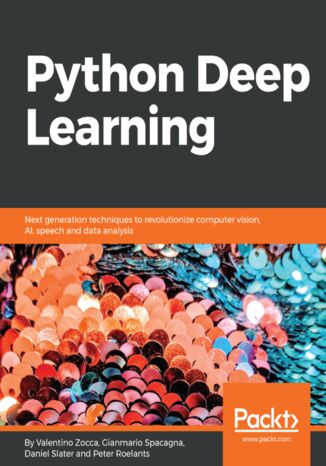
Valentino Zocca, Gianmario Spacagna, Daniel Slater, Peter...
With an increasing interest in AI around the world, deep learning has attracted a great deal of public attention. Every day, deep learning algorithms are used broadly across different industries.The book will give you all the practical information available on the subject, including the best practices, using real-world use cases. You will learn to recognize and extract information to increase predictive accuracy and optimize results.Starting with a quick recap of important machine learning concepts, the book will delve straight into deep learning principles using Sci-kit learn. Moving ahead, you will learn to use the latest open source libraries such as Theano, Keras, Google's TensorFlow, and H20. Use this guide to uncover the difficulties of pattern recognition, scaling data with greater accuracy and discussing deep learning algorithms and techniques.Whether you want to dive deeper into Deep Learning, or want to investigate how to get more out of this powerful technology, you’ll find everything inside.
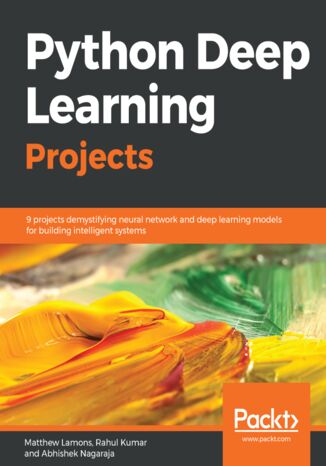
Matthew Lamons, Rahul Kumar, Abhishek Nagaraja
Deep learning has been gradually revolutionizing every field of artificial intelligence, making application development easier.Python Deep Learning Projects imparts all the knowledge needed to implement complex deep learning projects in the field of computational linguistics and computer vision. Each of these projects is unique, helping you progressively master the subject. You’ll learn how to implement a text classifier system using a recurrent neural network (RNN) model and optimize it to understand the shortcomings you might experience while implementing a simple deep learning system.Similarly, you’ll discover how to develop various projects, including word vector representation, open domain question answering, and building chatbots using seq-to-seq models and language modeling. In addition to this, you’ll cover advanced concepts, such as regularization, gradient clipping, gradient normalization, and bidirectional RNNs, through a series of engaging projects.By the end of this book, you will have gained knowledge to develop your own deep learning systems in a straightforward way and in an efficient way
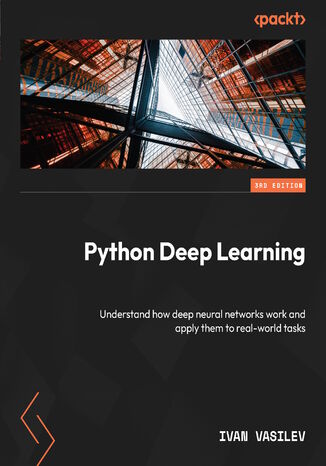
Ivan Vasilev, Valentino Zocca
The field of deep learning has developed rapidly recently and today covers a broad range of applications. This makes it challenging to navigate and hard to understand without solid foundations. This book will guide you from the basics of neural networks to the state-of-the-art large language models in use today.The first part of the book introduces the main machine learning concepts and paradigms. It covers the mathematical foundations, the structure, and the training algorithms of neural networks and dives into the essence of deep learning.The second part of the book introduces convolutional networks for computer vision. We’ll learn how to solve image classification, object detection, instance segmentation, and image generation tasks.The third part focuses on the attention mechanism and transformers – the core network architecture of large language models. We’ll discuss new types of advanced tasks they can solve, such as chatbots and text-to-image generation.By the end of this book, you’ll have a thorough understanding of the inner workings of deep neural networks. You'll have the ability to develop new models and adapt existing ones to solve your tasks. You’ll also have sufficient understanding to continue your research and stay up to date with the latest advancements in the field.
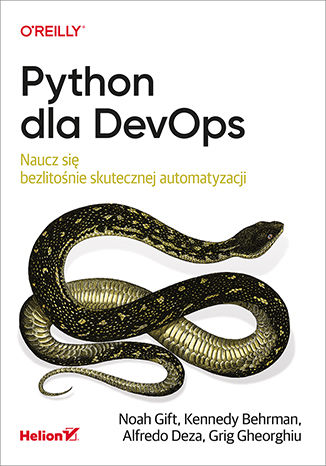
Python dla DevOps. Naucz się bezlitośnie skutecznej automatyzacji
Noah Gift, Kennedy Behrman, Alfredo Deza, Grig...
Ostatnia dekada zmieniła oblicze IT. Kluczowego znaczenia nabrały big data, a chmura i automatyzacja rozpowszechniły się wszędzie tam, gdzie mowa o efektywności. Inżynierowie muszą wykorzystywać zalety systemów linuksowych w codziennej praktyce, aby zapewnić należyty poziom automatyzacji swoich zadań. Do tych celów świetnie nadaje się Python. Język ten zdobywa coraz większe uznanie z uwagi na jego wszechstronność, jak również wydajność, przenaszalność i bezpieczeństwo kodu. Warto więc wykorzystywać Pythona do administrowania systemami Linux wraz z takimi narzędziami DevOps jak Docker, Kubernetes i Terraform. Dzięki tej książce dowiesz się, jak sobie z tym poradzić. Znalazło się w niej krótkie wprowadzenie do Pythona oraz do automatyzacji przetwarzania tekstu i obsługi systemu plików, a także do pisania własnych narzędzi wiersza poleceń. Zaprezentowano również przydatne narzędzia linuksowe, systemy zarządzania pakietami oraz systemy budowania, monitorowania i automatycznego testowania kodu. Zagadnienia te szczególnie zainteresują specjalistów DevOps. Ponadto zawarto tu podstawowe informacje o chmurze obliczeniowej, usługach IaC i systemach Kubernetes. Omówiono zasady uczenia maszynowego i inżynierii danych z perspektywy DevOps. Przedstawiono także kompletny przewodnik po procesach budowania, wdrażania oraz operacyjnego wykorzystywania modelu uczenia maszynowego z użyciem systemów Flask, sklearn, Docker i Kubernetes. W tej książce: wprowadzenie do Pythona automatyczne przetwarzanie tekstu oraz automatyzacja operacji na plikach automatyzacja za pomocą sprawdzonych narzędzi linuksowych chmura, infrastruktura jako kod, Kubernetes i tryb bezserwerowy uczenie maszynowe i inżynieria danych z perspektywy DevOps tworzenie i operacjonalizacja projektu uczenia maszynowego Python: tutaj ważna jest prawdziwa nowoczesność oprogramowania!