
Informatyka
Zajrzyj do kategorii Informatyka w księgarni internetowej Ebookpoint. Znajdziesz tutaj bestsellerowe książki, ebooki i kursy video z branży IT. Sięgnij po najlepszą literaturę dla specjalistów i rozwijaj doświadczenie, które już posiadasz, lub rozpocznij swoją przygodę z programowaniem, cyberbezpieczeństwem lub grafiką komputerową. Pogłębiaj swoją wiedzę tak, jak Ci wygodnie - z tradycyjną książką, wygodnym ebookiem lub nowoczesnym videokursem. Sprawdź, jakie tytuły znajdziesz w kategorii Informatyka!
Distributed Computing with Go. Practical concurrency and parallelism for Go applications
V.N. Nikhil Anurag, Jinzhu Zhang, Pankaj Khairnar
Distributed Computing with Go gives developers with a good idea how basic Go development works the tools to fulfill the true potential of Golang development in a world of concurrent web and cloud applications. Nikhil starts out by setting up a professional Go development environment. Then you’ll learn the basic concepts and practices of Golang concurrent and parallel development. You’ll find out in the new few chapters how to balance resources and data with REST and standard web approaches while keeping concurrency in mind. Most Go applications these days will run in a data center or on the cloud, which is a condition upon which the next chapter depends. There, you’ll expand your skills considerably by writing a distributed document indexing system during the next two chapters. This system has to balance a large corpus of documents with considerable analytical demands. Another use case is the way in which a web application written in Go can be consciously redesigned to take distributed features into account. The chapter is rather interesting for Go developers who have to migrate existing Go applications to computationally and memory-intensive environments. The final chapter relates to the rather onerous task of testing parallel and distributed applications, something that is not usually taught in standard computer science curricula.
Distributed Data Systems with Azure Databricks. Create, deploy, and manage enterprise data pipelines
Alan Bernardo Palacio
Microsoft Azure Databricks helps you to harness the power of distributed computing and apply it to create robust data pipelines, along with training and deploying machine learning and deep learning models. Databricks' advanced features enable developers to process, transform, and explore data. Distributed Data Systems with Azure Databricks will help you to put your knowledge of Databricks to work to create big data pipelines. The book provides a hands-on approach to implementing Azure Databricks and its associated methodologies that will make you productive in no time. Complete with detailed explanations of essential concepts, practical examples, and self-assessment questions, you’ll begin with a quick introduction to Databricks core functionalities, before performing distributed model training and inference using TensorFlow and Spark MLlib. As you advance, you’ll explore MLflow Model Serving on Azure Databricks and implement distributed training pipelines using HorovodRunner in Databricks. Finally, you’ll discover how to transform, use, and obtain insights from massive amounts of data to train predictive models and create entire fully working data pipelines. By the end of this MS Azure book, you’ll have gained a solid understanding of how to work with Databricks to create and manage an entire big data pipeline.

Jeremiah Ginn
The SASE concept was coined by Gartner after seeing a pattern emerge in cloud and SD-WAN projects where full security integration was needed. The market behavior lately has sparked something like a space race for all technology manufacturers and cloud service providers to offer a SASE solution. The current training available in the market is minimal and manufacturer-oriented, with new services being released every few weeks. Professional architects and engineers trying to implement SASE need to take a manufacturer-neutral approach.This guide provides a foundation for understanding SASE, but it also has a lasting impact because it not only addresses the problems that existed at the time of publication, but also provides a continual learning approach to successfully lead in a market that evolves every few weeks. Technology teams need a tool that provides a model to keep up with new information as it becomes available and stay ahead of market hype.With this book, you’ll learn about crucial models for SASE success in designing, building, deploying, and supporting operations to ensure the most positive user experience (UX). In addition to SASE, you’ll gain insight into SD-WAN design, DevOps, zero trust, and next-generation technical education methods.
Ayman Hourieh
Django is a high-level Python web framework that was developed by a fast-moving online-news operation to meet the stringent twin challenges of newsroom deadlines and the needs of web developers. It is designed to promote rapid development and clean, pragmatic design and lets you build high-performing, elegant web applications rapidly. Django focuses on automating as much as possible and adhering to the DRY (Don't Repeat Yourself) principle, making it easier to build high-performance web applications faster, with less code.This book will show you how to assemble Django's features and take advantage of its power to design, develop, and deploy a fully-featured web site. It will walk you through the creation of an example web application, with lots of code examples.Specially revised for version 1.0 of Django, the book starts by introducing the main design concepts in Django. Next, it leads you through the process of installing Django on your system. After that, you will start right away on building your social bookmarking application using Django. Various Django 1.0 components and sub-frameworks will be explained during this process, and you will learn about them by example.In each chapter, you will build one or more of the features that are essential in Web 2.0 applications, like user management, tags, and AJAX. You will also learn about good software development practices, such as keeping your application secure, and automating testing with unit tests. By the end of the book, you will have built a fully functional real-life Web 2.0 application, and learned how to deploy it to a production server.
Django 1.1 Testing and Debugging. Building rigorously tested and bug-free Django applications
Karen Tracey
Bugs are a time consuming burden during software development. Django's built-in test framework and debugging support help lessen this burden. This book will teach you quick and efficient techniques for using Django and Python tools to eradicate bugs and ensure your Django application works correctly. This book will walk you step by step through development of a complete sample Django application. You will learn how best to test and debug models, views, URL configuration, templates, and template tags. This book will help you integrate with and make use of the rich external environment of test and debugging tools for Python and Django applications. The book starts with a basic overview of testing. It will highlight areas to look out for while testing. You will learn about different kinds of tests available, and the pros and cons of each, and also details of test extensions provided by Django that simplify the task of testing Django applications. You will see an illustration of how external tools that provide even more sophisticated testing features can be integrated into Django's framework. On the debugging front, the book illustrates how to interpret the extensive debugging information provided by Django's debug error pages, and how to utilize logging and other external tools to learn what code is doing.
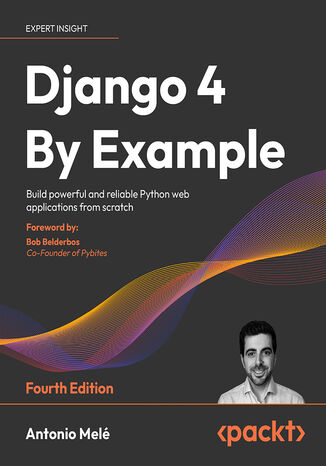
Antonio Melé
Django 4 By Example is the 4th edition of the best-selling franchise that helps you build web apps. This book will walk you through the creation of real-world applications, solving common problems, and implementing best practices using a step-by-step approach.You'll cover a wide range of web app development topics as you build four different apps:A blog application: Create data models, views, and URLs and implement an admin site for your blog. Create sitemaps and RSS feeds and implement a full-text search engine with PostgreSQL.A social website: Implement authentication with Facebook, Twitter, and Google. Create user profiles, image thumbnails, a bookmarklet, and an activity stream. Implement a user follower system and add infinite scroll pagination to your website.An e-commerce application: Build a product catalog, a shopping cart, and asynchronous tasks with Celery and RabbitMQ. Process payments with Stripe and manage payment notifications via webhooks. Build a product recommendation engine with Redis. Create PDF invoices and export orders to CSV.An e-learning platform: Create a content management system to manage polymorphic content. Cache content with Memcached and Redis. Build and consume a RESTful API. Implement a real-time chat using WebSockets with ASGI. Create a production environment using NGINX, uWSGI and Daphne with Docker Compose.This is a practical book that will have you creating web apps quickly.
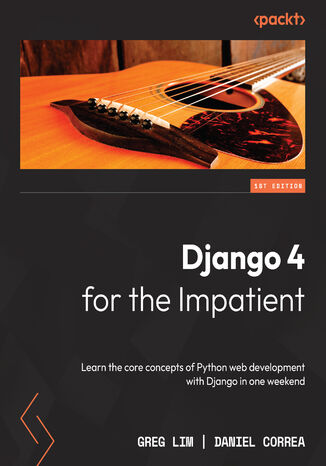
Greg Lim, Daniel Correa
Learning Django can be a tricky and time-consuming activity. There are hundreds of tutorials, loads of documentation, and many explanations that are hard to digest. However, this book enables you to use and learn Django in just a couple of days.In this book, you’ll go on a fun, hands-on, and pragmatic journey to learn Django full stack development. You'll start building your first Django app within minutes. You'll be provided with short explanations and a practical approach that cover some of the most important Django features, such as Django Apps’ structure, URLs, views, templates, models, CSS inclusion, image storage, authentication and authorization, Django admin panel, and many more. You'll also use Django to develop a movies review app and deploy it to the internet.By the end of this book, you'll be able to build and deploy your own Django web applications.
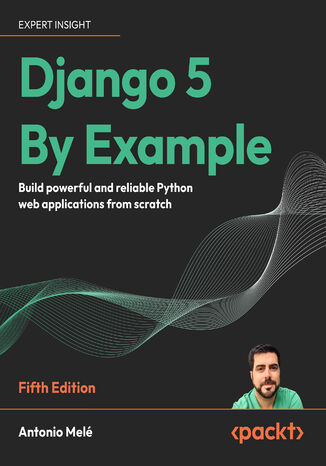
Antonio Melé, Paolo Melchiorre
If you want to learn Django by doing, this book is for you.This 2025 EDITION, fully updated to Django 5.2 LTS, is the fifth edition of the best-selling Django By Example franchise that helps you build real-world web apps. This book will walk you through planning and creation, solving common problems, and implementing best practices using a step-by-step approach.You’ll cover a wide range of web application development topics through four different projects: a blog application, a social website, an e-commerce application, and an e-learning platform. Pick up what’s new in Django 5 as you build end-to-end Python web apps, follow detailed project plans, and understand the hows and whys of Django.This is a practical and approachable book that will have you creating web apps quickly.*Email sign-up and proof of purchase required