
Informatyka
Zajrzyj do kategorii Informatyka w księgarni internetowej Ebookpoint. Znajdziesz tutaj bestsellerowe książki, ebooki i kursy video z branży IT. Sięgnij po najlepszą literaturę dla specjalistów i rozwijaj doświadczenie, które już posiadasz, lub rozpocznij swoją przygodę z programowaniem, cyberbezpieczeństwem lub grafiką komputerową. Pogłębiaj swoją wiedzę tak, jak Ci wygodnie - z tradycyjną książką, wygodnym ebookiem lub nowoczesnym videokursem. Sprawdź, jakie tytuły znajdziesz w kategorii Informatyka!
Efficient Algorithm Design. Unlock the power of algorithms to optimize computer programming
Masoud Makrehchi
Efficient Algorithm Design redefines algorithms, tracing the evolution of computer science as a discipline bridging natural science and mathematics. Author Masoud Makrehchi, PhD, with his extensive experience in delivering publications and presentations, explores the duality of computers as mortal hardware and immortal algorithms. The book guides you through essential aspects of algorithm design and analysis, including proving correctness and the importance of repetition and loops. This groundwork sets the stage for exploring algorithm complexity, with practical exercises in design and analysis using sorting and search as examples. Each chapter delves into critical topics such as recursion and dynamic programming, reinforced with practical examples and exercises that link theory with real-world applications. What sets this book apart is its focus on the practical application of algorithm design and analysis, equipping you to solve real programming challenges effectively.By the end of this book, you’ll have a deep understanding of algorithmic foundations and gain proficiency in designing efficient algorithms, empowering you to develop more robust and optimized software solutions.
Alfonso San Miguel Sánchez, Danny Obando García
In response to the escalating challenges of cloud adoption, where balancing costs and maximizing cloud values is paramount, FinOps practices have emerged as the cornerstone of fi nancial optimization. This book serves as your comprehensive guide to understanding how FinOps is implemented in organizations worldwide through team collaboration and proper cloud governance.Presenting FinOps from a practical point of view, covering the three phases—inform, optimize, and operate—this book demonstrates an end-to-end methodology for optimizing costs and performing financial management in the cloud. You’ll learn how to design KPIs and dashboards for judicious cost allocation, covering key features of cloud services such as reserved instances, rightsizing, scaling, and automation for cost optimization. This book further simplifi es architectural concepts and best practices, enabling you to design superior and more optimized solutions. Finally, you’ll discover potential synergies and future challenges, from the integration of artifi cial intelligence to cloud sustainability considerations, to prepare for the future of cloud FinOps.By the end of this book, you’ll have built the expertise to seamlessly implement FinOps practices across major public clouds, armed with insights and ideas to propel your organization toward business growth.
Ashish Choudhary
Kubernetes has become the de facto standard for container orchestration, drastically improving how we deploy and manage cloud-native apps. Although it has simplified the lives of support professionals, we cannot say the same for developers who need to be equipped with better tools to increase productivity. An automated workflow that solves a wide variety of problems that every developer faces can make all the difference!Enter Skaffold – a command-line tool that automates the build, push, and deploy steps for Kubernetes applications.This book is divided into three parts, starting with common challenges encountered by developers in building apps with Kubernetes. The second part covers Skaffold features, its architecture, supported container image builders, and more. In the last part, you'll focus on practical implementation, learning how to deploy Spring Boot apps to cloud platforms such as Google Cloud Platform (GCP) using Skaffold. You'll also create CI/CD pipelines for your cloud-native apps with Skaffold. Although the examples covered in this book are written in Java and Spring Boot, the techniques can be applied to apps built using other technologies too.By the end of this Skaffold book, you'll develop skills that will help accelerate your inner development loop and be able to build and deploy your apps to the Kubernetes cluster with Skaffold.
Deepak Vohra
EJB (Enterprise JavaBeans) 3.0 is a commonly used database persistence technology in Java EE applications. EJB 3.0 has simplified the development of EJBs with an annotations-based API that eliminates the use of remote/local interfaces, home/local home interfaces, and deployment descriptors. A number of other books are available on EJB 3.0, but none covers EJB 3.0 support in Oracle Fusion Middleware 11g, which is one of the leaders in the application server market.This is the first book that covers all aspects of EJB 3.0 database persistence development using Oracle Fusion Middleware technology. It covers all the best practices for database persistence ensuring that your applications are easily maintainable. Leaving theory behind, this book uses real-world examples to guide you in building your own EJB 3.0 applications that are well integrated with commonly used Java EE frameworks.The book gets going by discussing the new features in the EJB 3.0 specification. As some readers may still be using EJB 2.0, the book explains how to convert your EJB 2.0 entity beans to EJB 3.0. It then goes on to discuss using EJB 3.0 database persistence with JDeveloper, WebLogic Server, and Enterprise Pack for Eclipse, the main Java EE components of Oracle Fusion Middleware 11g. The book also covers EJB 3.0 relationships and integrating EJB 3.0 relationships with JSF user interfaces. EJB 3.0 database persistence with some of the commonly used frameworks such as ADF Faces, AJAX, and Web Services is also discussed in the book. It uses the integrated WebLogic Server 11g in some of the chapters and the standalone WebLogic Server in other chapters. While JDeveloper is the primary Java IDE used in the book, one of the chapters is based on the Oracle Enterprise Pack for Eclipse.By the time you reach the end of this book, you will be well-versed with developing EJB 3.0 applications using the different Java EE components of Oracle Fusion Middleware 11g.

E-konsument w Europie - komparatywna analiza zachowań
Magdalena Jaciow, Agata Stolecka - Makowska, Robert...
Kraje Europy rozwijają się w różnym tempie, stopniu i zakresie, w zależności od czynników ekonomicznych, demograficznych, społecznych, kulturowych czy stopnia zaawansowania technologicznego. Innowacyjność gospodarki ma coraz większe znaczenie dla rozwoju danego państwa, ponieważ przekłada się na konkurencyjność podmiotów rynkowych i zwyczaje konsumentów. Jednym z przejawów tej innowacyjności jest wirtualizacja życia społeczno-gospodarczego, o określonych skutkach dla handlu międzynarodowego. Książka uzupełnia wiedzę w zakresie zachowań e-konsumentów w Europie. Autorzy skupiają się przede wszystkim na identyfikacji i porównaniu zachowań nabywczych e-klientów w wybranych krajach (we Francji i Włoszech, w Polsce, Portugalii, Rumunii i na Słowacji). Zawarto w niej także informacje, które mogą pomóc w podejmowaniu decyzji przedsiębiorstwom prowadzącym działalność w Internecie i kierującym ofertę do e-konsumentów na obszarze naszego kontynentu. Książka stanowi swoiste kompendium wiedzy na temat zachowań e-konsumentów w Europie, pozwala zidentyfikować ich profil demograficzno-psychograficzny oraz wskazać, jak zachowują się dokonując zakupów w Internecie. To powoduje, że jest ona rzetelnym źródłem wiedzy w zakresie zachowań nabywczych młodych e-konsumentów a przez to może stanowić inspirację dla pracowników naukowych czy studentów prowadzących badania o takiej lub zbliżonej tematyce. prof. US dr hab. EDYTA RUDAWSKA, Uniwersytet Szczeciński (fragment recenzji książki) Analizy dokonane przez autorów pozwalają czytelnikowi zaktualizować swoją wiedzę na temat nowych wyzwań i możliwości, jakie stwarzają globalizacja i technologie internetowe. Styl pisania i struktura książki - mimo iż mamy do czynienia z pracą naukową - są przyjazne czytelnikowi. Książkę czyta się przyjemnie. Jest ona zarówno podręcznikiem, jak i „przewodnikiem” po zagadnieniach marketingu międzynarodowego i międzynarodowych badań rynku. Gorąco polecam. doc. Ing. PAVOL KITA, PhD, Ekonomická univerzita v Bratislave (fragment recenzji książki) MAGDALENA JACIOW - doktor nauk ekonomicznych w zakresie nauk o zarządzaniu, adiunkt w Katedrze Rynku i Konsumpcji Uniwersytetu Ekonomicznego w Katowicach, ekspert Centrum Badań i Ekspertyz UE w Katowicach, członek Polskiego Towarzystwa Badaczy Rynku i Opinii, wykładowca na studiach podyplomowych z zakresu marketingu, badań i analizy rynku. ROBERT WOLNY - doktor nauk ekonomicznych w zakresie ekonomii, adiunkt w Katedrze Rynku i Konsumpcji Uniwersytetu Ekonomicznego w Katowicach, dyrektor Centrum Badań i Ekspertyz UE w Katowicach, członek Sieci Badawczej Krajów Grupy Wyszehradzkiej - Réseau PGV, członek Polskiego Towarzystwa Badaczy Rynku i Opinii, wykładowca na studiach podyplomowych z zakresu handlu, marketingu i badań rynku. AGATA STOLECKA-MAKOWSKA - magister nauk ekonomicznych w zakresie ekonomii, asystent w Katedrze Rynku i Konsumpcji Uniwersytetu Ekonomicznego w Katowicach, ekspert w Centrum Badań i Ekspertyz UE w Katowicach, członek Sieci Badawczej Krajów Grupy Wyszehradzkiej - Réseau PGV, wykładowca na Uniwersytecie Ekonomicznym z zakresu marketingu, zachowań podmiotów rynkowych i badań rynku.
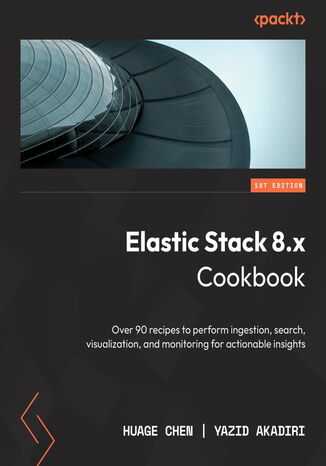
Huage Chen, Yazid Akadiri, Shay Banon
Learn how to make the most of the Elastic Stack (ELK Stack) products—including Elasticsearch, Kibana, Elastic Agent, and Logstash—to take data reliably and securely from any source, in any format, and then search, analyze, and visualize it in real-time. This cookbook takes a practical approach to unlocking the full potential of Elastic Stack through detailed recipes step by step.Starting with installing and ingesting data using Elastic Agent and Beats, this book guides you through data transformation and enrichment with various Elastic components and explores the latest advancements in search applications, including semantic search and Generative AI. You'll then visualize and explore your data and create dashboards using Kibana. As you progress, you'll advance your skills with machine learning for data science, get to grips with natural language processing, and discover the power of vector search. The book covers Elastic Observability use cases for log, infrastructure, and synthetics monitoring, along with essential strategies for securing the Elastic Stack. Finally, you'll gain expertise in Elastic Stack operations to effectively monitor and manage your system.
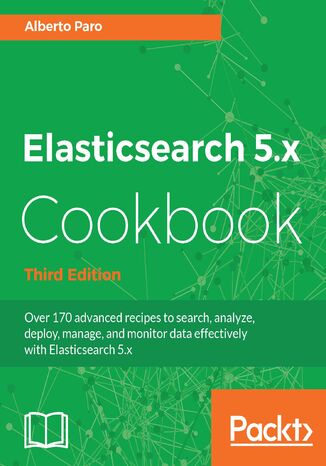
Elasticsearch 5.x Cookbook. Distributed Search and Analytics - Third Edition
Alberto Paro
Elasticsearch is a Lucene-based distributed search server that allows users to index and search unstructured content with petabytes of data. This book is your one-stop guide to master the complete Elasticsearch ecosystem. We’ll guide you through comprehensive recipes on what’s new in Elasticsearch 5.x, showing you how to create complex queries and analytics, and perform index mapping, aggregation, and scripting. Further on, you will explore the modules of Cluster and Node monitoring and see ways to back up and restore a snapshot of an index. You will understand how to install Kibana to monitor a cluster and also to extend Kibana for plugins. Finally, you will also see how you can integrate your Java, Scala, Python, and Big Data applications such as Apache Spark and Pig with Elasticsearch, and add enhanced functionalities with custom plugins.By the end of this book, you will have an in-depth knowledge of the implementation of the Elasticsearch architecture and will be able to manage data efficiently and effectively with Elasticsearch.
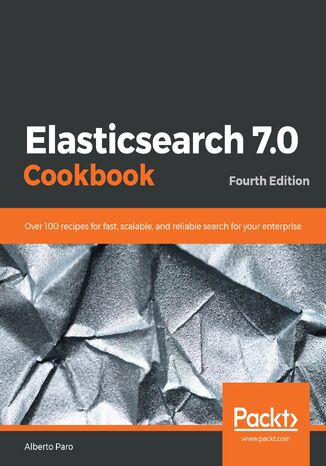
Alberto Paro
Elasticsearch is a Lucene-based distributed search server that allows users to index and search unstructured content with petabytes of data. With this book, you'll be guided through comprehensive recipes on what's new in Elasticsearch 7, and see how to create and run complex queries and analytics.Packed with recipes on performing index mapping, aggregation, and scripting using Elasticsearch, this fourth edition of Elasticsearch Cookbook will get you acquainted with numerous solutions and quick techniques for performing both every day and uncommon tasks such as deploying Elasticsearch nodes, integrating other tools to Elasticsearch, and creating different visualizations. You will install Kibana to monitor a cluster and also extend it using a variety of plugins. Finally, you will integrate your Java, Scala, Python, and big data applications such as Apache Spark and Pig with Elasticsearch, and create efficient data applications powered by enhanced functionalities and custom plugins.By the end of this book, you will have gained in-depth knowledge of implementing Elasticsearch architecture, and you'll be able to manage, search, and store data efficiently and effectively using Elasticsearch.