
Informatyka
Amita Kapoor, Hector Duran Lopez-Velarde
There are many applications that use data science and analytics to gain insights from terabytes of data. These apps, however, do not address the challenge of continually discovering patterns for IoT data. In Hands-On Artificial Intelligence for IoT, we cover various aspects of artificial intelligence (AI) and its implementation to make your IoT solutions smarter.This book starts by covering the process of gathering and preprocessing IoT data gathered from distributed sources. You will learn different AI techniques such as machine learning, deep learning, reinforcement learning, and natural language processing to build smart IoT systems. You will also leverage the power of AI to handle real-time data coming from wearable devices. As you progress through the book, techniques for building models that work with different kinds of data generated and consumed by IoT devices such as time series, images, and audio will be covered. Useful case studies on four major application areas of IoT solutions are a key focal point of this book. In the concluding chapters, you will leverage the power of widely used Python libraries, TensorFlow and Keras, to build different kinds of smart AI models.By the end of this book, you will be able to build smart AI-powered IoT apps with confidence.
Devangini Patel
With the emergence of big data and modern technologies, AI has acquired a lot of relevance in many domains. The increase in demand for automation has generated many applications for AI in fields such as robotics, predictive analytics, finance, and more.In this book, you will understand what artificial intelligence is. It explains in detail basic search methods: Depth-First Search (DFS), Breadth-First Search (BFS), and A* Search, which can be used to make intelligent decisions when the initial state, end state, and possible actions are known. Random solutions or greedy solutions can be found for such problems. But these are not optimal in either space or time and efficient approaches in time and space will be explored. We will also understand how to formulate a problem, which involves looking at it and identifying its initial state, goal state, and the actions that are possible in each state. We also need to understand the data structures involved while implementing these search algorithms as they form the basis of search exploration. Finally, we will look into what a heuristic is as this decides the quality of one sub-solution over another and helps you decide which step to take.
Nisheeth Joshi
Artificial intelligence (AI) is increasingly in demand as well as relevant in the modern world, where everything is driven by technology and data. AI can be used for automating systems or processes to carry out complex tasks and functions in order to achieve optimal performance and productivity.Hands-On Artificial Intelligence with Java for Beginners begins by introducing you to AI concepts and algorithms. You will learn about various Java-based libraries and frameworks that can be used in implementing AI to build smart applications. In addition to this, the book teaches you how to implement easy to complex AI tasks, such as genetic programming, heuristic searches, reinforcement learning, neural networks, and segmentation, all with a practical approach.By the end of this book, you will not only have a solid grasp of AI concepts, but you'll also be able to build your own smart applications for multiple domains.
Sibanjan Das, Umit Mert Cakmak
AutoML is designed to automate parts of Machine Learning. Readily available AutoML tools are making data science practitioners’ work easy and are received well in the advanced analytics community. Automated Machine Learning covers the necessary foundation needed to create automated machine learning modules and helps you get up to speed with them in the most practical way possible. In this book, you’ll learn how to automate different tasks in the machine learning pipeline such as data preprocessing, feature selection, model training, model optimization, and much more. In addition to this, it demonstrates how you can use the available automation libraries, such as auto-sklearn and MLBox, and create and extend your own custom AutoML components for Machine Learning. By the end of this book, you will have a clearer understanding of the different aspects of automated Machine Learning, and you’ll be able to incorporate automation tasks using practical datasets. You can leverage your learning from this book to implement Machine Learning in your projects and get a step closer to winning various machine learning competitions.
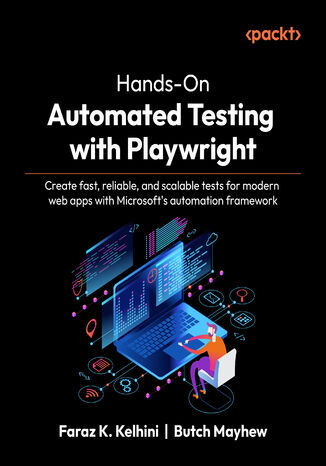
Faraz K. Kelhini, Butch Mayhew, Ben Fellows
Hands-On Automated Testing with Playwright draws from Faraz and Butch’s extensive experience to help you harness the full potential of Microsoft's Playwright framework.The book begins with a quick setup refresher, walking you through intermediate and advanced concepts such as dynamic content handling, accessibility testing, AI-generated test scripts, and parallel test execution. You'll explore real-world applications with end-to-end testing workflows for e-commerce and single-page applications. Alongside traditional topics such as accessibility, mobile, and visual regression testing, this book delves into modern trends such as CI/CD pipelines, DevOps integration, and AI-driven testing enhancements. Each chapter is packed with practical examples, expert techniques, and performance optimization tips, helping you gain a deep understanding of maintainable automation strategies. Whether you're transitioning from manual testing or expanding your automation toolbox, this Playwright book provides the skills and confidence to build future-proof testing systems in today's complex web development landscape.*Email sign-up and proof of purchase required
Rahul Shetty
Java is one of the most commonly-used software languages by programmers and developers. Are you from a non-technical background and looking to master Java for your automation needs? Then Hands-On Automation Testing with Java for Beginners is for you.This book provides you with efficient techniques to effectively handle Java-related automation projects. You will learn how to handle strings and their functions in Java. As you make your way through the book, you will get to grips with classes and objects, along with their uses. In the concluding chapters, you will learn about the importance of inheritance and exceptions with practical examples. By the end of this book, you will have gained comprehensive knowledge of Java.
Kamil Mrzygłód
Microsoft Azure is one of the fastest growing public cloud service providers in the market currently, and also holds the second highest market share after AWS. Azure has a sophisticated set of services that will help you build fault-tolerant and scalable cloud-based applications.Hands-On Azure for Developers will take you on a journey through multiple PaaS services available in Azure, including App Services, Functions, and Service Fabric, and explain in detail how to build a complete and reliable system with ease. You will learn about how to maximize your skills when building cloud-based solutions leveraging different SQL/NoSQL databases, serverless and messaging components, and even search engines such as Azure Search. In the concluding chapters, this book covers more advanced scenarios such as scalability best practices, serving static content with Azure CDN, and distributing loads with Azure Traffic Manager.By the end of the book, you will be able to build modern applications on the Azure cloud using the most popular and promising technologies, which will help make your solutions reliable, stable, and efficient.
James Cross, Rudy Lai, Bartłomiej Potaczek
Apache Spark is an open source parallel-processing framework that has been around for quite some time now. One of the many uses of Apache Spark is for data analytics applications across clustered computers. In this book, you will not only learn how to use Spark and the Python API to create high-performance analytics with big data, but also discover techniques for testing, immunizing, and parallelizing Spark jobs.You will learn how to source data from all popular data hosting platforms, including HDFS, Hive, JSON, and S3, and deal with large datasets with PySpark to gain practical big data experience. This book will help you work on prototypes on local machines and subsequently go on to handle messy data in production and at scale. This book covers installing and setting up PySpark, RDD operations, big data cleaning and wrangling, and aggregating and summarizing data into useful reports. You will also learn how to implement some practical and proven techniques to improve certain aspects of programming and administration in Apache Spark.By the end of the book, you will be able to build big data analytical solutions using the various PySpark offerings and also optimize them effectively.