
Informatyka
Alena Traukina, Jayant Thomas, Prashant Tyagi, Veera...
The Industrial Internet refers to the integration of complex physical machines with networked sensors and software. The growth in the number of sensors used in industrial machinery has led to an exponential increase in data being captured for predictive analytics.Industrial Internet Application Development is a practical guide for developers who want to create applications that leverage the full capabilities of IIoT. You will get started by learning how to develop your first IIoT application and understanding its deployment and security. Once you’re familiar with what IIoT is, you will move on to exploring Edge Development along with the analytics aspect of the IIoT stack. In later chapters, you’ll get to grips with the deployment of IIoT applications on the Predix platform. As you cover these concepts, you’ll be able to identify key elements of the development framework and understand their importance while considering architecture and design for IIoT applications.By the end of this book, you will have the skills you need to deploy IIoT applications on the Predix platform and incorporate best practices for developing fault-tolerant and reliable IIoT systems.
Spyridon Maniotis
In recent years, large financial services institutions have been embracing the concept of DevOps in the core of their digital transformation strategies. This book is inspired by real enterprise DevOps adoptions in the financial services industry and provides a comprehensive proven practice guide on how large corporate organizations can evolve their DevOps operating model.The book starts by outlining the fundamentals comprising a complete DevOps operating model. It continues with a zoom in on those fundamentals, combining adoption frameworks with real-life examples. You’ll cover the three main themes underpinning the book’s approach that include the concepts of 360°, at relevance, and speeds. You’ll explore how a bank’s corporate and technology strategy links to its enterprise DevOps evolution. The book also provides a rich array of proven practices on how to design and create a harmonious 360° DevOps operating model which should be enabled and adopted at relevance in a multi-speed context. It comes packed with real case studies and examples from the financial services industry that you can adopt in your organization and context.By the end of this book, you will have plenty of inspiration that you can take back to your organization and be able to apply the learning from pitfalls and success stories covered in the book.
Wagner R Santos
This practical guide is intended for those who want to learn how to build extremely scalable applications. This book is easy to read and is aimed at Java enterprise developers with a solid knowledge of Java. However, no previous coding experience with Infinispan is required.
Infografiki. Praktyczne zastosowanie w biznesie
Mark Smiciklas
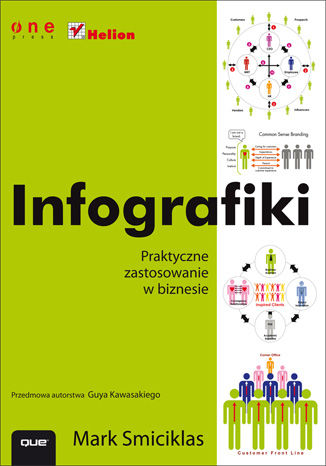
Przedmowa autorstwa Guya Kawasakiego! Infografika jest dziś najlepszym sposobem na… wszystko! Dlaczego? Ponieważ infografiki: są wzrokowym środkiem przekazu, w mgnieniu oka ujawniają swoje znaczenie, są intuicyjne, są zabawne, są estetyczne, są uwielbiane przez wszystkich, są skuteczne! Możesz wizualizować: rozbudowane koncepcje, dane liczbowe, procesy, sprawy osobiste. Przy pomocy infografik można: zwiększyć sprzedaż, budować marki, obsługiwać klientów, organizować zespoły, mierzyć ROI (kierownictwo to lubi). Naucz się tworzyć infografiki. To proste, zobaczysz! Mark Smiciklas - twórca ds. strategii Intersection Consulting. Uznany wizualizator i orędownik infografiki (zna się na rzeczy jak nikt). Ponad osiemnaście lat doświadczenia w roli starszego specjalisty ds. marketingu (B2B, B2C i reszta).
Darren Death
Having an information security mechanism is one of the most crucial factors for any organization. Important assets of organization demand a proper risk management and threat model for security, and so information security concepts are gaining a lot of traction. This book starts with the concept of information security and shows you why it’s important.It then moves on to modules such as threat modeling, risk management, and mitigation. It also covers the concepts of incident response systems, information rights management, and more. Moving on, it guides you to build your own information security framework as the best fit for your organization. Toward the end, you’ll discover some best practices that can be implemented to make your security framework strong. By the end of this book, you will be well-versed with all the factors involved in information security, which will help you build a security framework that is a perfect fit your organization’s requirements.
IT Governance Publishing, Alan Calder, Steve G...
This guide navigates through the essential processes of risk management within an ISO 27001/27002 framework. Beginning with foundational principles and methodologies, it systematically details every stage from assessment and analysis to treatment and review. Readers will learn how to apply both qualitative and quantitative techniques to measure impact, likelihood, and risk levels accurately.The book provides clarity on roles, policies, asset classification, and control selection, reinforced by practical tools like gap analysis and risk assessment software. Real-world scenarios and methodologies are contextualized for effective decision-making aligned with international compliance standards.By the end, readers will possess a comprehensive understanding of implementing and sustaining a risk management system that meets ISO 27001/27002 requirements, enabling them to better safeguard information assets and demonstrate regulatory accountability.

Information Theory. A Tutorial Introduction to the Principles and Applications of Information Theory
James V Stone
This book offers a comprehensive journey through the fascinating world of information theory, beginning with the fundamental question: what is information? Early chapters introduce key concepts like entropy, binary representation, and data compression, providing a clear and accessible foundation. Readers explore Shannon's source coding theorem and practical tools like Huffman coding to understand how information is quantified and optimized.Building on these basics, the book delves into advanced topics such as the noisy channel coding theorem, mutual information, and error correction techniques. It examines entropy in continuous systems, channel capacity, and rate-distortion theory, making complex ideas accessible through real-world examples. Connections between information and thermodynamics are also explored, including Maxwell’s Demon, the Landauer Limit, and the second law of thermodynamics.The final chapters tie information theory to biology and artificial intelligence, investigating its role in evolution, the human genome, and brain computation. With practical examples throughout, this book balances theoretical depth with hands-on learning, making it an essential resource for mastering information theory. A basic mathematical foundation will be beneficial but is not required to engage with the material.

Adam Chojnowski
Pozycja obowiązkowa dla biegłego sądowego z zakresu informatyki i elektroniki Akty prawne regulujące pracę biegłego Badania i analizy sądowe systemów informatycznych Opiniowanie sądowe z zakresu informatyki i elektroniki Informatyka sądowa to gałąź nauk sądowych, której celem jest dostarczanie wiedzy z zakresu informatyki sądom, organom przygotowawczym w sprawach karnych oraz komornikom sądowym. Osoby zajmujące się tą dziedziną przeprowadzają analizy informacji cyfrowych, w tym incydentów informatycznych i włamań do sieci, a także opisują, analizują i wyceniają systemy teleinformatyczne. Powołane przez sąd, stanowią rzetelne źródło informacji z zakresu teleinformatyki lub informatyki, w razie gdy związane z nimi tematy są niezrozumiałe lub nieczytelne albo w toku sprawy sądowej wymagana jest specjalistyczna wiedza z branży IT. Na polskim rynku brakowało dotąd opracowania opisującego informatykę sądową kompleksowo, w nieco szerszym kontekście, a przy tym napisanego językiem zrozumiałym dla czytelnika nieposiadającego formalnego wykształcenia prawniczego. Zadaniem książki jest wypełnienie tej luki i przybliżenie informatyki sądowej biegłym sądowym oraz osobom zainteresowanym poruszaną tematyką. Cenne wskazówki znajdą tu również prawnicy, specjaliści do spraw bezpieczeństwa teleinformatycznego, administratorzy, studenci kierunków informatycznych, a także pracownicy oraz funkcjonariusze służb, policji i organów ścigania. Akty prawne regulujące pracę biegłego sądowego Odpowiedzialność cywilna i karna biegłego sądowego Wymogi formalnoprawne dotyczące opinii Warsztat pracy biegłego sądowego z zakresu informatyki Przebieg badań i analiz systemów informatycznych Analiza incydentów i włamań do systemów IT Inwigilacja i wykrywanie złośliwego oprogramowania Wycena systemów komputerowych Prawa autorskie do oprogramowania Opiniowanie z zakresu informatyki i elektroniki Praktyczne przykłady opinii sądowych Teoria i praktyka opiniowania sądowego z zakresu informatyki i elektroniki