
Informatyka
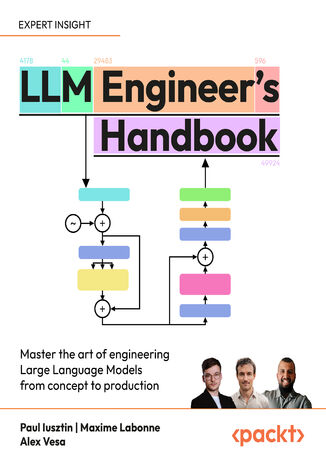
Paul Iusztin, Maxime Labonne, Julien Chaumond, Hamza...
Artificial intelligence has undergone rapid advancements, and Large Language Models (LLMs) are at the forefront of this revolution. This LLM book offers insights into designing, training, and deploying LLMs in real-world scenarios by leveraging MLOps best practices. The guide walks you through building an LLM-powered twin that’s cost-effective, scalable, and modular. It moves beyond isolated Jupyter notebooks, focusing on how to build production-grade end-to-end LLM systems.Throughout this book, you will learn data engineering, supervised fine-tuning, and deployment. The hands-on approach to building the LLM Twin use case will help you implement MLOps components in your own projects. You will also explore cutting-edge advancements in the field, including inference optimization, preference alignment, and real-time data processing, making this a vital resource for those looking to apply LLMs in their projects.By the end of this book, you will be proficient in deploying LLMs that solve practical problems while maintaining low-latency and high-availability inference capabilities. Whether you are new to artificial intelligence or an experienced practitioner, this book delivers guidance and practical techniques that will deepen your understanding of LLMs and sharpen your ability to implement them effectively.*Email sign-up and proof of purchase required
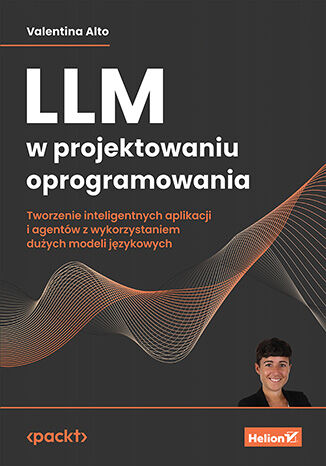
Valentina Alto
Duże modele językowe (LLM) stały się technologicznym przełomem. Ich wszechstronność i funkcjonalność sprawiły, że coraz częściej mówi się o nowej erze inteligentnie działających urządzeń i aplikacji. Umiejętność zastosowania LLM we własnych projektach już dziś jest koniecznością dla wielu projektantów i programistów. Dzięki tej książce opanujesz podstawowe koncepcje związane z użyciem LLM. Poznasz unikatowe cechy i mocne strony kilku najważniejszych modeli (w tym GPT, Gemini, Falcon). Następnie dowiesz się, w jaki sposób LangChain, lekki framework Pythona, pozwala na projektowanie inteligentnych agentów do przetwarzania danych o nieuporządkowanej strukturze. Znajdziesz tu również informacje dotyczące dużych modeli podstawowych, które wykraczają poza obsługę języka i potrafią wykonywać różne zadania związane na przykład z grafiką i dźwiękiem. Na koniec zgłębisz zagadnienia dotyczące ryzyka związanego z LLM, a także poznasz techniki uniemożliwiania tym modelom potencjalnie szkodliwych działań w aplikacji. Najciekawsze zagadnienia: architektura dużych modeli językowych unikatowe funkcje LLM komponenty służące do koordynacji sztucznej inteligencji, w tym tworzenia frontendu użycie wiedzy nieparametrycznej i wektorowych baz danych dostrajanie dużych modeli językowych do własnych potrzeb odpowiedzialność i etyka w systemach korzystających z LLM Odkryj, jak łatwo model generatywnej AI zintegruje się z Twoją aplikacją! O książce w mediach: Eksperyment Myślowy - recenzja książki
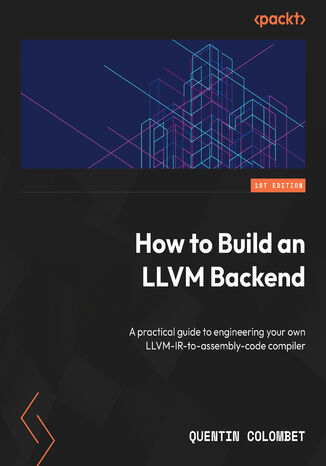
LLVM Code Generation. A deep dive into compiler backend development
Quentin Colombet, Kristof Beyls
The LLVM infrastructure is a popular compiler ecosystem widely used in the tech industry and academia. This technology is crucial for both experienced and aspiring compiler developers looking to make an impact in the field. Written by Quentin Colombet, a veteran LLVM contributor and architect of the GlobalISel framework, this book provides a primer on the main aspects of LLVM, with an emphasis on its backend infrastructure; that is, everything needed to transform the intermediate representation (IR) produced by frontends like Clang into assembly code and object files.You’ll learn how to write an optimizing code generator for a toy backend in LLVM. The chapters will guide you step by step through building this backend while exploring key concepts, such as the ABI, cost model, and register allocation. You’ll also find out how to express these concepts using LLVM's existing infrastructure and how established backends address these challenges. Furthermore, the book features code snippets that demonstrate the actual APIs.By the end of this book, you’ll have gained a deeper understanding of LLVM. The concepts presented are expected to remain stable across different LLVM versions, making this book a reliable quick reference guide for understanding LLVM.
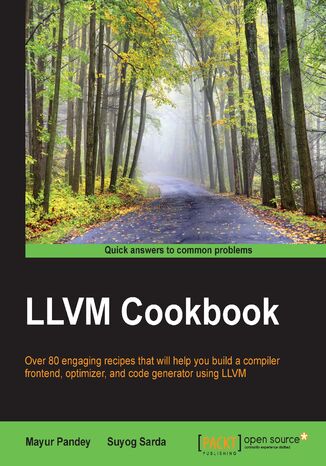
Mayur Pandey, Suyog Sarda
The book is for compiler programmers who are familiar with concepts of compilers and want to indulge in understanding, exploring, and using LLVM infrastructure in a meaningful way in their work.This book is also for programmers who are not directly involved in compiler projects but are often involved in development phases where they write thousands of lines of code. With knowledge of how compilers work, they will be able to code in an optimal way and improve performance with clean code.
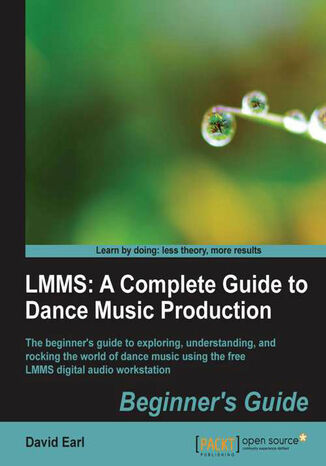
David Earl
You've scoured the forums, watched the tutorial videos, and done everything you can to learn the secrets of the art of making dance music. Everyone is saying something different about how to get into producing your own projects. This book will help connect the dots and lay a solid foundation of knowledge so you can get beats banging out of LMMS.This book will show you the ins and outs of making Dance music with LMMS. Do you make house, trance, techno or down-tempo? After this book you'll be able to make a song that stands out from the masses, using time honoured tricks of the trade. From inception to conception, this book will help give you a workflow to channel your muse using LMMS.Readers will be given a brief lesson on the best of dance music history, then learn how to recreate it using the Open Source digital workstation - LMMS. The reader will be guided through creating a project from start to finish. By the end of this book, the reader will know how to create a full dance track in LMMS and make it ready for distribution.Along the way, readers will take short stops into music theory, song arranging, recording, and other related information to give them a good foundation for making dance music with depth as well as power. Reading LMMS: A Complete Guide to Dance Music Production will not just teach the reader how to use LMMS, but also how good dance music is crafted. The reader will not just be taught how to make decisions in LMMS, but when and why. After devouring this book, the reader should be able to focus on his or her creativity, with LMMS as a co-conspirator in the process of making great dance music.
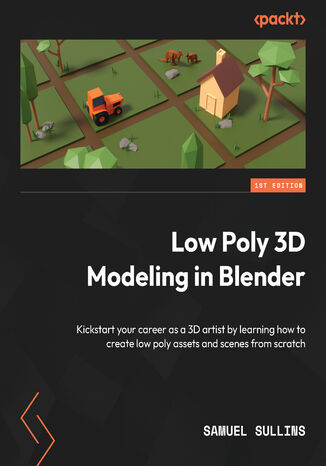
Samuel Sullins
Step into the world of low poly 3D art with Low Poly 3D Modeling in Blender—your entry point into Blender and mastering the fundamentals of 3D art. This beginner-friendly guide ensures that you’re fully prepared for the creative adventure that follows.Through a step-by-step learning process starting with the principles of low poly art, this book gradually immerses you in the intricacies of modeling. As you progress, you’ll gain hands-on experience creating diverse projects ranging from designing a simple 3D crate to rendering complete low poly scenes. The book covers a wide spectrum of topics as you navigate Blender's interface, mastering essential modeling tools and exploring both basic and advanced modeling techniques. Advancing to the final chapters, you’ll find ways to breathe life into your models with material creation and gain practical insights into modeling a variety of low poly objects. From end-to-end scene construction to configuring Blender for rendering high-quality images, you’ll be equipped with the foundational skills to propel your career in 3D modeling and explore the boundless creative possibilities that Blender offers.By the end of this book, you'll have a solid understanding of Blender, 3D modeling, low poly methodologies, material design, 3D rendering techniques, and the broader world of 3D art.
Stefan Helzle
This book is an exhaustive overview of how the Appian Low-Code BPM Suite enables tech-savvy professionals to rapidly automate business processes across their organization, integrating people, software bots, and data. This is crucial as 80% of all software development is expected to be carried out in low code by 2024.This practical guide helps you master business application development with Appian as a beginner low-code developer. You'll learn to automate business processes using Appian low-code, records, processes, and expressions quickly and on an enterprise scale. In a fictional development project, guided by step-by-step explanations of the concepts and practical examples, this book will empower you to transform complex business processes into software.At first, you’ll learn the power of no-code with Appian Quick Apps to solve some of your most crucial business challenges. You’ll then get to grips with the building blocks of an Appian, starting with no-code and advancing to low-code, eventually transforming complex business requirements into a working enterprise-ready application.By the end of this book, you'll be able to deploy Appian Quick Apps in minutes and successfully transform a complex business process into low-code process models, data, and UIs to deploy full-featured, enterprise-ready, process-driven, mobile-enabled apps.
Lua Quick Start Guide. The easiest way to learn Lua programming
Gabor Szauer
Lua is a small, powerful and extendable scripting/programming language that can be used for learning to program, and writing games and applications, or as an embedded scripting language. There are many popular commercial projects that allow you to modify or extend them through Lua scripting, and this book will get you ready for that. This book is the easiest way to learn Lua. It introduces you to the basics of Lua and helps you to understand the problems it solves. You will work with the basic language features, the libraries Lua provides, and powerful topics such as object-oriented programming. Every aspect of programming in Lua, variables, data types, functions, tables, arrays and objects, is covered in sufficient detail for you to get started. You will also find out about Lua's module system and how to interface with the operating system.After reading this book, you will be ready to use Lua as a programming language to write code that can interface with the operating system, automate tasks, make playable games, and much more. This book is a solid starting point for those who want to learn Lua in order to move onto other technologies such as Love2D or Roblox.A quick start guide is a focused, shorter title that provides a faster paced introduction to a technology. It is designed for people who don't need all the details at this point in their learning curve. This presentation has been streamlined to concentrate on the things you really need to know.