
Informatyka
Zajrzyj do kategorii Informatyka w księgarni internetowej Ebookpoint. Znajdziesz tutaj bestsellerowe książki, ebooki i kursy video z branży IT. Sięgnij po najlepszą literaturę dla specjalistów i rozwijaj doświadczenie, które już posiadasz, lub rozpocznij swoją przygodę z programowaniem, cyberbezpieczeństwem lub grafiką komputerową. Pogłębiaj swoją wiedzę tak, jak Ci wygodnie - z tradycyjną książką, wygodnym ebookiem lub nowoczesnym videokursem. Sprawdź, jakie tytuły znajdziesz w kategorii Informatyka!
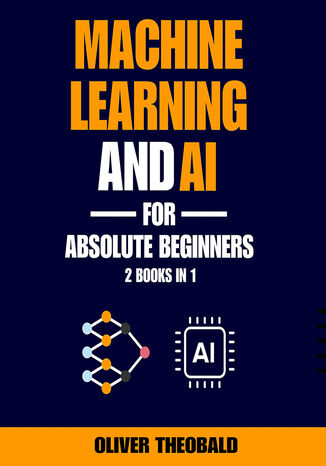
Oliver Theobald
This book is an ideal starting point for anyone interested in Artificial Intelligence and Machine Learning. It begins with the foundational principles of AI, offering a deep dive into its history, building blocks, and the stages of development. Readers will explore key AI concepts and gradually transition to practical applications, starting with machine learning algorithms such as linear regression and k-nearest neighbors. Through step-by-step Python tutorials, the book helps readers build and implement models with hands-on experience.As the book progresses, readers will dive into advanced AI topics like deep learning, natural language processing (NLP), and generative AI. Topics such as recommender systems and computer vision demonstrate the real-world applications of AI technologies. Ethical considerations and privacy concerns are also addressed, providing insight into the societal impact of these technologies.By the end of the book, readers will have a solid understanding of both the theory and practice of AI and Machine Learning. The final chapters provide resources for continued learning, ensuring that readers can continue to grow their AI expertise beyond the book.
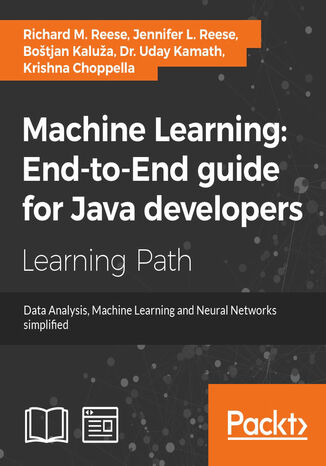
Uday Kamath, Krishna Choppella
Machine Learning is one of the core area of Artificial Intelligence where computers are trained to self-learn, grow, change, and develop on their own without being explicitly programmed. In this course, we cover how Java is employed to build powerful machine learning models to address the problems being faced in the world of Data Science. The course demonstrates complex data extraction and statistical analysis techniques supported by Java, applying various machine learning methods, exploring machine learning sub-domains, and exploring real-world use cases such as recommendation systems, fraud detection, natural language processing, and more, using Java programming. The course begins with an introduction to data science and basic data science tasks such as data collection, data cleaning, data analysis, and data visualization. The next section has a detailed overview of statistical techniques, covering machine learning, neural networks, and deep learning. The next couple of sections cover applying machine learning methods using Java to a variety of chores including classifying, predicting, forecasting, market basket analysis, clustering stream learning, active learning, semi-supervised learning, probabilistic graph modeling, text mining, and deep learning.The last section highlights real-world test cases such as performing activity recognition, developing image recognition, text classification, and anomaly detection. The course includes premium content from three of our most popular books:[*]Java for Data Science[*]Machine Learning in Java [*]Mastering Java Machine LearningOn completion of this course, you will understand various machine learning techniques, different machine learning java algorithms you can use to gain data insights, building data models to analyze larger complex data sets, and incubating applications using Java and machine learning algorithms in the field of artificial intelligence.
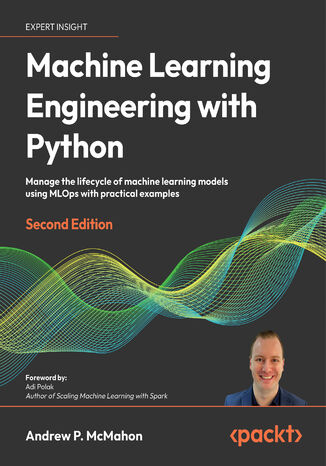
Andrew P. McMahon
The Second Edition of Machine Learning Engineering with Python is the practical guide that MLOps and ML engineers need to build solutions to real-world problems. It will provide you with the skills you need to stay ahead in this rapidly evolving field.The book takes an examples-based approach to help you develop your skills and covers the technical concepts, implementation patterns, and development methodologies you need. You'll explore the key steps of the ML development lifecycle and create your own standardized model factory for training and retraining of models. You'll learn to employ concepts like CI/CD and how to detect different types of drift.Get hands-on with the latest in deployment architectures and discover methods for scaling up your solutions. This edition goes deeper in all aspects of ML engineering and MLOps, with emphasis on the latest open-source and cloud-based technologies. This includes a completely revamped approach to advanced pipelining and orchestration techniques.With a new chapter on deep learning, generative AI, and LLMOps, you will learn to use tools like LangChain, PyTorch, and Hugging Face to leverage LLMs for supercharged analysis. You will explore AI assistants like GitHub Copilot to become more productive, then dive deep into the engineering considerations of working with deep learning.
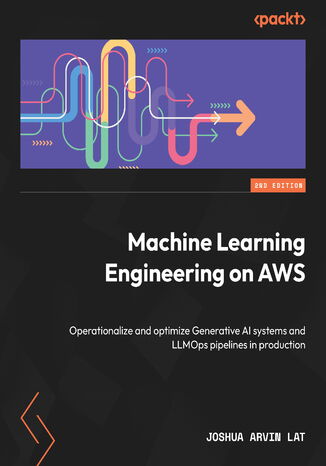
Joshua Arvin Lat
Modern AI systems increasingly leverage large language models, retrieval-augmented generation, and AI agents to power generative AI applications in the cloud. As organizations operationalize these systems at scale, there is a growing need for engineers with strong machine learning engineering expertise. To stay ahead in this rapidly evolving field, you need a deep understanding of AI and ML concepts as well as, practical, hands-on experience with the platforms and tools used to build and operate production-grade AI systems.Machine Learning Engineering on AWS is a practical guide that shows you how to use AWS services such as Amazon Bedrock and Amazon SageMaker AI to fine-tune, evaluate, and deploy LLMs and generative AI systems. You'll learn how to develop RAG-powered systems, build and deploy AI agents using Bedrock AgentCore and Strands Agents, evaluate models using LLM-as-a-judge techniques, and automate LLMOps pipelines using SageMaker Pipelines. The book also covers best practices for building scalable, secure, and production-ready GenAI systems.AWS AI hero Joshua Arvin Lat equips you with the skills and practical knowledge to handle a wide variety of ML engineering requirements, helping you design, operationalize, and secure generative AI systems and AI agents on AWS with confidence.*Email sign-up and proof of purchase required
Joshua Arvin Lat
There is a growing need for professionals with experience in working on machine learning (ML) engineering requirements as well as those with knowledge of automating complex MLOps pipelines in the cloud. This book explores a variety of AWS services, such as Amazon Elastic Kubernetes Service, AWS Glue, AWS Lambda, Amazon Redshift, and AWS Lake Formation, which ML practitioners can leverage to meet various data engineering and ML engineering requirements in production.This machine learning book covers the essential concepts as well as step-by-step instructions that are designed to help you get a solid understanding of how to manage and secure ML workloads in the cloud. As you progress through the chapters, you’ll discover how to use several container and serverless solutions when training and deploying TensorFlow and PyTorch deep learning models on AWS. You’ll also delve into proven cost optimization techniques as well as data privacy and model privacy preservation strategies in detail as you explore best practices when using each AWS.By the end of this AWS book, you'll be able to build, scale, and secure your own ML systems and pipelines, which will give you the experience and confidence needed to architect custom solutions using a variety of AWS services for ML engineering requirements.
Rodolfo Bonnin
Most of us have heard about the term Machine Learning, but surprisingly the question frequently asked by developers across the globe is, “How do I get started in Machine Learning?”. One reason could be attributed to the vastness of the subject area because people often get overwhelmed by the abstractness of ML and terms such as regression, supervised learning, probability density function, and so on. This book is a systematic guide teaching you how to implement various Machine Learning techniques and their day-to-day application and development. You will start with the very basics of data and mathematical models in easy-to-follow language that you are familiar with; you will feel at home while implementing the examples. The book will introduce you to various libraries and frameworks used in the world of Machine Learning, and then, without wasting any time, you will get to the point and implement Regression, Clustering, classification, Neural networks, and more with fun examples. As you get to grips with the techniques, you’ll learn to implement those concepts to solve real-world scenarios for ML applications such as image analysis, Natural Language processing, and anomaly detections of time series data. By the end of the book, you will have learned various ML techniques to develop more efficient and intelligent applications.
Eduonix Learning Solutions
Machine Learning (ML) has changed the way organizations and individuals use data to improve the efficiency of a system. ML algorithms allow strategists to deal with a variety of structured, unstructured, and semi-structured data. Machine Learning for Healthcare Analytics Projects is packed with new approaches and methodologies for creating powerful solutions for healthcare analytics.This book will teach you how to implement key machine learning algorithms and walk you through their use cases by employing a range of libraries from the Python ecosystem. You will build five end-to-end projects to evaluate the efficiency of Artificial Intelligence (AI) applications for carrying out simple-to-complex healthcare analytics tasks. With each project, you will gain new insights, which will then help you handle healthcare data efficiently. As you make your way through the book, you will use ML to detect cancer in a set of patients using support vector machines (SVMs) and k-Nearest neighbors (KNN) models. In the final chapters, you will create a deep neural network in Keras to predict the onset of diabetes in a huge dataset of patients. You will also learn how to predict heart diseases using neural networks.By the end of this book, you will have learned how to address long-standing challenges, provide specialized solutions for how to deal with them, and carry out a range of cognitive tasks in the healthcare domain.
Revathi Gopalakrishnan, Avinash Venkateswarlu
Machine learning presents an entirely unique opportunity in software development. It allows smartphones to produce an enormous amount of useful data that can be mined, analyzed, and used to make predictions. This book will help you master machine learning for mobile devices with easy-to-follow, practical examples.You will begin with an introduction to machine learning on mobiles and grasp the fundamentals so you become well-acquainted with the subject. You will master supervised and unsupervised learning algorithms, and then learn how to build a machine learning model using mobile-based libraries such as Core ML, TensorFlow Lite, ML Kit, and Fritz on Android and iOS platforms. In doing so, you will also tackle some common and not-so-common machine learning problems with regard to Computer Vision and other real-world domains.By the end of this book, you will have explored machine learning in depth and implemented on-device machine learning with ease, thereby gaining a thorough understanding of how to run, create, and build real-time machine-learning applications on your mobile devices.