
Informatyka
Eduonix Learning Solutions
Machine Learning (ML) has changed the way organizations and individuals use data to improve the efficiency of a system. ML algorithms allow strategists to deal with a variety of structured, unstructured, and semi-structured data. Machine Learning for Healthcare Analytics Projects is packed with new approaches and methodologies for creating powerful solutions for healthcare analytics.This book will teach you how to implement key machine learning algorithms and walk you through their use cases by employing a range of libraries from the Python ecosystem. You will build five end-to-end projects to evaluate the efficiency of Artificial Intelligence (AI) applications for carrying out simple-to-complex healthcare analytics tasks. With each project, you will gain new insights, which will then help you handle healthcare data efficiently. As you make your way through the book, you will use ML to detect cancer in a set of patients using support vector machines (SVMs) and k-Nearest neighbors (KNN) models. In the final chapters, you will create a deep neural network in Keras to predict the onset of diabetes in a huge dataset of patients. You will also learn how to predict heart diseases using neural networks.By the end of this book, you will have learned how to address long-standing challenges, provide specialized solutions for how to deal with them, and carry out a range of cognitive tasks in the healthcare domain.
Revathi Gopalakrishnan, Avinash Venkateswarlu
Machine learning presents an entirely unique opportunity in software development. It allows smartphones to produce an enormous amount of useful data that can be mined, analyzed, and used to make predictions. This book will help you master machine learning for mobile devices with easy-to-follow, practical examples.You will begin with an introduction to machine learning on mobiles and grasp the fundamentals so you become well-acquainted with the subject. You will master supervised and unsupervised learning algorithms, and then learn how to build a machine learning model using mobile-based libraries such as Core ML, TensorFlow Lite, ML Kit, and Fritz on Android and iOS platforms. In doing so, you will also tackle some common and not-so-common machine learning problems with regard to Computer Vision and other real-world domains.By the end of this book, you will have explored machine learning in depth and implemented on-device machine learning with ease, thereby gaining a thorough understanding of how to run, create, and build real-time machine-learning applications on your mobile devices.
Machine Learning for OpenCV. Intelligent image processing with Python
Michael Beyeler, Michael Beyeler (USD)
Machine learning is no longer just a buzzword, it is all around us: from protecting your email, to automatically tagging friends in pictures, to predicting what movies you like. Computer vision is one of today's most exciting application fields of machine learning, with Deep Learning driving innovative systems such as self-driving cars and Google’s DeepMind.OpenCV lies at the intersection of these topics, providing a comprehensive open-source library for classic as well as state-of-the-art computer vision and machine learning algorithms. In combination with Python Anaconda, you will have access to all the open-source computing libraries you could possibly ask for.Machine learning for OpenCV begins by introducing you to the essential concepts of statistical learning, such as classification and regression. Once all the basics are covered, you will start exploring various algorithms such as decision trees, support vector machines, and Bayesian networks, and learn how to combine them with other OpenCV functionality. As the book progresses, so will your machine learning skills, until you are ready to take on today's hottest topic in the field: Deep Learning.By the end of this book, you will be ready to take on your own machine learning problems, either by building on the existing source code or developing your own algorithm from scratch!
Joos Korstanje
Streaming data is the new top technology to watch out for in the field of data science and machine learning. As business needs become more demanding, many use cases require real-time analysis as well as real-time machine learning. This book will help you to get up to speed with data analytics for streaming data and focus strongly on adapting machine learning and other analytics to the case of streaming data.You will first learn about the architecture for streaming and real-time machine learning. Next, you will look at the state-of-the-art frameworks for streaming data like River. Later chapters will focus on various industrial use cases for streaming data like Online Anomaly Detection and others. As you progress, you will discover various challenges and learn how to mitigate them. In addition to this, you will learn best practices that will help you use streaming data to generate real-time insights.By the end of this book, you will have gained the confidence you need to stream data in your machine learning models.
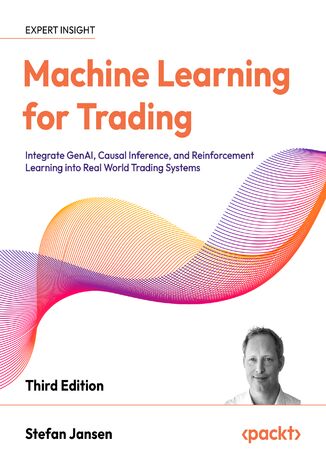
Stefan Jansen
The rapid rise of AI and the growing complexity of financial markets have transformed quantitative trading into a data-driven, process-oriented discipline. This third edition provides a comprehensive blueprint for designing, validating, and deploying systematic trading strategies powered by modern machine learning. It introduces the 7 stage ML4T Workflow, a professional framework that unites data engineering, model development, validation, and live deployment into one cohesive process. It demonstrates how to turn raw market, fundamental, and alternative data into predictive signals and robust, production-ready trading systems. You’ll learn to build advanced pipelines for feature engineering, model evaluation, and portfolio optimization using libraries such as Polars, LightGBM, PyTorch, and Optuna. Practical notebooks illustrate every stage of the workflow, from factor testing and backtesting with zipline reloaded to live deployment with MLOps tools such as MLflow, Feast, and Prometheus. Additional coverage of synthetic data generation, Graph Neural Networks, and Reinforcement Learning extends the toolkit for building resilient, adaptive strategies that thrive in dynamic markets. By the end of this book, you’ll be proficient to build your own industrial-grade “alpha factory.
Hyatt Saleh
As machine learning algorithms become popular, new tools that optimize these algorithms are also developed. Machine Learning Fundamentals explains you how to use the syntax of scikit-learn. You'll study the difference between supervised and unsupervised models, as well as the importance of choosing the appropriate algorithm for each dataset. You'll apply unsupervised clustering algorithms over real-world datasets, to discover patterns and profiles, and explore the process to solve an unsupervised machine learning problem.The focus of the book then shifts to supervised learning algorithms. You'll learn to implement different supervised algorithms and develop neural network structures using the scikit-learn package. You'll also learn how to perform coherent result analysis to improve the performance of the algorithm by tuning hyperparameters.By the end of this book, you will have gain all the skills required to start programming machine learning algorithms.
Machine learning i natural language processing w programowaniu. Podręcznik z ćwiczeniami w Pythonie
Piotr Wróblewski
Wejdź na nowy poziom programowania z ML i NLP Sztuczna inteligencja stale się rozwija. Właściwie codziennie słyszymy o jej rosnących możliwościach, nowych osiągnięciach i przyszłości, jaką nam przyniesie. Jednak w tej książce skupiamy się nie na przyszłości, a na teraźniejszości i praktycznym obliczu AI - na usługach, które świadczy już dziś. Większość najciekawszych zastosowań sztucznej inteligencji bazuje na ML (uczenie maszynowe, ang. machine learning), NLP (przetwarzanie języka naturalnego, ang. natural language processing) i architekturze RAG (ang. retrieval augmented generation) zwiększającej możliwości tzw. dużych modeli językowych (LLM, ang. large language model). Stanowią one podwaliny budowy systemów AI, bez których te systemy często wcale nie mogłyby powstać. Do niedawna ML i NLP pozostawały domeną badaczy i specjalistów - znajdowały się poza zasięgiem praktyków programowania. Aktualnie jest inaczej, szybkie komputery, pojemne pamięci RAM i zaawansowane procesory pozwalają stosować te technologie w codziennej pracy programisty. Szczególnie programisty języka Python, do którego są one niemal "naturalnie" przypisane. Mało tego, od kodujących w Pythonie coraz częściej wręcz wymaga się umiejętności znajomości obszaru AI. Tym bardziej warto sięgnąć po ten podręcznik z ćwiczeniami, dzięki któremu między innymi: Dowiesz się, jak używać Pythona do rozwiązywania problemów AI Poznasz tajniki analizy tekstów, analizy sentymentu Zrozumiesz, jak skutecznie używać algorytmów klasyfikacji, regresji i grupowania do rozwiązywania problemów biznesowych Pokonwersujesz z ChatGPT - i to bez wchodzenia na stronę internetową tego serwisu
Mohamed Osam Abouahmed, Omar Ahmed
With the rising need for agile development and very short time-to-market system deployments, incorporating machine learning algorithms into decoupled fine-grained microservices systems provides the perfect technology mix for modern systems. Machine Learning in Microservices is your essential guide to staying ahead of the curve in this ever-evolving world of technology.The book starts by introducing you to the concept of machine learning microservices architecture (MSA) and comparing MSA with service-based and event-driven architectures, along with how to transition into MSA. Next, you’ll learn about the different approaches to building MSA and find out how to overcome common practical challenges faced in MSA design. As you advance, you’ll get to grips with machine learning (ML) concepts and see how they can help better design and run MSA systems. Finally, the book will take you through practical examples and open source applications that will help you build and run highly efficient, agile microservices systems.By the end of this microservices book, you’ll have a clear idea of different models of microservices architecture and machine learning and be able to combine both technologies to deliver a flexible and highly scalable enterprise system.