
Informatyka
Sjoukje Zaal
Architecting Microsoft Azure Solutions: Exam Guide 70-535 will get Azure architects and developers up-to-date with the latest updates on Azure from an architecture and design perspective. The book includes all the topics that are still relevant from the previous 70-534 exam, and is updated with latest topics covered, including Artificial Intelligence, IoT, and architecture styles.This exam guide is divided into six parts, where the first part will give you a good understanding of how to design a compute infrastructure. It also dives into designing networking and data implementations. You will learn about designing solutions for Platform Service and operations. Next, you will be able to secure your resources and data, as well as design a mechanism for governance and policies. You will also understand the objective of designing solutions for Platform Services, by covering Artificial Intelligence, IoT, media services, and messaging solution concepts. Finally, you will cover the designing for operations objective. This objective covers application and platform monitoring, as well as designing alerting strategies and operations automation strategies. By the end of the book, you’ll have met all of the exam objectives, and will have all the information you need to ace the 70-535 exam. You will also have become an expert in designing solutions on Microsoft Azure.
Sebastian Daschner
Java EE 8 brings with it a load of features, mainly targeting newer architectures such as microservices, modernized security APIs, and cloud deployments. This book will teach you to design and develop modern, business-oriented applications using Java EE 8. It shows how to structure systems and applications, and how design patterns and Domain Driven Design aspects are realized in the age of Java EE 8. You will learn about the concepts and principles behind Java EE applications, and how to effect communication, persistence, technical and cross-cutting concerns, and asynchronous behavior.This book covers Continuous Delivery, DevOps, infrastructure-as-code, containers, container orchestration technologies, such as Docker and Kubernetes, and why and especially how Java EE fits into this world. It also covers the requirements behind containerized, zero-dependency applications and how modern Java EE application servers support these approaches. You will also learn about automated, fast, and reliable software tests, in different test levels, scopes, and test technologies. This book covers the prerequisites and challenges of distributed systems that lead to microservice, shared-nothing architectures. The challenges and solutions of consistency versus scalability will further lead us to event sourcing, event-driven architectures, and the CQRS principle. This book also includes the nuts and bolts of application performance as well as how to realize resilience, logging, monitoring and tracing in a modern enterprise world. Last but not least the demands of securing enterprise systems are covered.By the end, you will understand the ins and outs of Java EE so that you can make critical design decisions that not only live up to, but also surpass your clients' expectations.
Amit Chaudhary
Salesforce stands as a leading cloud-based customer relationship management (CRM) platform with extensive support for businesses in managing their sales, marketing, customer service, and other critical activities. Becoming a Salesforce Architect opens doors to lucrative career opportunities in a thriving industry, given the high demand for skilled professionals.This guide offers expert insights and best practices for developers who want to ascend the Salesforce ladder, technical leads honing their prowess in Salesforce, and enthusiasts exploring the dynamic world of Salesforce architecture. Whether you’re seeking a roadmap to success as a Salesforce Architect or want to enhance your skills, this concise yet insightful report ensures your growth in the vibrant Salesforce community.This guide will help you change your mindset from developer to architect, highlighting key considerations when designing a solution for clients. By the end of this book, you’ll have gained a comprehensive understanding of the role of a Salesforce Architect and the prerequisites and essential soft skills necessary for success within the Salesforce ecosystem.
Serdar Simsekler, Eric Du
SAP BTP is the foundation of SAP’s intelligent and sustainable enterprise vision for its customers. It’s efficient, agile, and an enabler of innovation. It’s technically robust, yet its superpower is its business centricity.If you’re involved in building IT and business strategies, it’s essential to familiarize yourself with SAP BTP to see the big picture for digitalization with SAP solutions. Similarly, if you have design responsibilities for enterprise solutions, learning SAP BTP is crucial to produce effective and complete architecture designs.This book teaches you about SAP BTP in five parts. First, you’ll see how SAP BTP is positioned in the intelligent enterprise. In the second part, you’ll learn the foundational elements of SAP BTP and find out how it operates. The next part covers integration architecture guidelines, integration strategy considerations, and integration styles with SAP’s integration technologies. Later, you’ll learn how to use application development capabilities to extend enterprise solutions for innovation and agility. This part also includes digital experience and process automation capabilities. The last part covers how SAP BTP can facilitate data-to-value use cases to produce actionable business insights.By the end of this SAP book, you’ll be able to architect solutions using SAP BTP to deliver high business value.
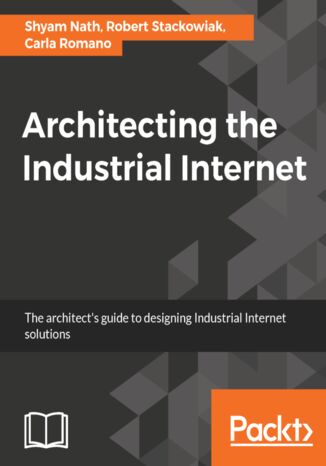
Robert Stackowiak, Carla Romano, Shyam Varan Nath
The Industrial Internet or the IIoT has gained a lot of traction. Many leading companies are driving this revolution by connecting smart edge devices to cloud-based analysis platforms and solving their business challenges in new ways. To ensure a smooth integration of such machines and devices, sound architecture strategies based on accepted principles, best practices, and lessons learned must be applied.This book begins by providing a bird's eye view of what the IIoT is and how the industrial revolution has evolved into embracing this technology. It then describes architectural approaches for success, gathering business requirements, and mapping requirements into functional solutions. In a later chapter, many other potential use cases are introduced including those in manufacturing and specific examples in predictive maintenance, asset tracking and handling, and environmental impact and abatement. The book concludes by exploring evolving technologies that will impact IIoT architecture in the future and discusses possible societal implications of the Industrial Internet and perceptions regarding these projects.By the end of this book, you will be better equipped to embrace the benefits of the burgeoning IIoT.
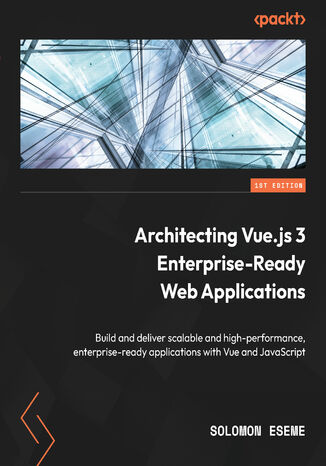
Solomon Eseme
Building enterprise-ready Vue.js apps entails following best practices for creating high-performance and scalable applications. Complete with step-by-step explanations and best practices outlined, this Vue.js book is a must-read for any developer who works with a large Vue.js codebase where performance and scalability are indispensable.Throughout this book, you’ll learn how to configure and set up Vue.js 3 and the composition API and use it to build real-world applications. You’ll develop the skills to create reusable components and scale performance in Vue.js 3 applications. As you progress, the book guides you in scaling performance with asynchronous lazy loading, image compression, code splitting, and tree shaking. Furthermore, you’ll see how to use the Restful API, Docker, GraphQL, and different types of testing to ensure that your Vue.js 3 application is scalable and maintainable.By the end of this book, you’ll be well-versed in best practices for implementing Restful API, Docker, GraphQL, and testing methods to build and deploy an enterprise-ready Vue.js 3 application of any scale.
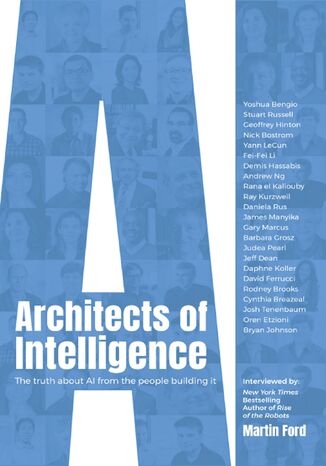
Architects of Intelligence. The truth about AI from the people building it
Martin Ford
Financial Times Best Books of the Year 2018TechRepublic Top Books Every Techie Should ReadHow will AI evolve and what major innovations are on the horizon? What will its impact be on the job market, economy, and society? What is the path toward human-level machine intelligence? What should we be concerned about as artificial intelligence advances?Architects of Intelligence contains a series of in-depth, one-to-one interviews where New York Times bestselling author, Martin Ford, uncovers the truth behind these questions from some of the brightest minds in the Artificial Intelligence community.Martin has wide-ranging conversations with twenty-three of the world's foremost researchers and entrepreneurs working in AI and robotics: Demis Hassabis (DeepMind), Ray Kurzweil (Google), Geoffrey Hinton (Univ. of Toronto and Google), Rodney Brooks (Rethink Robotics), Yann LeCun (Facebook) , Fei-Fei Li (Stanford and Google), Yoshua Bengio (Univ. of Montreal), Andrew Ng (AI Fund), Daphne Koller (Stanford), Stuart Russell (UC Berkeley), Nick Bostrom (Univ. of Oxford), Barbara Grosz (Harvard), David Ferrucci (Elemental Cognition), James Manyika (McKinsey), Judea Pearl (UCLA), Josh Tenenbaum (MIT), Rana el Kaliouby (Affectiva), Daniela Rus (MIT), Jeff Dean (Google), Cynthia Breazeal (MIT), Oren Etzioni (Allen Institute for AI), Gary Marcus (NYU), and Bryan Johnson (Kernel).Martin Ford is a prominent futurist, and author of Financial Times Business Book of the Year, Rise of the Robots. He speaks at conferences and companies around the world on what AI and automation might mean for the future.Meet the minds behind the AI superpowers as they discuss the science, business and ethics of modern artificial intelligence. Read James Manyika’s thoughts on AI analytics, Geoffrey Hinton’s breakthroughs in AI programming and development, and Rana el Kaliouby’s insights into AI marketing. This AI book collects the opinions of the luminaries of the AI business, such as Stuart Russell (coauthor of the leading AI textbook), Rodney Brooks (a leader in AI robotics), Demis Hassabis (chess prodigy and mind behind AlphaGo), and Yoshua Bengio (leader in deep learning) to complete your AI education and give you an AI advantage in 2019 and the future.
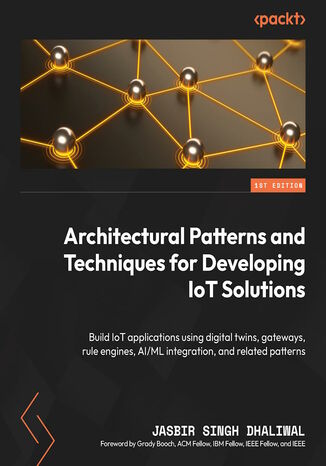
Jasbir Singh Dhaliwal, Grady Booch
As the Internet of Things (IoT) expands and moves to new domains, architectural patterns need to enable faster digital transformation and more uniform development. Through numerous use cases and examples, this book helps you conceptualize and implement IoT architectural patterns and use them in diverse contexts in real-world scenarios.The book begins by introducing you to a variety of IoT architectural patterns and then helps you understand how they are used in domains such as retail, smart manufacturing, consumer, smart cities, and smart agriculture. You’ll also find out how cross-cutting concerns such as security require special considerations in the IoT context. As you advance, you’ll discover all the nuances that are inherent in each layer of IoT reference architecture, including considerations related to analytics for edge/constrained devices, data visualizations, and so on. In the concluding chapters, you’ll explore emerging technologies such as blockchain, 3D printing, 5G, generative AI, quantum computing, and large language models (LLMs) that enhance IoT capabilities to realize broader applications.By the end of this book, you’ll have learned to architect scalable, secure, and unique IoT solutions in any domain using the power of IoT architectural patterns, and you will be able to avoid the pitfalls that typically derail IoT projects.