
Informatyka
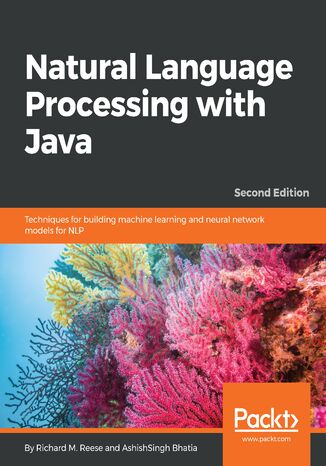
Richard M. Reese, AshishSingh Bhatia
Natural Language Processing (NLP) allows you to take any sentence and identify patterns, special names, company names, and more. The second edition of Natural Language Processing with Java teaches you how to perform language analysis with the help of Java libraries, while constantly gaining insights from the outcomes.You’ll start by understanding how NLP and its various concepts work. Having got to grips with the basics, you’ll explore important tools and libraries in Java for NLP, such as CoreNLP, OpenNLP, Neuroph, and Mallet. You’ll then start performing NLP on different inputs and tasks, such as tokenization, model training, parts-of-speech and parsing trees. You’ll learn about statistical machine translation, summarization, dialog systems, complex searches, supervised and unsupervised NLP, and more.By the end of this book, you’ll have learned more about NLP, neural networks, and various other trained models in Java for enhancing the performance of NLP applications.
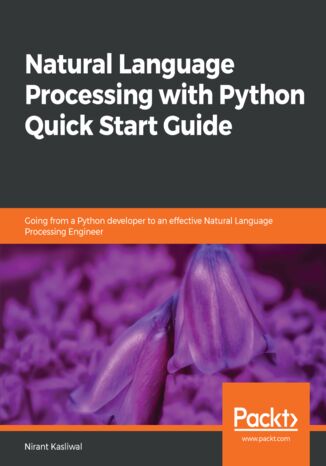
Nirant Kasliwal
NLP in Python is among the most sought after skills among data scientists. With code and relevant case studies, this book will show how you can use industry-grade tools to implement NLP programs capable of learning from relevant data. We will explore many modern methods ranging from spaCy to word vectors that have reinvented NLP.The book takes you from the basics of NLP to building text processing applications. We start with an introduction to the basic vocabulary along with a work?ow for building NLP applications.We use industry-grade NLP tools for cleaning and pre-processing text, automatic question and answer generation using linguistics, text embedding, text classifier, and building a chatbot. With each project, you will learn a new concept of NLP. You will learn about entity recognition, part of speech tagging and dependency parsing for Q and A. We use text embedding for both clustering documents and making chatbots, and then build classifiers using scikit-learn.We conclude by deploying these models as REST APIs with Flask.By the end, you will be confident building NLP applications, and know exactly what to look for when approaching new challenges.
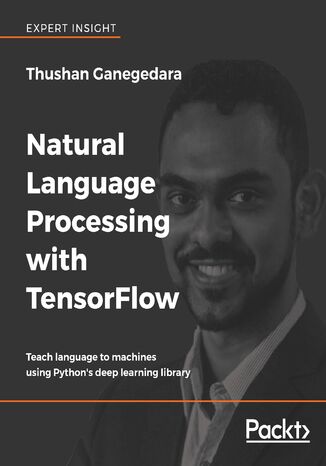
Thushan Ganegedara
Natural language processing (NLP) supplies the majority of data available to deep learning applications, while TensorFlow is the most important deep learning framework currently available. Natural Language Processing with TensorFlow brings TensorFlow and NLP together to give you invaluable tools to work with the immense volume of unstructured data in today’s data streams, and apply these tools to specific NLP tasks.Thushan Ganegedara starts by giving you a grounding in NLP and TensorFlow basics. You'll then learn how to use Word2vec, including advanced extensions, to create word embeddings that turn sequences of words into vectors accessible to deep learning algorithms. Chapters on classical deep learning algorithms, like convolutional neural networks (CNN) and recurrent neural networks (RNN), demonstrate important NLP tasks as sentence classification and language generation. You will learn how to apply high-performance RNN models, like long short-term memory (LSTM) cells, to NLP tasks. You will also explore neural machine translation and implement a neural machine translator.After reading this book, you will gain an understanding of NLP and you'll have the skills to apply TensorFlow in deep learning NLP applications, and how to perform specific NLP tasks.
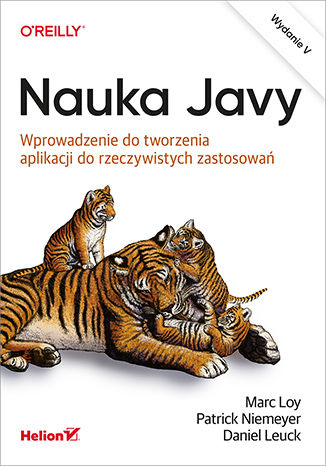
Nauka Javy. Wprowadzenie do tworzenia aplikacji do rzeczywistych zastosowań. Wydanie V
Marc Loy, Patrick Niemeyer, Daniel Leuck
Twórcy Javy od początku historii tego języka śmiało wprowadzali kolejne awangardowe innowacje, a pisane w niej aplikacje miały swój udział w napędzaniu internetowego postępu. Obecnie Java jest uważana za najpopularniejszy język programowania na świecie, a miliony deweloperów wciąż tworzą za jej pomocą oprogramowanie dla niemal każdego urządzenia wyposażonego w procesor. Java jest wyjątkowo wszechstronnym narzędziem: pozwala napisać zarówno prostą aplikację mobilną, jak i złożony system internetowy. Pozostaje przy tym stosunkowo prosta w nauce - co sprawia, że jest idealnym językiem dla początkujących, którzy mają ambicję dojścia do profesjonalnego poziomu. Ta książka jest praktycznym przewodnikiem dla każdego, kto chce zdobyć doświadczenie w tworzeniu rzeczywistych aplikacji w Javie. To również znakomity kurs programowania obiektowego dla początkujących, umożliwiający gruntowne zrozumienie podstaw języka Java i jego interfejsów API. Wyczerpująco opisano tu biblioteki klas, techniki programowania oraz idiomy. Nie zabrakło zaawansowanych zagadnień, takich jak wyrażenia lambda czy serwlety. W tym przejrzanym i zaktualizowanym wydaniu ujęto zmiany wprowadzone zarówno w wersji 11 Javy, jak i w przeglądowych wersjach 12, 13 i 14. Przedstawiono więc takie nowości jak interferencja typów w typach sparametryzowanych, ulepszenia w obsłudze wyjątków czy nowe środowisko testowe jshell. W książce między innymi: przygotowanie środowiska pracy i konfiguracja przydatnych narzędzi typy, instrukcje, wyrażenia oraz obiekty w Javie obsługa wątków i pakiet współbieżności Javy błędy i wyjątki interfejs API wyrażeń regularnych tworzenie zaawansowanych aplikacji i usług sieciowych Java: niezawodny kod, aplikacja, która działa!
Ankur Goel
If you are already using Neo4j in your application and want to learn more about data analysis or database graphs, this is the book for you. This book also caters for your needs if you are looking to migrate your existing application to Neo4j in the future. We assume that you are already familiar with any general purpose programming language and have some familiarity with Neo4j.
Neo4j Graph Data Modelling. Design efficient and flexible databases by optimizing the power of Neo4j
Mahesh K Lal
If you are a developer who wants to understand the fundamentals of modeling data in Neo4j and how it can be used to model full-fledged applications, then this book is for you. Some understanding of domain modeling may be advantageous but is not essential.
Sonal Raj
If you are a professional or enthusiast who has a basic understanding of graphs or has basic knowledge of Neo4j operations, this is the book for you. Although it is targeted at an advanced user base, this book can be used by beginners as it touches upon the basics. So, if you are passionate about taming complex data with the help of graphs and building high performance applications, you will be able to get valuable insights from this book.
Sudipta Mukherjee
Generics were added as part of .NET Framework 2.0 in November 2005. Although similar to generics in Java, .NET generics do not apply type erasure but every object has unique representation at run-time. There is no performance hit from runtime casts and boxing conversions, which are normally expensive..NET offers type-safe versions of every classical data structure and some hybrid ones.This book will show you everything you need to start writing type-safe applications using generic data structures available in Generics API. You will also see how you can use several collections for each task you perform. This book is full of practical examples, interesting applications, and comparisons between Generics and more traditional approaches. Finally, each container is bench marked on the basis of performance for a given task, so you know which one to use and when.This book first covers the fundamental concepts such as type safety, Generic Methods, and Generic Containers. As the book progresses, you will learn how to join several generic containers to achieve your goals and query them efficiently using Linq. There are short exercises in every chapter to boost your knowledge.The book also teaches you some best practices, and several patterns that are commonly available in generic code.Some important generic algorithm definitions are present in Power Collection (an API created by Wintellect Inc.) that are missing from .NET framework. This book shows you how to use such algorithms seamlessly with other generic containers.The book also discusses C5 collections. Java Programmers will find themselves at home with this API. This is the closest to JCF. Some very interesting problems are solved using generic containers from .NET framework, C5, and PowerCollection Algorithms ñ a clone of Google Set and Gender Genie for example!The author has also created a website (https://www.consulttoday.com/genguide) for the book where you can find many useful tools, code snippets, and, applications, which are not the part of code-download section