
Informatyka
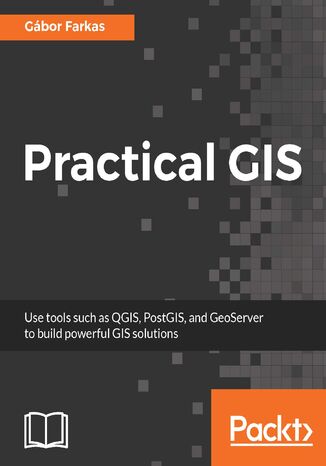
Practical GIS. Learn novice to advanced topics such as QGIS, Spatial data analysis, and more
Gábor Farkas
The most commonly used GIS tools automate tasks that were historically done manually—compiling new maps by overlaying one on top of the other or physically cutting maps into pieces representing specific study areas, changing their projection, and getting meaningful results from the various layers by applying mathematical functions and operations. This book is an easy-to-follow guide to use the most matured open source GIS tools for these tasks.We’ll start by setting up the environment for the tools we use in the book. Then you will learn how to work with QGIS in order to generate useful spatial data. You will get to know the basics of queries, data management, and geoprocessing.After that, you will start to practice your knowledge on real-world examples. We will solve various types of geospatial analyses with various methods. We will start with basic GIS problems by imitating the work of an enthusiastic real estate agent, and continue with more advanced, but typical tasks by solving a decision problem. Finally, you will find out how to publish your data (and results) on the web. We will publish our data with QGIS Server and GeoServer, and create a basic web map with the API of the lightweight Leaflet web mapping library.
Chris Seferlis , Christopher Nellis, Andy Roberts
Azure Cognitive Services and OpenAI are a set of pre-built artificial intelligence (AI) solution APIs that can be leveraged from existing applications, allowing customers to take advantage of Microsoft’s award-winning Vision, Speech, Text, Decision, and GPT-4 AI capabilities.With Practical Guide to Azure Cognitive Services, you’ll work through industry-specific examples of implementations to get a head-start in your production journey. You’ll begin with an overview of the categorization of Azure Cognitive Services and the benefits of embracing AI solutions for practical business applications. After that, you’ll explore the benefits of using Azure Cognitive Services to optimize efficiency and improve predictive capabilities. Then, you’ll learn how to leverage Vision capabilities for quality control, Form Recognizer to streamline supply chain nuances, language understanding to improve customer service, and Cognitive Search for next-generation knowledge-mining solutions.By the end of this book, you’ll be able to implement various Cognitive Services solutions that will help you enhance efficiency, reduce costs, and improve the customer experience at your organization. You’ll also be well equipped to automate mundane tasks by reaping the full potential of OpenAI.

Jean-Georges Valle
If you’re looking for hands-on introduction to pentesting that delivers, then Practical Hardware Pentesting is for you. This book will help you plan attacks, hack your embedded devices, and secure the hardware infrastructure.Throughout the book, you will see how a specific device works, explore the functional and security aspects, and learn how a system senses and communicates with the outside world. You’ll set up a lab from scratch and then gradually work towards an advanced hardware lab—but you’ll still be able to follow along with a basic setup. As you progress, you’ll get to grips with the global architecture of an embedded system and sniff on-board traffic, learn how to identify and formalize threats to the embedded system, and understand its relationship with its ecosystem. You’ll discover how to analyze your hardware and locate its possible system vulnerabilities before going on to explore firmware dumping, analysis, and exploitation. The reverse engineering chapter will get you thinking from an attacker point of view; you’ll understand how devices are attacked, how they are compromised, and how you can harden a device against the most common hardware attack vectors. By the end of this book, you will be well-versed with security best practices and understand how they can be implemented to secure your hardware.
Brett Jephson, Lewis Coulson, Ana Carolina Silveira
In the ever-evolving landscape of web development, mastering HTML and CSS is crucial for building modern, responsive websites. This comprehensive guide equips you with the essential knowledge and skills you need to excel in web design and development.Starting with the foundational principles of HTML and CSS, the book swiftly advances to cover more complex topics, providing a thorough understanding of these vital technologies. You’ll learn how to build websites from scratch, create intuitive user input forms, and enhance web design by integrating multimedia elements like videos, animations, and themes. Emphasizing responsive web design principles, this book teaches you how to create layouts that flawlessly adapt to different devices using media queries. You’ll also get to grips with SEO essentials to optimize website visibility and search engine rankings. A dedicated section guides you through performance optimization techniques to ensure your websites deliver a smooth and lightning-fast user experience.By the end of this HTML and CSS book, you’ll have developed confidence in your web development skills, and you'll be well-equipped to build modern, visually appealing, and high-performing websites.
Sravani Bhattacharjee
Securing connected industries and autonomous systems is of primary concern to the Industrial Internet of Things (IIoT) community. Unlike cybersecurity, cyber-physical security directly ties to system reliability as well as human and environmental safety.This hands-on guide begins by establishing the foundational concepts of IIoT security with the help of real-world case studies, threat models, and reference architectures. You’ll work with practical tools to design risk-based security controls for industrial use cases and gain practical knowledge of multi-layered defense techniques, including identity and access management (IAM), endpoint security, and communication infrastructure. You’ll also understand how to secure IIoT lifecycle processes, standardization, and governance. In the concluding chapters, you’ll explore the design and implementation of resilient connected systems with emerging technologies such as blockchain, artificial intelligence, and machine learning.By the end of this book, you’ll be equipped with the all the knowledge required to design industry-standard IoT systems confidently.
Arvind Ravulavaru
In this world of technology upgrades, IoT is currently leading with its promise to make the world a more smarter and efficient place.This book will show you how to build simple IoT solutions that will help you to understand how this technology works. We would not only explore the IoT solution stack, but we will also see how to do it with the world’s most misunderstood programming language - JavaScript. Using Raspberry Pi 3 and JavaScript (ES5/ES6) as the base to build all the projects, you will begin with learning about the fundamentals of IoT and then build a standard framework for developing all the applications covered in this book. You will then move on to build a weather station with temperature, humidity and moisture sensors and further integrate Alexa with it. Further, you will build a smart wearable for understanding the concept of fall detection. You will then extend it with the 'If This Then That' (IFTTT) rules engine to send an email on fall detection. Finally, you will be working with the Raspberry Pi 3 camera module and surveillance with a bit of facial detection using Amazon Rekognition platform.At the end of the book, you will not only be able to build standalone exciting IoT applications but also learn how you can extend your projects to another level.
Practical IT Service Management. A concise guide for busy executives
IT Governance Publishing, Thejendra B.S
This book provides a detailed guide to IT service management (ITSM), centered around the ITIL framework to enhance IT service delivery. It starts by introducing foundational concepts such as IT services, common challenges in IT departments, and the evolution of ITIL, particularly the 2011 edition. The early chapters cover core topics like service strategy, design, and the ITIL lifecycle, offering a strong foundation for understanding how ITIL aligns with business objectives.As the book progresses, it delves into key ITIL processes such as service desk management, incident management, problem management, change and release management, and service asset management. Each chapter explains the roles, responsibilities, and best practices for each process, providing actionable advice and real-world examples for effective application. These sections focus on improving service efficiency and handling IT challenges.The final chapters address advanced topics like service level management, financial management, supplier management, and service continuity. These insights help readers manage resources, build vendor relationships, and ensure business continuity. By the end, readers will be equipped to apply ITIL to optimize IT operations, align them with business needs, and drive continuous improvement.
Sunila Gollapudi
This book explores an extensive range of machine learning techniques uncovering hidden tricks and tips for several types of data using practical and real-world examples. While machine learning can be highly theoretical, this book offers a refreshing hands-on approach without losing sight of the underlying principles. Inside, a full exploration of the various algorithms gives you high-quality guidance so you can begin to see just how effective machine learning is at tackling contemporary challenges of big dataThis is the only book you need to implement a whole suite of open source tools, frameworks, and languages in machine learning. We will cover the leading data science languages, Python and R, and the underrated but powerful Julia, as well as a range of other big data platforms including Spark, Hadoop, and Mahout. Practical Machine Learning is an essential resource for the modern data scientists who want to get to grips with its real-world application.With this book, you will not only learn the fundamentals of machine learning but dive deep into the complexities of real world data before moving on to using Hadoop and its wider ecosystem of tools to process and manage your structured and unstructured data. You will explore different machine learning techniques for both supervised and unsupervised learning; from decision trees to Naïve Bayes classifiers and linear and clustering methods, you will learn strategies for a truly advanced approach to the statistical analysis of data. The book also explores the cutting-edge advancements in machine learning, with worked examples and guidance on deep learning and reinforcement learning, providing you with practical demonstrations and samples that help take the theory–and mystery–out of even the most advanced machine learning methodologies.