
Informatyka
Maxwell Flitton
Are safety and high performance a big concern for you while developing web applications?With this practical Rust book, you’ll discover how you can implement Rust on the web to achieve the desired performance and security as you learn techniques and tooling to build fully operational web apps.In this second edition, you’ll get hands-on with implementing emerging Rust web frameworks, including Actix, Rocket, and Hyper. It also features HTTPS configuration on AWS when deploying a web application and introduces you to Terraform for automating the building of web infrastructure on AWS. What’s more, this edition also covers advanced async topics. Built on the Tokio async runtime, this explores TCP and framing, implementing async systems with the actor framework, and queuing tasks on Redis to be consumed by a number of worker nodes. Finally, you’ll go over best practices for packaging Rust servers in distroless Rust Docker images with database drivers, so your servers are a total size of 50Mb each.By the end of this book, you’ll have confidence in your skills to build robust, functional, and scalable web applications from scratch.
Maxwell Flitton
Rust is no longer just for systems programming. This book will show you why this safe and performant language is a crucial up-and-coming option for developing web applications, and get you on your way to building fully functional Rust web apps. You don’t need any experience with Rust to get started, and this new edition also comes with a shallower learning curve.You’ll get hands-on with emerging Rust web frameworks including Actix, Axum, Rocket, and Hyper. You’ll look at injecting Rust into the frontend with WebAssembly and HTTPS configuration with NGINX. Later, you’ll move on to more advanced async topics, exploring TCP and framing, and implementing async systems.As you work through the book, you’ll build a to-do application with authentication using a microservice architecture that compiles into one Rust binary, including the embedding of a frontend JavaScript application in the same binary. The application will have end-to-end atomic testing and a deployment pipeline.By the end of this book, you’ll fully understand the significance of Rust for web development. You’ll also have the confidence to build robust, functional, and scalable Rust web applications from scratch.
Nikola Mitrović , Santosh Yadav
Building modern web applications that are responsive and resilient is essential in this rapidly evolving digital world. Imagine effortlessly managing complex data streams and creating seamless user experiences—this book helps you do just that by adopting RxJS to boost your development skills and transform your approach to reactive programming.Written by a seasoned software engineer and consultant with a decade of industry experience, this book equips you to harness the power of RxJS techniques, patterns, and operators tailored for real-world scenarios. Each chapter is filled with practical recipes designed to tackle a variety of challenges, from managing side effects and ensuring error resiliency in client applications to developing real-time chat applications and event-driven microservices. You’ll learn how to integrate RxJS with popular frameworks, such as Angular and NestJS, gaining insights into modern web development practices that enhance performance and interactivity.By the end of this book, you’ll have mastered reactive programming principles, the RxJS library, and working with Observables, while crafting code that reacts to changes in data and events in a declarative and asynchronous way.

Ryszard Kilvington. Nieskończoność i geometria
Robert Podkoński
Już autorzy średniowiecznych tekstów zapoczątkowali proces, który zwykło się nazywać rewolucją naukową. Czy siedemnastowieczna rewolucja naukowa zaistniałaby bez poprzedzających ją scholastycznych dysput, których niektórzy uczestnicy doszukiwali się w pomysłach średniowiecznych przyrodników antycypacji idei nowożytnych fizyków. Inni natomiast stwierdzali, że nauka siedemnastowieczna w najmniejszym stopniu nie była kontynuacją filozofii przyrody wieków średnich, nawet pomimo tego, iż wiele jej elementów uderzająco przypominało koncepcje uznane przez fizykę nowożytną. Należy tutaj podkreślić, że zwolennicy zarówno jednej, jak i drugiej opcji za kryterium nowoczesności uznawali głównie wykorzystanie matematyki do opisu i rozwiązywania problemów fizycznych. Wysiłki historyków nauki próbujących rozwiązać tę kwestię ujawniły jednakże wiele zaskakujących i ciekawych aspektów średniowiecznej filozofii przyrody. Dzięki ich pracy wypełnionych zostało przynajmniej kilka pustych miejsc w skomplikowanej i wielopoziomowej układance, jaką jest obraz historii ludzkiego geniuszu. Celem niniejszej pracy jest zapełnienie kolejnej luki w tym obrazie.
Rytm i technika gry na gitarze dla bystrzaków
Desi Serna
Dowiedz się, jak: opanować podstawy czytania muzyki, liczenia rytmów oraz uderzania strun palcami i piórkiem, poprawić swoje umiejętności rytmicznej gry i wyczucia rytmu, rozwinąć techniki stosowane w takich stylach, jak pop, rock, blues, folk i funk. Przygnębia Cię słaba gra rytmiczna? Mistrzowie gitary wyglądają, jakby granie nie sprawiało im wysiłku, ale opanowanie rytmu i technik wymaga naprawdę sporej dawki ćwiczeń. Ten przyjazny poradnik ułatwi Ci zrealizowanie marzenia o tym, by grać jak zawodowy muzyk. Znajdziesz tu mnóstwo praktycznych i szczegółowych instrukcji na każdy temat, od gry akordowej po palcowanie i piórkowanie. Znajdź swój rytm — naucz się czytać i grać podstawowe rytmy, popraw umiejętność bicia i graj z większym groove’em. Piórko lub kostka — poznaj zalety i wady gry piórkiem i opanuj crosspicking, sweeping oraz piórkowanie naprzemienne i ekonomiczne, aby piórko nie miało dla Ciebie tajemnic. Zrób to palcem — zagraj popularne schematy palcowania i aranżacje w stylu melodii z akordami oraz naucz się gry hybrydowej i perkusyjnego slappingu. Doszlifuj warsztat — poćwicz hammering, pull-off, slide i podciągnięcia strun, rozwijając przy tym zręczność i synchronizację palców. Poznaj lepiej dostępne narzędzia — dowiedz się, jak korzystać z piórka, rurki slide i wajchy tremolo. Rozwiń swoje umiejętności i poznaj wiele przydatnych technik gitarowych! W książce znajdziesz: tajniki utrzymywania rytmu, popularne schematy bicia, techniki ulepszania groove’u, sposoby artykulacji i ekspresji, mechanikę piórkowania, ćwiczenia rozwijające umiejętności czytania nut i gry na gitarze, piosenki i gitarzystów, którzy zainspirują Twój rozwój rytmiczny i techniczny, nagrania i filmiki dostępne na stronie poświęconej książce. Desi Serna jest twórcą prężnie działającej platformy internetowej, na której działa jako przekonujący i kontaktowy guru gitary. Ma na koncie ponad 10 000 godzin doświadczenia w prowadzeniu prywatnych lekcji i zajęć z gitary i został ochrzczony przez magazyn „Rolling Stone” „ekspertem teorii muzyki”.
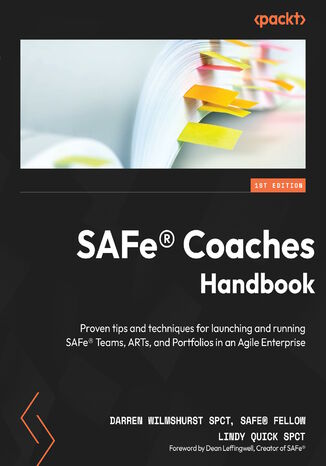
Darren Wilmshurst, Dean Leffingwell, Lindy Quick
The Scaled Agile Framework (SAFe®) is widely recognized as an eff ective methodology for implementing Agile practices at the Enterprise level. However, the complexity of SAFe® can make it challenging for Teams and organizations to determine which practices can be safely adapted to their unique needs. Although SAFe® is a framework rather than a set of rules, promoting adaptation, it’s crucial to understand why SAFe® practices are designed the way they are along with the consequences of modifying them.The SAFe® Coaches Handbook is a comprehensive resource that goes beyond a how-to guide, providing a deep understanding of SAFe® principles and practices. The chapters are designed in a way to teach you how to successfully implement SAFe® in your organization and eff ectively manage the Team’s Backlog while avoiding common pitfalls. You’ll discover optimal ways to create SAFe® Teams and run successful Events. You’ll also learn how to plan Agile Release Trains (ARTs), manage the ART Backlog, conduct PI Planning, and grasp the importance of Value Stream Identifi cation in driving value delivery.By the end of this book, you’ll be armed with practical tips and advice to help you successfully customize the Scaled Agile Framework to your Enterprise’s needs while preserving the aspects that make it work successfully.
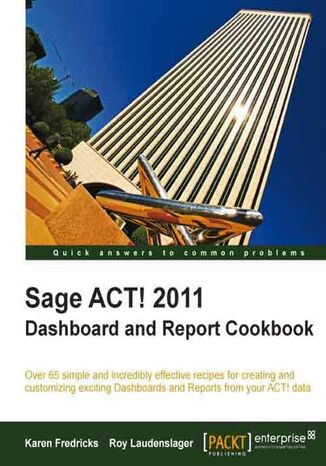
Karen Fredricks, Roy Laudenslager
Sage ACT! is the top selling CRM software application, and it helps businesses to centralize contact information, organize their calendars and notes, and ultimately maximize contact relationships to optimize business efficiency and profitability. In ACT! 2011, a variety of new dashboards and reports are available for producing graphical representations of client information and for measuring the success of your sales force.This cookbook is full of practical and immediately applicable recipes that will take you from being an ACT! report and dashboard novice to a report-writing pro in no time. The recipes will show you how to create custom dashboards and reports, as well as utilize the new templates available in recent ACT! versions. You will learn to use ACT!'s Report Editor and Dashboard Designer so that you will be able to easily view important information about your business and your sales force.The recipes begin by covering the most basic elements of the ACT! reports and continue to include several recipes that will guide you through creating brand-new reports. If you have an ACT! database, you need to be able to access it quickly and logically; this book will help you do just that.
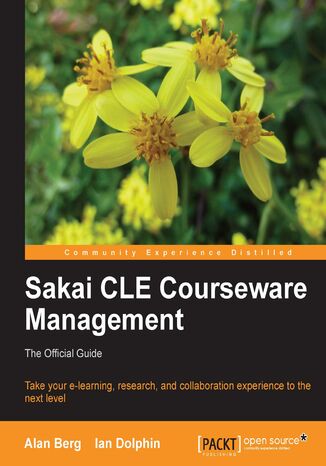
Alan Mark Berg, Ian Dolphin
Sakai is a Collaboration and Learning environment that provides the means to manage users, courses, instructors, and facilities, as well as a spectrum of tools including assessment, grading, and messaging. Sakai is loaded with many handy features and tools, which make it uniquely the Learning system of the present as well as the future.This book is the officially endorsed Sakai guide and is an update to the previous book, Sakai Courseware Management: The Official Guide. From setting up and running Sakai for the first time to creatively using its tools and features, this book delivers everything you need to know.Written by Alan Berg, a Sakai fellow and former Quality Assurance Director of the Sakai Foundation and Ian Dolphin the Executive Director of the Sakai Foundation with significant contributions from the Sakai community, Sakai CLE Courseware Management: The Official Guide is a comprehensive study of how Sakai CLE should be used, managed, and maintained, with real world examples and practical explanations.The book opens with an overview of Sakai, its history and how to set up a demonstration version. Next, the underlying structures and tools are described. In using Sakai for Teaching and Collaboration, there is a detailed discussion of how to structure online courses for teaching and collaboration between groups of students, from creating course sites to understanding their use in different organizations around the world.