
Informatyka
Pawel Bazyluk
With support for both server-side and client-side hosting, as well as the flexibility to mix render modes, Blazor empowers you to leverage cloud computing while maintaining the performance of local applications. Paweł Bazyluk—a Blazor expert with over a decade of experience in .NET technologies—shows you how Blazor, a Microsoft framework, enables you to create interactive web applications using C# and .NET, while reducing reliance on JavaScript. This cookbook highlights Blazor’s vast possibilities using practical recipes that address key aspects of web development and showcase the framework's versatility in building modern, integrated applications.Pawel demonstrates how to skillfully navigate component-based architecture, and create, parameterize, and customize components to achieve high modularity. Working through practical insights and hands-on guidance in each chapter, you’ll progress from advanced data binding and event handling intricacies to optimizing data display using grids. You’ll explore application state management, build interactive forms with validation, leverage Blazor’s routing engine, and keep every part of the application secure. The book also explores cutting-edge topics, touching on how to enhance your application with AI-powered features.By the end of the book, you’ll be fully equipped to build robust, scalable, and secure web applications in Blazor.
Virgilio Carlo de Menezes Vasconcelos
Blender is an open source 3D graphics application that can be used for modeling, rigging, animating, rendering and thousands of other things. While modeling characters isn't the biggest of your worries, animating them to make them feel as-good-as alive is what differentiates a professional from an amateur. This book offers clear, illustrative, and easy-to-follow recipes to create character rigs and animations for common situations. Bring your characters to life by understanding the principles, techniques and approaches involved in creating rigs and animations, you'll be able to adapt them to your own characters and films. The book offers clear step-by-step tutorials, with detailed explanations, screenshots and support files to help you understand the principles behind each topic. Each recipe covers a logical step of the complete creation of a character rig and animation, so you're not overwhelmed with too much information at once.You'll see numerous examples and screenshots that guide to achieve various rigging and animation tasks, logically separated so you can understand each in detail. The rigging topics are divided by each region of the body (torso, limbs, face, eyes), and further separated by the specific topic (neck, fingers, mouth, eyelids, etc) for clarity. All rigging tasks are accomplished with the built-in tools in Blender, without the complexity of coding custom Python behaviors or user interface elements.The animation topics deal with common situations found in real world productions, showing good practices to understand and overcome the challenges.
Colin Litster
Blender 2.5 is one of the most usable 3D suites available. Its material and texture functions offer spectacular surface creation possibilities. It can take you hours just to create basic textures and materials in Blender and when you think of creating complex materials and textures you are petrified. Imagine how you will feel when you overcome these obstacles.This book wastes no time on boring theory and bombards you with examples of ready-created materials and textures from the start, with clear instructions on how they were created, and what you can learn from them for making your own. It covers all core Blender functions you will ever need to easily create perfect simulation of objects from the simplest to the most complex ones.The book begins with recipes that show you how to create natural surface materials, including a variety of pebbles, rocks, wood, and water, as well as man-made metals, complete with rust. By utilizing some of the easiest-to-use animation tools available, you will be able to produce accurate movement in mesh objects. Familiarize yourself with a plethora of tools that will help you to effectively organize your textures and materials.You will learn how to emulate the reflective properties of natural materials and how to simulate materials such as rusted iron, which is difficult to make believable. Transparency and reflection are both tricky natural surface properties to simulate but these recipes will make it easy. Explore ways to speed up animations by using special painting techniques to significantly lower render times. By the end of the book, you will be able to simulate some of the most difficult effects to recreate in any 3D suite, such as smoke, fire, and explosions.
Enrico Valenza
Cycles is Blender's new, powerful rendering engine. Using practical examples, this book will show you how to create a vast array of realistic and stunning materials and texture effects using the Cycles rendering engine.Blender 2.6 Cycles: Materials and Textures Cookbook is a practical journey into the new and exciting Cycles rendering engine for Blender. In this book you will learn how to create a vast array of materials and textures in Cycles, including glass, ice, snow, rock, metal and water. If you want to take your 3D models to the next level, but don't know how, then this cookbook is for you!In this practical cookbook, you will learn how to create stunning materials and textures to really bring your 3D models to life! Diving deep into Cycles you will learn Cycle's node-based material system, how to set-up a 3D scene for rendering, how to create a natural and man-made materials as well as the correct organization and re-use of Cycles materials to save you time and effort.To ensure that your creations look stunning you will learn how illumination works in Cycles, improve the quality of the final render and to avoid the presence of noise and fireflies. Each chapter of Blender 2.6 Cycles: Materials and Textures Cookbook builds on the complexity of the last so that by the end of this book you will know how to create an impressive library of realistic-looking materials and textures.
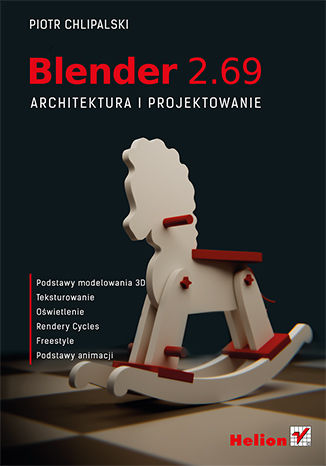
Blender 2.69. Architektura i projektowanie
Piotr Chlipalski
Chcesz szybko nauczyć się Blendera? Dobrze trafiłeś! Podstawy modelowania 3D Materiały i teksturowanie Oświetlenie Rendery Cycles Freestyle Podstawy animacji Blender to oprogramowanie open source do modelowania 3D, tworzenia animacji, wirtualnych spacerów i gier komputerowych oraz renderowania. Aplikacja skutecznie konkuruje na tych polach z komercyjnymi rozwiązaniami konkurencji i zdobywa rzesze wiernych użytkowników. Sprawdza się doskonale zarówno u freelancerów, jak i w dużych, profesjonalnych studiach graficznych i filmowych. Możliwości programu są ogromne, choć jego sukces związany jest także z dostępnością: można go pobrać zupełnie za darmo, a działa na trzech najbardziej popularnych systemach operacyjnych. Zalety te docenili nie tylko graficy, lecz również osoby zajmujące się zawodowo projektowaniem architektonicznym. Jeśli jesteś zainteresowany wykorzystaniem Blendera i jego narzędzi w swoich projektach, jeśli chcesz zacząć stosować je w codziennej praktyce, sięgnij po książkę Blender 2.69. Architektura i projektowanie. Dzięki niej łatwo opanujesz podstawy modelowania, teksturowania, oświetlania i renderowania scen, a także nauczysz się używać kamer. Samodzielnie stworzysz szkice, schematy i fotorealistyczne wizualizacje, poznasz też metody umożliwiające opracowywanie wirtualnych spacerów. Z tą książką zdobędziesz niezbędną wiedzę i praktyczne umiejętności oraz poszerzysz je w oparciu o dostępne w sieci materiały o Blenderze. Instalacja i interfejs Blendera Podstawy animacji i poruszanie się w przestrzeni 3D Modelowanie obiektów i modyfikatory Definiowanie i ustawianie kamer Stosowanie materiałów i tekstur Oświetlanie i renderowanie scen Podstawy renderów w Blender Internal Rendery fotorealistyczne w Cycles Rendery artystyczne w Freestyle Bezpłatny, potężny, nowoczesny - właśnie taki jest Blender!
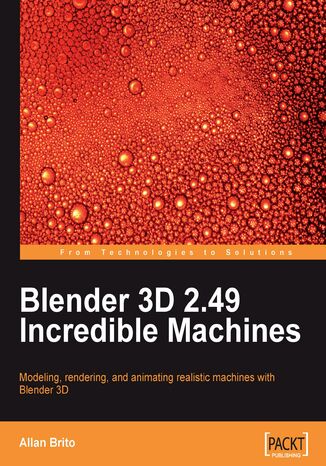
Allan Brito
Blender 3D provides all the features you need to create super-realistic 3D models of machines for use in artwork, movies, and computer games. Blender 3D 2.49 Incredible Machines gives you step-by-step instructions for building weapons, vehicles, robots, and more.This book will show you how to use Blender 3D for mechanical modeling and product visualization. Through the pages of the book, you will find a step-by-step guide to create three different projects: a fantasy weapon, a spacecraft, and a giant robot. Even though these machines are not realistic, you will be able to build your own sensible and incredible machines with the techniques that you will learn in this book along with the exercises and examples.All the three sections of this book, which cover three projects, are planned to have an increasing learning curve. The first project is about a hand weapon, and with that we can image a small-sized object with tiny details. This first part of the book will show you how to deal with these details and model them in Blender 3D.In the second project, we will create a spacecraft, adding a bit of scale to the project, and new materials and textures as well. With this project, we will be working with metal, glass, and other elements that make the spacecraft. Along with the object, a new space environment will be created in the book too.At the end we have a big and complex object, which is the transforming robot. This last part of the book will cover the modeling of two objects and show how you can make one transform into the other. The scale and number of objects in this project are quite big, but the same principles as in the other projects are applied here with a step-by-step guide on how to go through the workflow of the project.
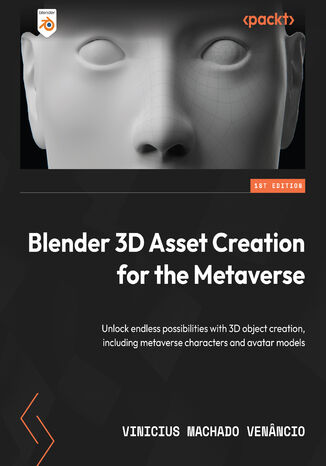
Vinicius Machado Venâncio
If you are familiar with modeling, this book will help you discover a practical and efficient workflow designed to accelerate your asset creation process for use in multiple projects, including games and the metaverse.Complete with shortcuts and tips on how to speed up the process, this book guides you in modeling assets and characters with the help of references. You’ll learn how to optimize the modeled asset for maximum rendering performance within game engines and the metaverse. Next, you’ll get to grips with unwrapping the 3D model for texturing and explore multiple texturing techniques to breathe life into your 3D models. Finally, you’ll integrate the 3D model to work seamlessly across a myriad of programs and game engines.By the end of this book, you’ll have the skills to efficiently create any type of 3D asset from scratch for use in renders, animations, or immersive gaming experiences.
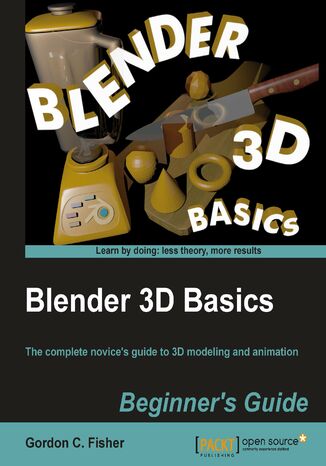
Blender 3D Basics. The complete novice's guide to 3D modeling and animation
Gordon Fisher
Blender is by far the most popular open source graphics program available. It is a full featured 3D modeling, animation and games development tool used by millions all over the world ñ and it's free! This book is for those looking for an entry into the world of 3D modeling and animation regardless of prior experience.Blender 3D Basics is the entry level book for those without prior experience using 3D tools. It caters for those who may have downloaded Blender in the past but were frustrated by its lack of intuitiveness. Using simple steps it builds, chapter by chapter, into a full foundation in 3D modeling and animation.Using Blender 3D Basics the reader will model a maritime scene complete with boats and water, then add materials, lighting and animation. The book demystifies the Blender interface and explains what each tool does so that you will be left with a thorough understanding of 3D.