
Informatyka

Carlos A. Lozano , Dhruv Shah, Riyaz...
Burp suite is a set of graphic tools focused towards penetration testing of web applications. Burp suite is widely used for web penetration testing by many security professionals for performing different web-level security tasks.The book starts by setting up the environment to begin an application penetration test. You will be able to configure the client and apply target whitelisting. You will also learn to setup and configure Android and IOS devices to work with Burp Suite. The book will explain how various features of Burp Suite can be used to detect various vulnerabilities as part of an application penetration test. Once detection is completed and the vulnerability is confirmed, you will be able to exploit a detected vulnerability using Burp Suite. The book will also covers advanced concepts like writing extensions and macros for Burp suite. Finally, you will discover various steps that are taken to identify the target, discover weaknesses in the authentication mechanism, and finally break the authentication implementation to gain access to the administrative console of the application.By the end of this book, you will be able to effectively perform end-to-end penetration testing with Burp Suite.
Jeffrey Ng , Subhash Shah
Remodeling your outlook on banking begins with keeping up to date with the latest and most effective approaches, such as artificial intelligence (AI). Hands-On Artificial Intelligence for Banking is a practical guide that will help you advance in your career in the banking domain. The book will demonstrate AI implementation to make your banking services smoother, more cost-efficient, and accessible to clients, focusing on both the client- and server-side uses of AI.You’ll begin by understanding the importance of artificial intelligence, while also gaining insights into the recent AI revolution in the banking industry. Next, you’ll get hands-on machine learning experience, exploring how to use time series analysis and reinforcement learning to automate client procurements and banking and finance decisions. After this, you’ll progress to learning about mechanizing capital market decisions, using automated portfolio management systems and predicting the future of investment banking. In addition to this, you’ll explore concepts such as building personal wealth advisors and mass customization of client lifetime wealth. Finally, you’ll get to grips with some real-world AI considerations in the field of banking. By the end of this book, you’ll be equipped with the skills you need to navigate the finance domain by leveraging the power of AI.
David Dindi, Patrick D. Smith
Virtual Assistants, such as Alexa and Siri, process our requests, Google's cars have started to read addresses, and Amazon's prices and Netflix's recommended videos are decided by AI. Artificial Intelligence is one of the most exciting technologies and is becoming increasingly significant in the modern world.Hands-On Artificial Intelligence for Beginners will teach you what Artificial Intelligence is and how to design and build intelligent applications. This book will teach you to harness packages such as TensorFlow in order to create powerful AI systems. You will begin with reviewing the recent changes in AI and learning how artificial neural networks (ANNs) have enabled more intelligent AI. You'll explore feedforward, recurrent, convolutional, and generative neural networks (FFNNs, RNNs, CNNs, and GNNs), as well as reinforcement learning methods. In the concluding chapters, you'll learn how to implement these methods for a variety of tasks, such as generating text for chatbots, and playing board and video games.By the end of this book, you will be able to understand exactly what you need to consider when optimizing ANNs and how to deploy and maintain AI applications.
Amita Kapoor, Hector Duran Lopez-Velarde
There are many applications that use data science and analytics to gain insights from terabytes of data. These apps, however, do not address the challenge of continually discovering patterns for IoT data. In Hands-On Artificial Intelligence for IoT, we cover various aspects of artificial intelligence (AI) and its implementation to make your IoT solutions smarter.This book starts by covering the process of gathering and preprocessing IoT data gathered from distributed sources. You will learn different AI techniques such as machine learning, deep learning, reinforcement learning, and natural language processing to build smart IoT systems. You will also leverage the power of AI to handle real-time data coming from wearable devices. As you progress through the book, techniques for building models that work with different kinds of data generated and consumed by IoT devices such as time series, images, and audio will be covered. Useful case studies on four major application areas of IoT solutions are a key focal point of this book. In the concluding chapters, you will leverage the power of widely used Python libraries, TensorFlow and Keras, to build different kinds of smart AI models.By the end of this book, you will be able to build smart AI-powered IoT apps with confidence.
Devangini Patel
With the emergence of big data and modern technologies, AI has acquired a lot of relevance in many domains. The increase in demand for automation has generated many applications for AI in fields such as robotics, predictive analytics, finance, and more.In this book, you will understand what artificial intelligence is. It explains in detail basic search methods: Depth-First Search (DFS), Breadth-First Search (BFS), and A* Search, which can be used to make intelligent decisions when the initial state, end state, and possible actions are known. Random solutions or greedy solutions can be found for such problems. But these are not optimal in either space or time and efficient approaches in time and space will be explored. We will also understand how to formulate a problem, which involves looking at it and identifying its initial state, goal state, and the actions that are possible in each state. We also need to understand the data structures involved while implementing these search algorithms as they form the basis of search exploration. Finally, we will look into what a heuristic is as this decides the quality of one sub-solution over another and helps you decide which step to take.
Subhashini Tripuraneni, Charles Song
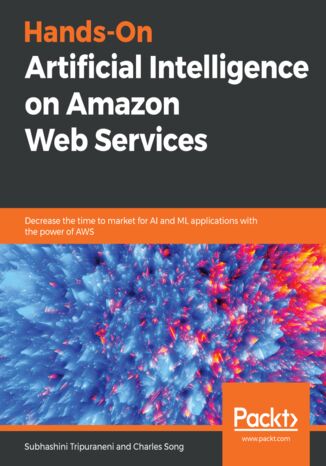
From data wrangling through to translating text, you can accomplish this and more with the artificial intelligence and machine learning services available on AWS.With this book, you’ll work through hands-on exercises and learn to use these services to solve real-world problems. You’ll even design, develop, monitor, and maintain machine and deep learning models on AWS.The book starts with an introduction to AI and its applications in different industries, along with an overview of AWS artificial intelligence and machine learning services. You’ll then get to grips with detecting and translating text with Amazon Rekognition and Amazon Translate. The book will assist you in performing speech-to-text with Amazon Transcribe and Amazon Polly. Later, you’ll discover the use of Amazon Comprehend for extracting information from text, and Amazon Lex for building voice chatbots. You will also understand the key capabilities of Amazon SageMaker such as wrangling big data, discovering topics in text collections, and classifying images. Finally, you’ll cover sales forecasting with deep learning and autoregression, before exploring the importance of a feedback loop in machine learning.By the end of this book, you will have the skills you need to implement AI in AWS through hands-on exercises that cover all aspects of the ML model life cycle.
Nisheeth Joshi
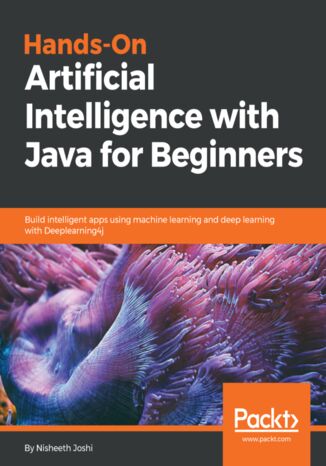
Artificial intelligence (AI) is increasingly in demand as well as relevant in the modern world, where everything is driven by technology and data. AI can be used for automating systems or processes to carry out complex tasks and functions in order to achieve optimal performance and productivity.Hands-On Artificial Intelligence with Java for Beginners begins by introducing you to AI concepts and algorithms. You will learn about various Java-based libraries and frameworks that can be used in implementing AI to build smart applications. In addition to this, the book teaches you how to implement easy to complex AI tasks, such as genetic programming, heuristic searches, reinforcement learning, neural networks, and segmentation, all with a practical approach.By the end of this book, you will not only have a solid grasp of AI concepts, but you'll also be able to build your own smart applications for multiple domains.
Nisheeth Joshi
Artificial intelligence (AI) is increasingly in demand as well as relevant in the modern world, where everything is driven by technology and data. AI can be used for automating systems or processes to carry out complex tasks and functions in order to achieve optimal performance and productivity.Hands-On Artificial Intelligence with Java for Beginners begins by introducing you to AI concepts and algorithms. You will learn about various Java-based libraries and frameworks that can be used in implementing AI to build smart applications. In addition to this, the book teaches you how to implement easy to complex AI tasks, such as genetic programming, heuristic searches, reinforcement learning, neural networks, and segmentation, all with a practical approach.By the end of this book, you will not only have a solid grasp of AI concepts, but you'll also be able to build your own smart applications for multiple domains.
Sibanjan Das, Umit Mert Cakmak
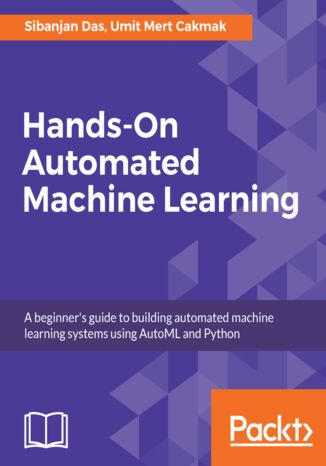
AutoML is designed to automate parts of Machine Learning. Readily available AutoML tools are making data science practitioners’ work easy and are received well in the advanced analytics community. Automated Machine Learning covers the necessary foundation needed to create automated machine learning modules and helps you get up to speed with them in the most practical way possible. In this book, you’ll learn how to automate different tasks in the machine learning pipeline such as data preprocessing, feature selection, model training, model optimization, and much more. In addition to this, it demonstrates how you can use the available automation libraries, such as auto-sklearn and MLBox, and create and extend your own custom AutoML components for Machine Learning. By the end of this book, you will have a clearer understanding of the different aspects of automated Machine Learning, and you’ll be able to incorporate automation tasks using practical datasets. You can leverage your learning from this book to implement Machine Learning in your projects and get a step closer to winning various machine learning competitions.