
Informatyka
Zajrzyj do kategorii Informatyka w księgarni internetowej Ebookpoint. Znajdziesz tutaj bestsellerowe książki, ebooki i kursy video z branży IT. Sięgnij po najlepszą literaturę dla specjalistów i rozwijaj doświadczenie, które już posiadasz, lub rozpocznij swoją przygodę z programowaniem, cyberbezpieczeństwem lub grafiką komputerową. Pogłębiaj swoją wiedzę tak, jak Ci wygodnie - z tradycyjną książką, wygodnym ebookiem lub nowoczesnym videokursem. Sprawdź, jakie tytuły znajdziesz w kategorii Informatyka!
Internet Rzeczy (IoT). Problemy cyberbezpieczeństwa
Jerzy Krawiec
Monografię można podzielić na dwie zasadnicze części. Pierwsza cześć obejmuje problematykę dotyczącą wyzwań Przemysłu 4.0, a właściwie jego kluczowego elementu, czyli Internetu Rzeczy (IoT). W tej części scharakteryzowano systemy i opisano modele IoT, przedstawiono wizje architektury IoT, zidentyfikowano problem wiarygodności IoT oraz przedstawiono zasady eksploracji danych i standardy komunikacji między urządzeniami systemu IoT. W drugiej części książki podjęto rozważania dotyczące problematyki zapewnienia cyberbezpieczeństwa systemów IoT. Ta część publikacji obejmuje modele odniesienia cyklu bezpieczeństwa urządzeń IoT oraz implementację systemu zarządzania bezpieczeństwem informacji w przedsiębiorstwie realizującym koncepcję IoT. Publikacja jest poparta licznymi przykładami praktycznymi oraz wynikami badań dotyczących poziomów bezpieczeństwa systemów informatycznych pracujących zarówno w sieci globalnej, jak i lokalnej. Jest także praktycznym przewodnikiem wprowadzającym w świat technologii IoT, ze szczególnym uwzględnieniem cyberbezpieczeństwa, przedstawieniem najnowszych zagrożeń internetowych oraz podaniem sposobów ochrony zasobów informacyjnych w przedsiębiorstwach.
Connor S Riley
A strong engineering team is the backbone of any technical company, and smart managers are always looking to hire top talent. Recruiting and interviewing engineers in a smart way is essential to the growth of your team and your company. In this saturated hiring market, your positions must stand out among the big name companies, and your hiring processes must be rigorous, fair and efficient.This comprehensive guide will show you how to hire outstanding technical employees. With its step-by-step instructions and examples, Interviewing Engineering Graduates will take you all the way through the process, from attracting great candidates to making hiring decisions with confidence.Hiring engineers is a complex, expensive and crucial process. This book will get you organized quickly and prepare you to make the right decisions every step of the way. First, you’ll see how to market your open jobs effectively through writing amazing job descriptions, and selling your company to top engineers so that you get the best applicants. You’ll then learn to narrow the field by identifying the best resumes. Using our tips, tricks and templates, you can design, plan and prepare thoroughly for smooth running, multi-stage assessments and interviews. Finally, you’ll easily identify which engineers will be top performers for your company, get your whole team involved in the hiring decision, and clinch that final offer!
Ramasubramanian Sankar, Vincent van der Leun
Anyone who knows software development knows about the Java Virtual Machine. The Java Virtual Machine is responsible for interpreting Java byte code and translating it into actions. In the beginning, Java was the only programming language used for the JVM. But increasing complexity of the language and the remarkable performance of the JVM created an opening for a new generation of programming languages. If you want to build a strong foundation with the Java Virtual Machine and get started with popular modern programming languages, then this book is for you.The book will begin with a general introduction of the JVM and its features, which are common to the JVM languages, helping you get abreast with its concepts. It will then dive into explaining languages such as Java, Scala, Clojure, Kotlin, and Groovy and will show how to work with each language, their features, use cases, and pros and cons. By writing example projects in those languages and focusing on each language’s strong points, it will help you find the programming language that is most appropriate for your particular needs. By the end of the book, you will have written multiple programs that run on the Java Virtual Machine and know about the differences between the various languages.
Introduction to Numerical Methods with 245 Solved Problems
Roman Z. Morawski, Andrzej Miękina
This textbook is the result of the authors' experience of teaching the undergraduate students of the Faculty of Electronics and Information Technology at Warsaw University of Technology in the period 1985-2025, and in particular - the students following the English-medium programmes of study offered there during last 30 years. It is composed of seven chapters devoted to basic numerical problems, such as accuracy of computation, approximation of functions, numerical differentiation and integration, solving algebraic and differential equations. Each chapter contains a short general introduction followed by a considerable number of solved numerical problems. The textbook may be useful for students attending any engineering-oriented course of numerical methods.
Introduction to Numerical Methods with 245 Solved Problems
Roman Z. Morawski, Andrzej Miękina
This textbook is the result of the authors' experience of teaching the undergraduate students of the Faculty of Electronics and Information Technology at Warsaw University of Technology in the period 1985-2025, and in particular - the students following the English-medium programmes of study offered there during last 30 years. It is composed of seven chapters devoted to basic numerical problems, such as accuracy of computation, approximation of functions, numerical differentiation and integration, solving algebraic and differential equations. Each chapter contains a short general introduction followed by a considerable number of solved numerical problems. The textbook may be useful for students attending any engineering-oriented course of numerical methods.
Introduction to Programming. Learn to program in Java with data structures, algorithms, and logic
Nick Samoylov
Have you ever thought about making your computer do what you want it to do? Do you want to learn to program, but just don't know where to start? Instead of guiding you in the right direction, have other learning resources got you confused with over-explanations?Don't worry. Look no further. Introduction to Programming is here to help.Written by an industry expert who understands the challenges faced by those from a non-programming background, this book takes a gentle, hand-holding approach to introducing you to the world of programming. Beginning with an introduction to what programming is, you'll go on to learn about languages, their syntax, and development environments. With plenty of examples for you to code alongside reading, the book's practical approach will help you to grasp everything it has to offer. More importantly, you'll understand several aspects of application development. As a result, you'll have your very own application running by the end of the book. To help you comprehensively understand Java programming, there are exercises at the end of each chapter to keep things interesting and encourage you to add your own personal touch to the code and, ultimately, your application.
Jay Gendron
Explore the world of Business Intelligence through the eyes of an analyst working in a successful and growing company. Learn R through use cases supporting different functions within that company. This book provides data-driven and analytically focused approaches to help you answer questions in operations, marketing, and finance. In Part 1, you will learn about extracting data from different sources, cleaning that data, and exploring its structure. In Part 2, you will explore predictive models and cluster analysis for Business Intelligence and analyze financial times series. Finally, in Part 3, you will learn to communicate results with sharp visualizations and interactive, web-based dashboards.After completing the use cases, you will be able to work with business data in the R programming environment and realize how data science helps make informed decisions and develops business strategy. Along the way, you will find helpful tips about R and Business Intelligence.
Gergely Daróczi, Michael Phule, Edina Berlinger (EURO),...
Introduction to R for Quantitative Finance will show you how to solve real-world quantitative fi nance problems using the statistical computing language R. The book covers diverse topics ranging from time series analysis to fi nancial networks. Each chapter briefl y presents the theory behind specific concepts and deals with solving a diverse range of problems using R with the help of practical examples.This book will be your guide on how to use and master R in order to solve quantitative finance problems. This book covers the essentials of quantitative finance, taking you through a number of clear and practical examples in R that will not only help you to understand the theory, but how to effectively deal with your own real-life problems.Starting with time series analysis, you will also learn how to optimize portfolios and how asset pricing models work. The book then covers fixed income securities and derivatives such as credit risk management.
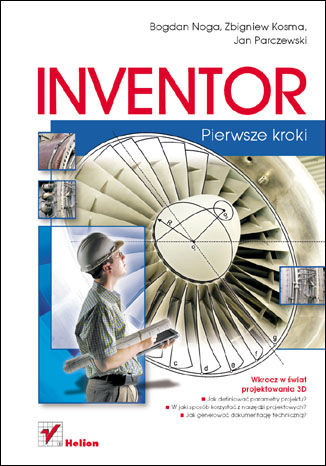
Bogdan Noga, Zbigniew Kosma, Jan Parczewski
Książka opisuje Inventor v. 2009 Wkrocz w świat projektowania 3D Jak definiować parametry projektu? W jaki sposób korzystać z narzędzi projektowych? Jak generować dokumentację techniczną? Inventor, opracowany i sprzedawany przez firmę Autodesk, to program typu CAD, pozwalający na zamodelowanie projektowanego urządzenia lub elementu w postaci bryły trójwymiarowej. W oparciu o tak zamodelowaną bryłę Inventor umożliwia wygenerowanie pełnej dokumentacji projektowej -- rysunków wykonawczych i złożeniowych, wykazu części i innych. Aplikacja pozwala także na przeprowadzenie symulacji i analizy działania projektowanego urządzenia. "Inventor. Pierwsze kroki " to podręcznik dla wszystkich osób, które chcą poznać możliwości tej aplikacji i wykorzystać je w swojej pracy. Książka opisuje proces instalacji i konfiguracji programu oraz definiowania parametrów projektu. Pokazuje także kolejne kroki jego realizacji. Przeczytasz w niej o tworzeniu szkiców, definiowaniu wiązań, generowaniu modeli bryłowych i tworzeniu zespołów. Dowiesz się także, w jaki sposób wygenerować dokumentację techniczną w oparciu o gotowy model oraz jak zaprezentować elementy projektu w postaci animacji trójwymiarowej. Instalacja Inventora Konfiguracja interfejsu użytkownika Praca z oknami dialogowymi Tworzenie szkiców i wiązań Edycja obiektów graficznych Tworzenie brył trójwymiarowych Łączenie elementów w zespoły Tworzenie dokumentacji technicznej Prezentacja zespołów Zrealizuj swoje wizje za pomocą Inventora!