
Informatyka
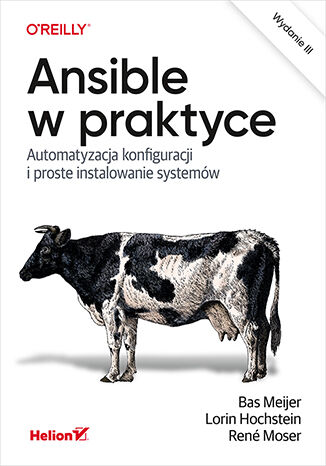
Ansible w praktyce. Automatyzacja konfiguracji i proste instalowanie systemów. Wydanie III
Bas Meijer, Lorin Hochstein, René Moser
Ansible służy do automatyzacji wdrożeń oprogramowania i zarządzania jego konfiguracjami. Inżynierowie cenią ten framework za minimalne rozmiary, brak konieczności instalowania czegokolwiek na serwerach i prostotę użytkowania. Oferuje on proste i bardzo przydatne funkcje przeznaczone do automatyzacji wielowarstwowych środowisk, przydaje się też do obsługi ciągłej integracji i ciągłego wdrażania oprogramowania (CI/CD) bez żadnego przestoju. Może służyć do różnych celów: przygotowania infrastruktury jako kodu, wdrożeń aplikacji czy automatyzacji codziennych, czasochłonnych zadań administracyjnych. Ta książka jest przeznaczona dla programistów i administratorów, którzy poszukują wydajnej metody zarządzania systemami. Pokazano w niej, w jaki sposób działa Ansible i jak należy przygotować go do pracy. Omówiono sposoby tworzenia scenariuszy (są to skrypty do zarządzania konfiguracją), zasady zarządzania zewnętrznymi serwerami, a także zaprezentowano najciekawsze funkcjonalności tego oprogramowania: wbudowane deklaratywne moduły . W tym wydaniu uwzględniono zmiany wynikające z dynamicznego rozwoju Ansible, dodano też kilka rozdziałów poświęconych kontenerom, platformie Molecule, kolekcjom Ansible, obrazom i infrastrukturze chmurowej. Wszystkie kody zostały zaktualizowane, a całość została wzbogacona o praktyczne wskazówki dotyczące dobrych praktyk programistycznych na platformach do weryfikowania kodu. W książce: zarządzanie konfiguracją i wdrożeniami systemów za pomocą Ansible dobre praktyki pracy z Ansible formaty kolekcji, moduły i wtyczki generowanie obrazów kontenerów i instancji chmurowych tworzenie infrastruktury chmurowej automatyzacja procesów CI/CD w środowisku programistycznym platforma Ansible Automation w metodyce DevOps Minimalne rozmiary, prostota i wyjątkowa skuteczność — poznaj Ansible!
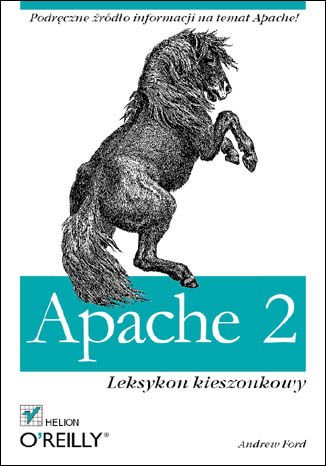
Apache 2. Leksykon kieszonkowy
Andrew Ford
Podręczne źródło informacji na temat Apache! Jak wykorzystać mechanizm mod_rewrite? Jak kontrolować dostęp do zasobów? Jak stosować bezpieczny protokół SSL? Apache jest jednym z najpopularniejszych serwerów HTTP. Jego zalety to niezawodność, wydajność i elastyczność. Można go uruchomić praktycznie w dowolnym systemie. Istotny jest również fakt, że Apache to rozwiązanie całkowicie bezpłatne! Pierwsza oficjalna wersja tego serwera ukazała się w 1995 roku. Oznaczono ją numerem 0.6.2. Po blisko piętnastu latach rozwiązanie to zyskało ogromną rzeszę użytkowników. Społeczność związana z tym narzędziem jest niezwykle chętna do pomocy, co niewątpliwie stanowi jeszcze jeden niezmiernie ważny atut, przemawiający na korzyść Apache. Niniejszy leksykon jest świetną pozycją dla tych osób, które miały już styczność z serwerem Apache lub chcą szybko opanować konkretne zagadnienia związane z jego konfiguracją. Dzięki tej książce poznasz wszystkie dyrektywy, które mogą być przydatne w codziennej pracy. Dowiesz się, jak skonfigurować środowisko serwera, oraz poznasz zasady odwzorowywania adresów URL. Ponadto nauczysz się zapewniać odpowiednią kontrolę dostępu do poszczególnych zasobów i korzystać z takich mechanizmów, jak filtry, metadane lub procedury obsługi. Wiele cennych informacji, zawartych w tej poręcznej książce, sprawi, że codzienna praca z serwerem Apache będzie dla Ciebie przyjemnością! Ogólne zagadnienia związane z pracą i konfiguracją Apache Konfiguracja wirtualnych hostów (VirtualHost) Zarządzanie procesami Odwzorowanie adresów URL Przekształcanie adresów z wykorzystaniem mod_rewrite Kontrola dostępu Uwierzytelnianie z użyciem mechanizmów HTTP Basic, HTTP Digest Zastosowanie metadanych dokumentów Manipulowanie nagłówkami HTTP Wykorzystanie skryptów CGI Zastosowanie WebDAV Używanie filtrów Buforowanie treści Konfiguracja i wykorzystanie bezpiecznego protokołu SSL Logowanie zdarzeń Skonfiguruj Apache zgodnie ze swoimi potrzebami!
Nitin Padalia
Apache Cassandra Essentials takes you step-by-step from from the basics of installation to advanced installation options and database design techniques. It gives you all the information you need to effectively design a well distributed and high performance database. You’ll get to know about the steps that are performed by a Cassandra node when you execute a read/write query, which is essential to properly maintain of a Cassandra cluster and to debug any issues. Next, you’ll discover how to integrate a Cassandra driver in your applications and perform read/write operations. Finally, you’ll learn about the various tools provided by Cassandra for serviceability aspects such as logging, metrics, backup, and recovery.
Steve Hoffman, Steven Hoffman, Kevin A. McGrail
Apache Flume is a distributed, reliable, and available service for efficiently collecting, aggregating, and moving large amounts of log data. Its main goal is to deliver data from applications to Apache Hadoop's HDFS. It has a simple and flexible architecture based on streaming data flows. It is robust and fault tolerant with many failover and recovery mechanisms.Apache Flume: Distributed Log Collection for Hadoop covers problems with HDFS and streaming data/logs, and how Flume can resolve these problems. This book explains the generalized architecture of Flume, which includes moving data to/from databases, NO-SQL-ish data stores, as well as optimizing performance. This book includes real-world scenarios on Flume implementation.Apache Flume: Distributed Log Collection for Hadoop starts with an architectural overview of Flume and then discusses each component in detail. It guides you through the complete installation process and compilation of Flume.It will give you a heads-up on how to use channels and channel selectors. For each architectural component (Sources, Channels, Sinks, Channel Processors, Sink Groups, and so on) the various implementations will be covered in detail along with configuration options. You can use it to customize Flume to your specific needs. There are pointers given on writing custom implementations as well that would help you learn and implement them.By the end, you should be able to construct a series of Flume agents to transport your streaming data and logs from your systems into Hadoop in near real time.
Apache Hadoop 3 Quick Start Guide. Learn about big data processing and analytics
Hrishikesh Vijay Karambelkar
Apache Hadoop is a widely used distributed data platform. It enables large datasets to be efficiently processed instead of using one large computer to store and process the data. This book will get you started with the Hadoop ecosystem, and introduce you to the main technical topics, including MapReduce, YARN, and HDFS.The book begins with an overview of big data and Apache Hadoop. Then, you will set up a pseudo Hadoop development environment and a multi-node enterprise Hadoop cluster. You will see how the parallel programming paradigm, such as MapReduce, can solve many complex data processing problems.The book also covers the important aspects of the big data software development lifecycle, including quality assurance and control, performance, administration, and monitoring. You will then learn about the Hadoop ecosystem, and tools such as Kafka, Sqoop, Flume, Pig, Hive, and HBase. Finally, you will look at advanced topics, including real time streaming using Apache Storm, and data analytics using Apache Spark. By the end of the book, you will be well versed with different configurations of the Hadoop 3 cluster.
Hanish Bansal, Shrey Mehrotra, Saurabh Chauhan
Hive was developed by Facebook and later open sourced in Apache community. Hive provides SQL like interface to run queries on Big Data frameworks. Hive provides SQL like syntax also called as HiveQL that includes all SQL capabilities like analytical functions which are the need of the hour in today’s Big Data world.This book provides you easy installation steps with different types of metastores supported by Hive. This book has simple and easy to learn recipes for configuring Hive clients and services. You would also learn different Hive optimizations including Partitions and Bucketing. The book also covers the source code explanation of latest Hive version.Hive Query Language is being used by other frameworks including spark. Towards the end you will cover integration of Hive with these frameworks.
Apache Ignite Quick Start Guide. Distributed data caching and processing made easy
Sujoy Acharya
Apache Ignite is a distributed in-memory platform designed to scale and process large volume of data. It can be integrated with microservices as well as monolithic systems, and can be used as a scalable, highly available and performant deployment platform for microservices. This book will teach you to use Apache Ignite for building a high-performance, scalable, highly available system architecture with data integrity.The book takes you through the basics of Apache Ignite and in-memory technologies. You will learn about installation and clustering Ignite nodes, caching topologies, and various caching strategies, such as cache aside, read and write through, and write behind. Next, you will delve into detailed aspects of Ignite’s data grid: web session clustering and querying data.You will learn how to process large volumes of data using compute grid and Ignite’s map-reduce and executor service. You will learn about the memory architecture of Apache Ignite and monitoring memory and caches. You will use Ignite for complex event processing, event streaming, and the time-series predictions of opportunities and threats. Additionally, you will go through off-heap and on-heap caching, swapping, and native and Spring framework integration with Apache Ignite.By the end of this book, you will be confident with all the features of Apache Ignite 2.x that can be used to build a high-performance system architecture.
Apache Mesos Cookbook. Efficiently handle and manage tasks in a distributed environment
David Blomquist, Tomasz Janiszewski
Apache Mesos is open source cluster sharing and management software. Deploying and managing scalable applications in large-scale clustered environments can be difficult, but Apache Mesos makes it easier with efficient resource isolation and sharing across application frameworks.The goal of this book is to guide you through the practical implementation of the Mesos core along with a number of Mesos supported frameworks. You will begin by installing Mesos and then learn how to configure clusters and maintain them. You will also see how to deploy a cluster in a production environment with high availability using Zookeeper.Next, you will get to grips with using Mesos, Marathon, and Docker to build and deploy a PaaS. You will see how to schedule jobs with Chronos. We’ll demonstrate how to integrate Mesos with big data frameworks such as Spark, Hadoop, and Storm. Practical solutions backed with clear examples will also show you how to deploy elastic big data jobs. You will find out how to deploy a scalable continuous integration and delivery system on Mesos with Jenkins. Finally, you will configure and deploy a highly scalable distributed search engine with ElasticSearch.Throughout the course of this book, you will get to know tips and tricks along with best practices to follow when working with Mesos.
Apache Mesos Cookbook. Efficiently handle and manage tasks in a distributed environment
David Blomquist, Tomasz Janiszewski
Apache Mesos is open source cluster sharing and management software. Deploying and managing scalable applications in large-scale clustered environments can be difficult, but Apache Mesos makes it easier with efficient resource isolation and sharing across application frameworks.The goal of this book is to guide you through the practical implementation of the Mesos core along with a number of Mesos supported frameworks. You will begin by installing Mesos and then learn how to configure clusters and maintain them. You will also see how to deploy a cluster in a production environment with high availability using Zookeeper.Next, you will get to grips with using Mesos, Marathon, and Docker to build and deploy a PaaS. You will see how to schedule jobs with Chronos. We’ll demonstrate how to integrate Mesos with big data frameworks such as Spark, Hadoop, and Storm. Practical solutions backed with clear examples will also show you how to deploy elastic big data jobs. You will find out how to deploy a scalable continuous integration and delivery system on Mesos with Jenkins. Finally, you will configure and deploy a highly scalable distributed search engine with ElasticSearch.Throughout the course of this book, you will get to know tips and tricks along with best practices to follow when working with Mesos.
Apache Mesos Cookbook. Efficiently handle and manage tasks in a distributed environment
David Blomquist, Tomasz Janiszewski
Apache Mesos is open source cluster sharing and management software. Deploying and managing scalable applications in large-scale clustered environments can be difficult, but Apache Mesos makes it easier with efficient resource isolation and sharing across application frameworks.The goal of this book is to guide you through the practical implementation of the Mesos core along with a number of Mesos supported frameworks. You will begin by installing Mesos and then learn how to configure clusters and maintain them. You will also see how to deploy a cluster in a production environment with high availability using Zookeeper.Next, you will get to grips with using Mesos, Marathon, and Docker to build and deploy a PaaS. You will see how to schedule jobs with Chronos. We’ll demonstrate how to integrate Mesos with big data frameworks such as Spark, Hadoop, and Storm. Practical solutions backed with clear examples will also show you how to deploy elastic big data jobs. You will find out how to deploy a scalable continuous integration and delivery system on Mesos with Jenkins. Finally, you will configure and deploy a highly scalable distributed search engine with ElasticSearch.Throughout the course of this book, you will get to know tips and tricks along with best practices to follow when working with Mesos.