
Informatyka
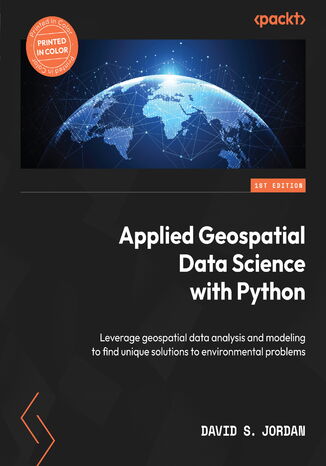
David S. Jordan
Data scientists, when presented with a myriad of data, can often lose sight of how to present geospatial analyses in a meaningful way so that it makes sense to everyone. Using Python to visualize data helps stakeholders in less technical roles to understand the problem and seek solutions. The goal of this book is to help data scientists and GIS professionals learn and implement geospatial data science workflows using Python.Throughout this book, you’ll uncover numerous geospatial Python libraries with which you can develop end-to-end spatial data science workflows. You’ll learn how to read, process, and manipulate spatial data effectively. With data in hand, you’ll move on to crafting spatial data visualizations to better understand and tell the story of your data through static and dynamic mapping applications. As you progress through the book, you’ll find yourself developing geospatial AI and ML models focused on clustering, regression, and optimization. The use cases can be leveraged as building blocks for more advanced work in a variety of industries.By the end of the book, you’ll be able to tackle random data, find meaningful correlations, and make geospatial data models.
Mani Khanuja, Farooq Sabir , Shreyas Subramanian,...
Machine learning (ML) and high-performance computing (HPC) on AWS run compute-intensive workloads across industries and emerging applications. Its use cases can be linked to various verticals, such as computational fluid dynamics (CFD), genomics, and autonomous vehicles.This book provides end-to-end guidance, starting with HPC concepts for storage and networking. It then progresses to working examples on how to process large datasets using SageMaker Studio and EMR. Next, you’ll learn how to build, train, and deploy large models using distributed training. Later chapters also guide you through deploying models to edge devices using SageMaker and IoT Greengrass, and performance optimization of ML models, for low latency use cases.By the end of this book, you’ll be able to build, train, and deploy your own large-scale ML application, using HPC on AWS, following industry best practices and addressing the key pain points encountered in the application life cycle.
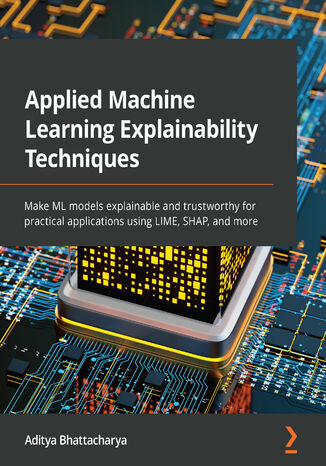
Aditya Bhattacharya
Explainable AI (XAI) is an emerging field that brings artificial intelligence (AI) closer to non-technical end users. XAI makes machine learning (ML) models transparent and trustworthy along with promoting AI adoption for industrial and research use cases.Applied Machine Learning Explainability Techniques comes with a unique blend of industrial and academic research perspectives to help you acquire practical XAI skills. You'll begin by gaining a conceptual understanding of XAI and why it's so important in AI. Next, you'll get the practical experience needed to utilize XAI in AI/ML problem-solving processes using state-of-the-art methods and frameworks. Finally, you'll get the essential guidelines needed to take your XAI journey to the next level and bridge the existing gaps between AI and end users.By the end of this ML book, you'll be equipped with best practices in the AI/ML life cycle and will be able to implement XAI methods and approaches using Python to solve industrial problems, successfully addressing key pain points encountered.
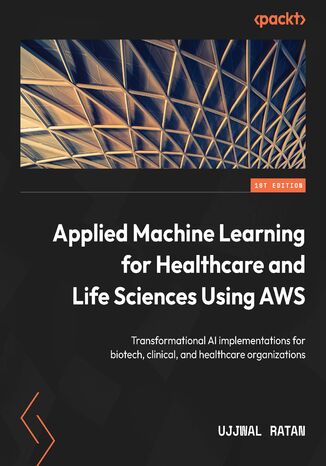
Ujjwal Ratan
While machine learning is not new, it's only now that we are beginning to uncover its true potential in the healthcare and life sciences industry. The availability of real-world datasets and access to better compute resources have helped researchers invent applications that utilize known AI techniques in every segment of this industry, such as providers, payers, drug discovery, and genomics.This book starts by summarizing the introductory concepts of machine learning and AWS machine learning services. You’ll then go through chapters dedicated to each segment of the healthcare and life sciences industry. Each of these chapters has three key purposes -- First, to introduce each segment of the industry, its challenges, and the applications of machine learning relevant to that segment. Second, to help you get to grips with the features of the services available in the AWS machine learning stack like Amazon SageMaker and Amazon Comprehend Medical. Third, to enable you to apply your new skills to create an ML-driven solution to solve problems particular to that segment. The concluding chapters outline future industry trends and applications.By the end of this book, you’ll be aware of key challenges faced in applying AI to healthcare and life sciences industry and learn how to address those challenges with confidence.
Applied Network Security. Proven tactics to detect and defend against all kinds of network attack
Warun Levesque, Arthur Salmon, Michael McLafferty
Computer networks are increasing at an exponential rate and the most challenging factor organisations are currently facing is network security. Breaching a network is not considered an ingenious effort anymore, so it is very important to gain expertise in securing your network.The book begins by showing you how to identify malicious network behaviour and improve your wireless security. We will teach you what network sniffing is, the various tools associated with it, and how to scan for vulnerable wireless networks. Then we’ll show you how attackers hide the payloads and bypass the victim’s antivirus. Furthermore, we’ll teach you how to spoof IP / MAC address and perform an SQL injection attack and prevent it on your website. We will create an evil twin and demonstrate how to intercept network traffic. Later, you will get familiar with Shodan and Intrusion Detection and will explore the features and tools associated with it. Toward the end, we cover tools such as Yardstick, Ubertooth, Wifi Pineapple, and Alfa used for wireless penetration testing and auditing. This book will show the tools and platform to ethically hack your own network whether it is for your business or for your personal home Wi-Fi.
Alok Malik, Bradford Tuckfield
Starting with the basics, Applied Unsupervised Learning with R explains clustering methods, distribution analysis, data encoders, and features of R that enable you to understand your data better and get answers to your most pressing business questions. This book begins with the most important and commonly used method for unsupervised learning - clustering - and explains the three main clustering algorithms - k-means, divisive, and agglomerative. Following this, you'll study market basket analysis, kernel density estimation, principal component analysis, and anomaly detection. You'll be introduced to these methods using code written in R, with further instructions on how to work with, edit, and improve R code. To help you gain a practical understanding, the book also features useful tips on applying these methods to real business problems, including market segmentation and fraud detection. By working through interesting activities, you'll explore data encoders and latent variable models. By the end of this book, you will have a better understanding of different anomaly detection methods, such as outlier detection, Mahalanobis distances, and contextual and collective anomaly detection.
Siva Ravada, Simon Greener
Spatial applications should be developed in the same way that users develop other database applications: by starting with an integrated data model in which the SDO_GEOMETRY objects are just another attribute describing entities and by using as many of the database features as possible for managing the data. If a task can be done using a database feature like replication, then it should be done using the standard replication technology instead of inventing a new procedure for replicating spatial data. Sometimes solving a business problem using a PL/SQL function can be more powerful, accessible, and easier to use than trying to use external software. Because Oracle Spatial's offerings are standards compliant, this book shows you how Oracle Spatial technology can be used to build cross-vendor database solutions. Applying and Extending Oracle Spatial shows you the clever things that can be done not just with Oracle Spatial on its own, but in combination with other database technologies. This is a great resource book that will convince you to purchase other Oracle technology books on non-spatial specialist technologies because you will finally see that spatial is not special: it is a small, fun, and clever part of a much larger whole.
Mercury Learning and Information, Paul Boudreau
Artificial intelligence is reshaping the way projects are managed, offering unprecedented opportunities to improve efficiency, accuracy, and outcomes. This course begins with an introduction to AI’s role in project management, exploring how machine learning, natural language processing, and predictive algorithms can transform traditional approaches. You’ll learn about the key components of AI-driven projects and how to develop a strong business case for adopting these innovations.As you progress, the course delves into practical applications of AI in automating project tasks, analyzing data, and predicting results. Participants will gain hands-on experience with tools that leverage machine learning to forecast project success, improve productivity, and resolve potential failures. Additionally, you’ll discover how generative AI and large language models can enhance communication, planning, and decision-making throughout the project lifecycle.Finally, the course examines the broader implications of integrating AI into project management. You’ll explore strategies for acquiring AI solutions, implementing them within teams, and navigating the ethical challenges they present. By the end of the course, participants will have a clear understanding of how to leverage AI to optimize projects and stay competitive in a rapidly evolving technological landscape.