
Informatyka
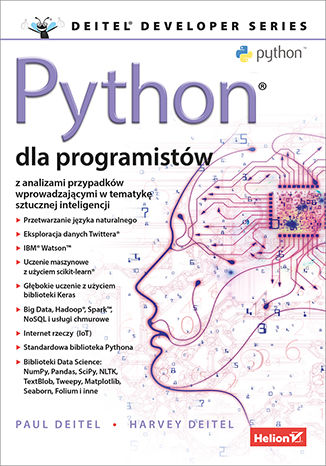
Python dla programistów. Big Data i AI. Studia przypadków
Paul J. Deitel, Harvey Deitel
Programiści lubią Pythona. Ujmuje ich wyrazistość, zwięzłość i interaktywność kodu, a także bogata kolekcja narzędzi i bibliotek. Zalety te są uzupełniane przez rozwój innych technologii, zwiększającą się dostępność coraz szybszego sprzętu oraz rosnącą przepustowość internetu. Z kolei to wszystko wiąże się z powstawaniem niewyobrażalnych ilości danych, które trzeba magazynować i efektywnie przetwarzać. Większość innowacji w świecie informatyki koncentruje się wokół danych. A z tymi zadaniami można sobie poradzić dzięki imponującym możliwościom Pythona i jego bibliotek. Ta książka ułatwi naukę Pythona metodą analizy i eksperymentów. Zawiera ponad 500 przykładów faktycznie wykorzystywanego kodu - od krótkich bloków po kompletne studia przypadków. Pokazano, w jaki sposób można kodować w interpreterze IPython i notatnikach Jupytera. Znalazł się tu obszerny opis Pythona oraz jego instrukcji sterujących i funkcji, omówiono pracę na plikach, kwestie serializacji w notacji JSON i obsługę wyjątków. Zaprezentowano różne paradygmaty programowania: proceduralnego, w stylu funkcyjnym i zorientowanego obiektowo. Sporo miejsca poświęcono bibliotekom: standardowej bibliotece Pythona i bibliotekom data science do realizacji złożonych zadań przy minimalnym udziale kodowania. Nie zabrakło wprowadzenia do takich zagadnień data science jak sztuczna inteligencja, symulacje, animacje czy przygotowanie danych do analizy. W książce między innymi: przetwarzanie języka naturalnego IBM stosowanie bibliotek scikit-learn i Keras big data, Hadoop(R), Spark™, NoSQL i usługi chmurowe programowanie dla internetu rzeczy (IoT) biblioteki: standardowa, NumPy, Pandas, SciPy, NLTK, YexyBlob, Tweepy, Matplotlib i inne
Python Essentials for AWS Cloud Developers. Run and deploy cloud-based Python applications using AWS
Serkan Sakinmaz
AWS provides a vast variety of services for implementing Python applications, which can pose a challenge for those without an AWS background. This book addresses one of the more predominant problems of choosing the right service and stepping into the implementation of exciting Python apps using AWS.The book begins by showing you how to install Python and create an AWS account, before helping you explore AWS Lambda, EC2, Elastic Beanstalk, and S3 for Python programming. You'll then gain hands-on experience in using these services to build the Python application. As you advance, you'll discover how to debug Python apps using PyCharm, and then start deploying the Python applications on Elastic Beanstalk. You’ll also learn how to monitor Python applications using the CloudWatch service, along with creating and publishing APIs on AWS to access the Python application. The concluding chapters will help you get to grips with storing unstructured and semi-structured data using NoSQL and DynamoDB, as well as advance your knowledge using the Glue serverless data integration service in AWS.By the end of this Python book, you’ll be able to take your application development skills up a notch with AWS services and advance in your career.
Soledad Galli
Feature engineering, the process of transforming variables and creating features, albeit time-consuming, ensures that your machine learning models perform seamlessly. This second edition of Python Feature Engineering Cookbook will take the struggle out of feature engineering by showing you how to use open source Python libraries to accelerate the process via a plethora of practical, hands-on recipes.This updated edition begins by addressing fundamental data challenges such as missing data and categorical values, before moving on to strategies for dealing with skewed distributions and outliers. The concluding chapters show you how to develop new features from various types of data, including text, time series, and relational databases. With the help of numerous open source Python libraries, you'll learn how to implement each feature engineering method in a performant, reproducible, and elegant manner.By the end of this Python book, you will have the tools and expertise needed to confidently build end-to-end and reproducible feature engineering pipelines that can be deployed into production.
Oliver Theobald
This book provides a thorough introduction to Python, starting with basic operations like arithmetic and variable creation. As you progress, you'll delve into more complex topics such as loops, conditionals, functions, and object-oriented programming. By the end, you'll be able to write Python code and use libraries like Pandas to manipulate data efficiently. Practical challenges and exercises help solidify your learning. It’s designed to be engaging and easy to follow, making the Python learning experience as enjoyable as it is informative. As you build your skills, you will also gain hands-on experience by tackling coding exercises that reinforce each concept. Whether you're new to programming or looking to sharpen your Python skills, this book will guide you through every essential aspect of the language, preparing you for real-world applications.
Mercury Learning and Information, Oswald Campesato
This book is designed for developers with little to no experience in Python or Pandas, providing a fast-paced introduction to Python programming and practical solutions to various tasks. The journey begins with a quick tour of basic Python 3, followed by a deep dive into loops and conditional logic. The text covers data structures extensively, and includes tasks involving strings and arrays.As the reader progresses, object-oriented programming concepts are introduced with illustrative code samples, along with an exploration of recursion and fundamental topics in combinatorics. An appendix provides an introduction to Pandas, equipping readers with essential tools for data manipulation and analysis.This book offers a comprehensive yet concise learning path, reinforced by numerous code samples and companion files available for download. It is an invaluable resource for beginners seeking to master Python and Pandas, providing a solid foundation for further exploration in programming and data science.
Ryan Marvin, Mark Nganga, Amos Omondi
After a brief history of Python and key differences between Python 2 and Python 3, you'll understand how Python has been used in applications such as YouTube and Google App Engine. As you work with the language, you'll learn about control statements, delve into controlling program flow and gradually work on more structured programs via functions.As you settle into the Python ecosystem, you'll learn about data structures and study ways to correctly store and represent information. By working through specific examples, you'll learn how Python implements object-oriented programming (OOP) concepts of abstraction, encapsulation of data, inheritance, and polymorphism. You'll be given an overview of how imports, modules, and packages work in Python, how you can handle errors to prevent apps from crashing, as well as file manipulation.By the end of this book, you'll have built up an impressive portfolio of projects and armed yourself with the skills you need to tackle Python projects in the real world.
Erik Westra
Geospatial development links your data to locations on the surface of the Earth. Writing geospatial programs involves tasks such as grouping data by location, storing and analyzing large amounts of spatial information, performing complex geospatial calculations, and drawing colorful interactive maps. In order to do this well, you’ll need appropriate tools and techniques, as well as a thorough understanding of geospatial concepts such as map projections, datums, and coordinate systems.This book provides an overview of the major geospatial concepts, data sources, and toolkits. It starts by showing you how to store and access spatial data using Python, how to perform a range of spatial calculations, and how to store spatial data in a database. Further on, the book teaches you how to build your own slippy map interface within a web application, and finishes with the detailed construction of a geospatial data editor using the GeoDjango framework. By the end of this book, you will be able to confidently use Python to write your own geospatial applications ranging from quick, one-off utilities to sophisticated web-based applications using maps and other geospatial data.