
Informatyka
Zajrzyj do kategorii Informatyka w księgarni internetowej Ebookpoint. Znajdziesz tutaj bestsellerowe książki, ebooki i kursy video z branży IT. Sięgnij po najlepszą literaturę dla specjalistów i rozwijaj doświadczenie, które już posiadasz, lub rozpocznij swoją przygodę z programowaniem, cyberbezpieczeństwem lub grafiką komputerową. Pogłębiaj swoją wiedzę tak, jak Ci wygodnie - z tradycyjną książką, wygodnym ebookiem lub nowoczesnym videokursem. Sprawdź, jakie tytuły znajdziesz w kategorii Informatyka!
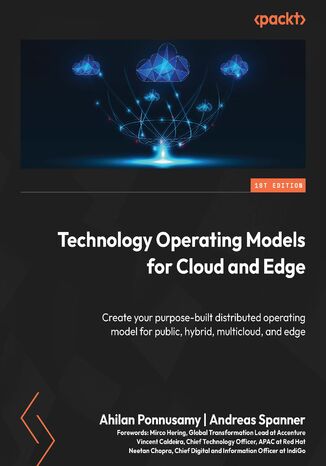
Ahilan Ponnusamy, Andreas Spanner, Mirco Hering, Vincent...
Cloud goals, such as faster time to market, lower total cost of ownership (TCO), capex reduction, self-service enablement, and complexity reduction are important, but organizations often struggle to achieve the desired outcomes. With edge computing gaining momentum across industries and making it possible to move workloads seamlessly between cloud and edge locations, organizations need working recipes to find ways of extracting the most value out of their cloud and edge estate.This book provides a practical way to build a strategy-aligned operating model while considering various related factors such as culture, leadership, team structures, metrics, intrinsic motivators, team incentives, tenant experience, platform engineering, operations, open source, and technology choices. Throughout the chapters, you’ll discover how single, hybrid, or multicloud architectures, security models, automation, application development, workload deployments, and application modernization can be reutilized for edge workloads to help you build a secure yet flexible technology operating model. The book also includes a case study which will walk you through the operating model build process in a step-by-step way.By the end of this book, you’ll be able to build your own fit-for-purpose distributed technology operating model for your organization in an open culture way.
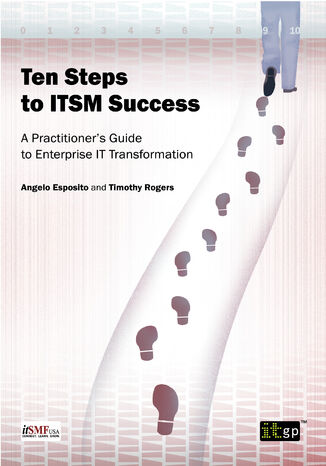
Ten Steps to ITSM Success. A Practitioner's Guide to Enterprise IT Transformation
IT Governance Publishing, Angelo Esposito, Timothy Rogers
This book provides a strategic framework for ITSM implementation, focusing on structured planning, role definition, process standardization, and ongoing performance assessments. With each chapter focusing on a critical aspect of ITSM, readers will gain the tools and knowledge needed to optimize service management practices and achieve long-term success. By the end of the book, IT leaders will understand how to build a robust ITSM program that aligns with business goals and drives continuous improvement.The book begins by setting the stage for ITSM implementation, helping readers assess the current state of services and plan their next steps. As the journey progresses, the book delves deeper into organizational changes, process development, and defining roles, ensuring that all stakeholders are aligned with the ITSM strategy.In the final chapters, the book focuses on deployment, continual improvement, and the importance of using metrics such as the balanced scorecard to ensure the ITSM framework is sustainable and continuously evolving. Readers will also learn how to handle operational sustainment and improve service delivery over time.
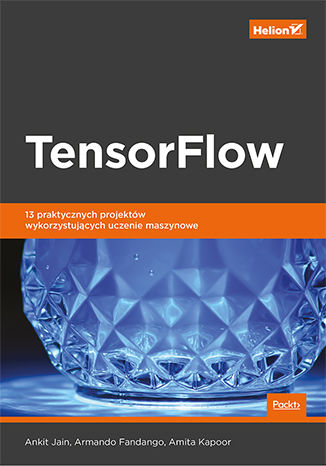
TensorFlow. 13 praktycznych projektów wykorzystujących uczenie maszynowe
Ankit Jain, Armando Fandango, Amita Kapoor
TensorFlow służy do projektowania i wdrażania zaawansowanych architektur głębokiego uczenia. Jego zaletami są prostota, wydajność i elastyczność. Umożliwia budowanie złożonych rozwiązań na bazie różnorodnych zbiorów danych. Co więcej, pozwala na stosowanie różnych technik uczenia nadzorowanego, nienadzorowanego oraz uczenia przez wzmacnianie. TensorFlow zmienił sposób postrzegania uczenia maszynowego. Dzięki temu środowisku każdy, kto chce uczynić z dużych zbiorów danych wiarygodne źródło wiedzy, może ten cel osiągnąć - niezależnie od tego, czy jest analitykiem danych, naukowcem, projektantem, czy pasjonatem metod sztucznej inteligencji. To książka przeznaczona dla osób, które chcą nauczyć się tworzyć całościowe rozwiązania z wykorzystaniem uczenia maszynowego. Poszczególne zagadnienia zilustrowano trzynastoma praktycznymi projektami, w których wykorzystano między innymi analizy sentymentów, przetwarzanie języka naturalnego, systemy rekomendacyjne, generatywne sieci kontradyktoryjne czy sieci kapsułowe. Pokazano, w jaki sposób używać TensorFlow z interfejsem APO Spark i wspomagać obliczenia układami GPU. Przedstawiono zastosowanie rozkładu macierzy (SVD++), modeli rankingowych i odmian splotowej sieci neuronowej. Nie zabrakło prezentacji nowych rozwiązań o dużym potencjale, takich jak sieci DiscoGAN. Dołączony do książki kod źródłowy, liczne wskazówki i porady pozwolą na płynne rozpoczęcie pracy z TensorFlow oraz innymi narzędziami do budowy sieci neuronowych. W tej książce między innymi: podstawy pracy z TensorFlow wykorzystanie TensorFlow do wizualizacji sieci neuronowych zastosowanie procesu gaussowskiego do prognozowania cen akcji wykrywanie oszukańczych transakcji za pomocą TensorFlow i Keras implementacja sieci kapsułowych w TensorFlow techniki uczenia przez wzmacnianie TensorFlow: prostota, wydajność i imponujący potencjał!
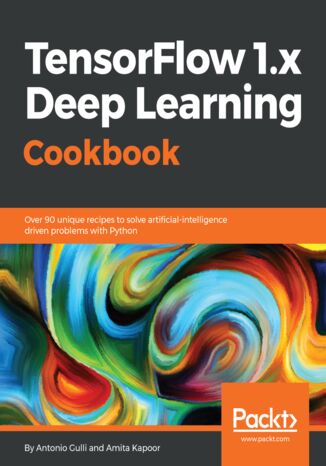
Antonio Gulli, Amita Kapoor
Deep neural networks (DNNs) have achieved a lot of success in the field of computer vision, speech recognition, and natural language processing. This exciting recipe-based guide will take you from the realm of DNN theory to implementing them practically to solve real-life problems in the artificial intelligence domain.In this book, you will learn how to efficiently use TensorFlow, Google’s open source framework for deep learning. You will implement different deep learning networks, such as Convolutional Neural Networks (CNNs), Recurrent Neural Networks (RNNs), Deep Q-learning Networks (DQNs), and Generative Adversarial Networks (GANs), with easy-to-follow standalone recipes. You will learn how to use TensorFlow with Keras as the backend. You will learn how different DNNs perform onsome popularly used datasets, such as MNIST, CIFAR-10, and Youtube8m. You will not only learn about the different mobile and embedded platforms supported by TensorFlow, but also how to set up cloud platforms for deep learning applications. You will also get a sneak peek at TPU architecture and how it will affect the future of DNNs.By using crisp, no-nonsense recipes, you will become an expert in implementing deep learning techniques in growing real-world applications and research areas such as reinforcement learning,GANs, and autoencoders.
Abhishek Thakur, Alberto Boschetti, Luca Massaron, Alexey...
TensorFlow is one of the most popular frameworks used for machine learning and, more recently, deep learning. It provides a fast and efficient framework for training different kinds of deep learning models, with very high accuracy. This book is your guide to master deep learning with TensorFlow with the help of 10 real-world projects.TensorFlow Deep Learning Projects starts with setting up the right TensorFlow environment for deep learning. You'll learn how to train different types of deep learning models using TensorFlow, including Convolutional Neural Networks, Recurrent Neural Networks, LSTMs, and Generative Adversarial Networks. While doing this, you will build end-to-end deep learning solutions to tackle different real-world problems in image processing, recommendation systems, stock prediction, and building chatbots, to name a few. You will also develop systems that perform machine translation and use reinforcement learning techniques to play games.By the end of this book, you will have mastered all the concepts of deep learning and their implementation with TensorFlow, and will be able to build and train your own deep learning models with TensorFlow confidently.
Nick McClure
TensorFlow is an open source software library for Machine Intelligence. The independent recipes in this book will teach you how to use TensorFlow for complex data computations and will let you dig deeper and gain more insights into your data than ever before. You’ll work through recipes on training models, model evaluation, sentiment analysis, regression analysis, clustering analysis, artificial neural networks, and deep learning – each using Google’s machine learning library TensorFlow.This guide starts with the fundamentals of the TensorFlow library which includes variables, matrices, and various data sources. Moving ahead, you will get hands-on experience with Linear Regression techniques with TensorFlow. The next chapters cover important high-level concepts such as neural networks, CNN, RNN, and NLP. Once you are familiar and comfortable with the TensorFlow ecosystem, the last chapter will show you how to take it to production.
Nick McClure
TensorFlow is an open source software library for Machine Intelligence. The independent recipes in this book will teach you how to use TensorFlow for complex data computations and allow you to dig deeper and gain more insights into your data than ever before. With the help of this book, you will work with recipes for training models, model evaluation, sentiment analysis, regression analysis, clustering analysis, artificial neural networks, and more. You will explore RNNs, CNNs, GANs, reinforcement learning, and capsule networks, each using Google's machine learning library, TensorFlow. Through real-world examples, you will get hands-on experience with linear regression techniques with TensorFlow. Once you are familiar and comfortable with the TensorFlow ecosystem, you will be shown how to take it to production.By the end of the book, you will be proficient in the field of machine intelligence using TensorFlow. You will also have good insight into deep learning and be capable of implementing machine learning algorithms in real-world scenarios.
Ankit Jain, Armando Fandango, Amita Kapoor
TensorFlow has transformed the way machine learning is perceived. TensorFlow Machine Learning Projects teaches you how to exploit the benefits—simplicity, efficiency, and flexibility—of using TensorFlow in various real-world projects. With the help of this book, you’ll not only learn how to build advanced projects using different datasets but also be able to tackle common challenges using a range of libraries from the TensorFlow ecosystem.To start with, you’ll get to grips with using TensorFlow for machine learning projects; you’ll explore a wide range of projects using TensorForest and TensorBoard for detecting exoplanets, TensorFlow.js for sentiment analysis, and TensorFlow Lite for digit classification.As you make your way through the book, you’ll build projects in various real-world domains, incorporating natural language processing (NLP), the Gaussian process, autoencoders, recommender systems, and Bayesian neural networks, along with trending areas such as Generative Adversarial Networks (GANs), capsule networks, and reinforcement learning. You’ll learn how to use the TensorFlow on Spark API and GPU-accelerated computing with TensorFlow to detect objects, followed by how to train and develop a recurrent neural network (RNN) model to generate book scripts.By the end of this book, you’ll have gained the required expertise to build full-fledged machine learning projects at work.