
Informatyka
Building Microservices with Go. Develop seamless, efficient, and robust microservices with Go
Nic Jackson
Microservice architecture is sweeping the world as the de facto pattern to build web-based applications. Golang is a language particularly well suited to building them. Its strong community, encouragement of idiomatic style, and statically-linked binary artifacts make integrating it with other technologies and managing microservices at scale consistent and intuitive. This book will teach you the common patterns and practices, showing you how to apply these using the Go programming language.It will teach you the fundamental concepts of architectural design and RESTful communication, and show you patterns that provide manageable code that is supportable in development and at scale in production. We will provide you with examples on how to put these concepts and patterns into practice with Go. Whether you are planning a new application or working in an existing monolith, this book will explain and illustrate with practical examples how teams of all sizes can start solving problems with microservices. It will help you understand Docker and Docker-Compose and how it can be used to isolate microservice dependencies and build environments. We finish off by showing you various techniques to monitor, test, and secure your microservices. By the end, you will know the benefits of system resilience of a microservice and the advantages of Go stack.
Gaurav Aroraa, Lalit Kale, Manish Kanwar
Microservices is an architectural style that promotes the development of complex applications as a suite of small services based on business capabilities. This book will help you identify the appropriate service boundaries within the business. We'll start by looking at what microservices are, and what the main characteristics are. Moving forward, you will be introduced to real-life application scenarios, and after assessing the current issues, we will begin the journey of transforming this application by splitting it into a suite of microservices. You will identify the service boundaries, split the application into multiple microservices, and define the service contracts. You will find out how to configure, deploy, and monitor microservices, and configure scaling to allow the application to quickly adapt to increased demand in the future.With an introduction to the reactive microservices, you strategically gain further value to keep your code base simple, focusing on what is more important rather than the messy asynchronous calls.
Daniel Kapexhiu
– Immerse yourself in the world of microservices with this guide to migration from a monolithic architecture to microservices. – With this book, you’ll acquire a deep understanding of microservices architecture and apply it confidently in your web application projects. – As you progress, you’ll be guided through the process of creating a simple application and incorporating the Node.js framework into it, along with its commonly used libraries. – You’ll learn how the framework operates, how to configure it, and how to develop handlers for the web framework and explore how to deploy your application to a production server. – Get to grips with the intricacies of JavaScript and Node.js and find out how to approach microservices in Node.js, implement them effectively, and integrate RESTful APIs. – Gain insights into service-to-service authentication and authorization and learn how to work with databases and caching, as well as with monitoring and logging in microservices with Node.js. – By the end of this microservices book, you’ll be able to develop a web app using the Node.js framework, configure it, extend it using libraries available for this framework, and launch it using best practices.
Daniel Kapexhiu
– Immerse yourself in the world of microservices with this guide to migration from a monolithic architecture to microservices. – With this book, you’ll acquire a deep understanding of microservices architecture and apply it confidently in your web application projects. – As you progress, you’ll be guided through the process of creating a simple application and incorporating the Node.js framework into it, along with its commonly used libraries. – You’ll learn how the framework operates, how to configure it, and how to develop handlers for the web framework and explore how to deploy your application to a production server. – Get to grips with the intricacies of JavaScript and Node.js and find out how to approach microservices in Node.js, implement them effectively, and integrate RESTful APIs. – Gain insights into service-to-service authentication and authorization and learn how to work with databases and caching, as well as with monitoring and logging in microservices with Node.js. – By the end of this microservices book, you’ll be able to develop a web app using the Node.js framework, configure it, extend it using libraries available for this framework, and launch it using best practices.
Dinesh Rajput, Rajesh R V
Getting Started with Spring Microservices begins with an overview of the Spring Framework 5.0, its design patterns, and its guidelines that enable you to implement responsive microservices at scale. You will learn how to use GoF patterns in application design. You will understand the dependency injection pattern, which is the main principle behind the decoupling process of the Spring Framework and makes it easier to manage your code. Then, you will learn how to use proxy patterns in aspect-oriented programming and remoting. Moving on, you will understand the JDBC template patterns and their use in abstracting database access. After understanding the basics, you will move on to more advanced topics, such as reactive streams and concurrency. Written to the latest specifications of Spring that focuses on Reactive Programming, the Learning Path teaches you how to build modern, internet-scale Java applications in no time. Next, you will understand how Spring Boot is used to deploying serverless autonomous services by removing the need to have a heavyweight application server. You’ll also explore ways to deploy your microservices to Docker and managing them with Mesos. By the end of this Learning Path, you will have the clarity and confidence for implementing microservices using Spring Framework.This Learning Path includes content from the following Packt products:• Spring 5 Microservices by Rajesh R V • Spring 5 Design Patterns by Dinesh Rajput
Dinesh Rajput, Rajesh R V
Getting Started with Spring Microservices begins with an overview of the Spring Framework 5.0, its design patterns, and its guidelines that enable you to implement responsive microservices at scale. You will learn how to use GoF patterns in application design. You will understand the dependency injection pattern, which is the main principle behind the decoupling process of the Spring Framework and makes it easier to manage your code. Then, you will learn how to use proxy patterns in aspect-oriented programming and remoting. Moving on, you will understand the JDBC template patterns and their use in abstracting database access. After understanding the basics, you will move on to more advanced topics, such as reactive streams and concurrency. Written to the latest specifications of Spring that focuses on Reactive Programming, the Learning Path teaches you how to build modern, internet-scale Java applications in no time. Next, you will understand how Spring Boot is used to deploying serverless autonomous services by removing the need to have a heavyweight application server. You’ll also explore ways to deploy your microservices to Docker and managing them with Mesos. By the end of this Learning Path, you will have the clarity and confidence for implementing microservices using Spring Framework.This Learning Path includes content from the following Packt products:• Spring 5 Microservices by Rajesh R V • Spring 5 Design Patterns by Dinesh Rajput
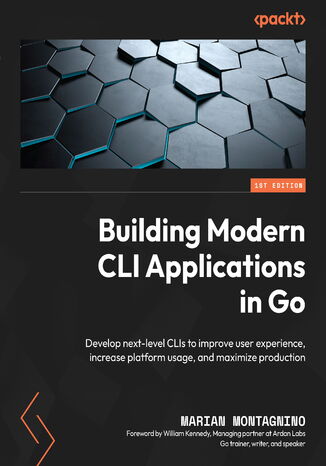
Marian Montagnino
Although graphical user interfaces (GUIs) are intuitive and user-friendly, nothing beats a command-line interface (CLI) when it comes to productivity. Many organizations settle for a GUI without searching for alternatives that offer better accessibility and functionality. If this describes your organization, then pick up this book and get them to rethink that decision.Building Modern CLI Applications in Go will help you achieve an interface that rivals a GUI in elegance yet surpasses it in high-performance execution. Through its practical, step-by-step approach, you’ll learn everything you need to harness the power and simplicity of the Go language to build CLI applications that revolutionize the way you work.After a primer on CLI standards and Go, you’ll be launched into tool design and proper framework use for true development proficiency. The book then moves on to all things CLI, helping you master everything from arguments and flags to errors and API calls. Later, you’ll dive into the nuances of empathic development so that you can ensure the best UX possible, before you finish up with build tags, cross-compilation, and container-based distribution.By the end of this UX book, you’ll be fully equipped to take the performance and flexibility of your organization’s applications to the next level.
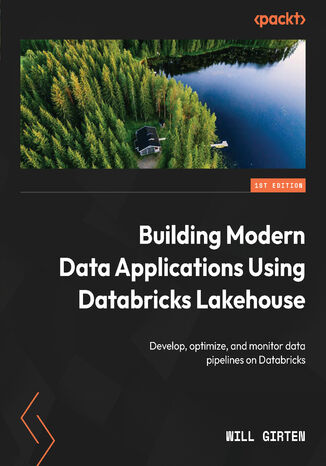
Will Girten
With so many tools to choose from in today’s data engineering development stack as well as operational complexity, this often overwhelms data engineers, causing them to spend less time gleaning value from their data and more time maintaining complex data pipelines. Guided by a lead specialist solutions architect at Databricks with 10+ years of experience in data and AI, this book shows you how the Delta Live Tables framework simplifies data pipeline development by allowing you to focus on defining input data sources, transformation logic, and output table destinations.This book gives you an overview of the Delta Lake format, the Databricks Data Intelligence Platform, and the Delta Live Tables framework. It teaches you how to apply data transformations by implementing the Databricks medallion architecture and continuously monitor the data quality of your pipelines. You’ll learn how to handle incoming data using the Databricks Auto Loader feature and automate real-time data processing using Databricks workflows. You’ll master how to recover from runtime errors automatically.By the end of this book, you’ll be able to build a real-time data pipeline from scratch using Delta Live Tables, leverage CI/CD tools to deploy data pipeline changes automatically across deployment environments, and monitor, control, and optimize cloud costs.
Ty Audronis
This book is for a wide range of individuals who are looking to shoot aerial footage with a multicopter. No previous flying experience is assumed, but even the most expert flyers will find unexpected and interesting information.
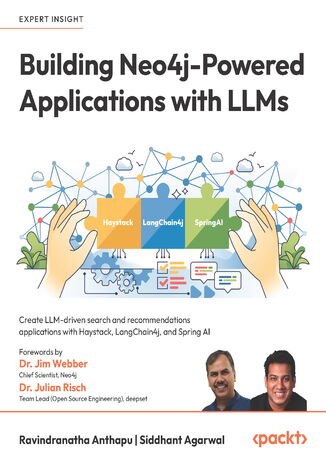
Ravindranatha Anthapu, Siddhant Agarwal, Dr. Jim Webber,...
Embark on an expert-led journey into building LLM-powered applications using Retrieval-Augmented Generation (RAG) and Neo4j knowledge graphs. Written by Ravindranatha Anthapu, Principal Consultant at Neo4j, and Siddhant Agrawal, a Google Developer Expert in GenAI, this comprehensive guide is your starting point for exploring alternatives to LangChain, covering frameworks such as Haystack, Spring AI, and LangChain4j.As LLMs (large language models) reshape how businesses interact with customers, this book helps you develop intelligent applications using RAG architecture and knowledge graphs, with a strong focus on overcoming one of AI’s most persistent challenges—mitigating hallucinations. You'll learn how to model and construct Neo4j knowledge graphs with Cypher to enhance the accuracy and relevance of LLM responses.Through real-world use cases like vector-powered search and personalized recommendations, the authors help you build hands-on experience with Neo4j GenAI integrations across Haystack and Spring AI. With access to a companion GitHub repository, you’ll work through code-heavy examples to confidently build and deploy GenAI apps on Google Cloud.By the end of this book, you’ll have the skills to ground LLMs with RAG and Neo4j, optimize graph performance, and strategically select the right cloud platform for your GenAI applications.
Ravindranatha Anthapu, Siddhant Agarwal, Dr. Jim Webber,...
Embark on an expert-led journey into building LLM-powered applications using Retrieval-Augmented Generation (RAG) and Neo4j knowledge graphs. Written by Ravindranatha Anthapu, Principal Consultant at Neo4j, and Siddhant Agrawal, a Google Developer Expert in GenAI, this comprehensive guide is your starting point for exploring alternatives to LangChain, covering frameworks such as Haystack, Spring AI, and LangChain4j.As LLMs (large language models) reshape how businesses interact with customers, this book helps you develop intelligent applications using RAG architecture and knowledge graphs, with a strong focus on overcoming one of AI’s most persistent challenges—mitigating hallucinations. You'll learn how to model and construct Neo4j knowledge graphs with Cypher to enhance the accuracy and relevance of LLM responses.Through real-world use cases like vector-powered search and personalized recommendations, the authors help you build hands-on experience with Neo4j GenAI integrations across Haystack and Spring AI. With access to a companion GitHub repository, you’ll work through code-heavy examples to confidently build and deploy GenAI apps on Google Cloud.By the end of this book, you’ll have the skills to ground LLMs with RAG and Neo4j, optimize graph performance, and strategically select the right cloud platform for your GenAI applications.