
Електронні книги
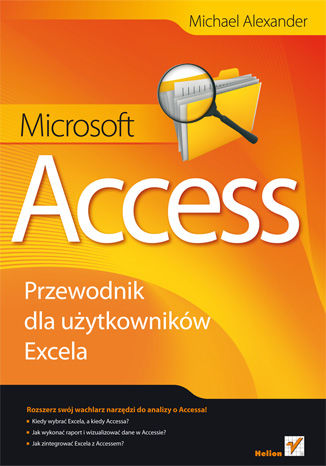
Microsoft Access. Przewodnik dla użytkowników Excela
Michael Alexander
Rozszerz swój wachlarz narzędzi do analizy o Accessa! Kiedy wybrać Excela, a kiedy Accessa? Jak wykonać raport i wizualizować dane w Accessie? Jak zintegrować Excel z Accessem? Excel to obok Worda najpopularniejsze narzędzie znajdujące się w pakiecie Microsoft Office. Narzędzie, bez którego nie wyobrażają sobie pracy analitycy, księgowi i prezesi firm. Dzięki ogromnym możliwościom oraz łatwości użycia znajduje on zastosowanie wszędzie tam, gdzie trzeba dokonać obliczeń na dużych ilościach danych. Czy Excel jest jednak lekarstwem na wszystko? Otóż nie! Pakiet Microsoft Office posiada w swych szeregach jeszcze jednego asa - program Access. Jeżeli zależy Ci na bezproblemowej współpracy kilku osób nad jednym zbiorem danych, jeżeli chcesz oddzielić wygląd raportu od danych, a w dodatku wymagasz skalowalności, Access może okazać się lepszym wyborem. Nie obawiaj się nowego! Dzięki tej książce błyskawicznie zapoznasz się ze środowiskiem, filozofią pracy oraz możliwościami Accessa. Książka odpowiada na wiele pytań, w tym na jedno kluczowe - kiedy lepszy jest Excel, a kiedy Access. Ponadto znajdziesz tu odpowiedzi na pytania dotyczące danych, ich struktur oraz metod analizy. Dowiesz się, jak korzystać z kwerend agregujących, funkcjonalnych oraz krzyżowych. Z pewnością zainteresują Cię również rozdziały poświęcone analizom warunkowym oraz tworzeniu raportów i wizualizacji danych w programie Access. Ostatni rozdział pozwoli Ci połączyć świat, który znasz - świat Excela, z tym, który poznałeś w trakcie lektury - światem Accessa. Integracja tych dwóch narzędzi zdejmie z Ciebie wszelkie ograniczenia w codziennej pracy z danymi o dowolnej wielkości i złożoności. Przekonaj się o tym sam! Trudny wybór - Access czy Excel Podstawy Accessa - tabele, teoria relacyjnych baz danych, kwerendy Kwerendy wybierające, funkcjonalne, usuwające, aktualizujące Wykorzystanie kwerend krzyżowych Transformacja danych za pomocą programu Access Wykonywanie obliczeń oraz przetwarzanie dat Analizy warunkowe Zastosowanie podkwerend i domenowych funkcji agregacji Statystyki opisowe w Accessie Planowanie zadań Wykorzystanie VBA do usprawnienia procesu analizy Tworzenie raportów w Accessie Wykorzystanie tabel i wykresów przestawnych Przenoszenie danych z Accessa do Excela Integracja Accessa z Excelem Tworzenie zapytań SQL Znasz Excel? Poznaj też Access - szybko i przyjemnie!
Bogdan Brinzarea, Cristian Darie
Microsoft AJAX Library Essentials is a practical reference for the client-side library of the ASP.NET AJAX Framework 1.0, and a tutorial for the underlying technologies and techniques required to use the library at its full potential. The main goal of this book is to get you comfortable with the Microsoft AJAX Library, a huge set of functions that can be used for developing powerful client-side functionality.Beginning with a hands-on tour of the basic technologies associated with AJAX, JavaScript, XMLHttpRequest, JSON, and the DOM, you'll move on to a crash course in the Microsoft AJAX tools. You will learn, through numerous step-by-step exercises, how to create basic AJAX applications, how the object-based programming model of JavaScript works, and how Microsoft AJAX Library extends this model. You'll understand the architecture of the Microsoft AJAX components, how they all fit together, and exactly what they can do for you. Then you will learn how to use the Microsoft AJAX Library in your web projects, and a detailed case study will walk you through creating your own customized client components. At every stage of your journey, you'll be able to try out examples to illuminate the theory, and consolidate your understanding. In addition to learning about the client and server controls, you'll also see how to handle errors and debug your AJAX applications.To complement your new found skills, the book ends with a visual reference of the Microsoft AJAX Library namespaces and classes, including diagrams and quick explanations for all the classes mentioned in the book, providing an invaluable reference you will turn to again and again.
Augusto Alvarez
Microsoft's Application Virtualization technology has been emerging as one of the main platforms in application virtualization. This is mainly because more and more organizations are thinking about application virtualization as a valid implementation; also because App-V represents probably the most attractive solution. App-V introduces a new and efficient way to improve operating systems and application life cycles in organizations. However, if we want to maximize our investment we must learn that every scenario and application differs from another, as does complexity.With Microsoft Application Virtualization Advanced Guide administrators will find detailed topics for understanding App-V components, architecture and implementation models; as well as step-by-step guidance to master App-V processes. There is also guidance on integrating App-V with other robust platforms like VDI, SCCM 2012 and even virtualizing server applications. Microsoft Application Virtualization Advanced Guide will start by giving readers the means to discover unfamiliar topics in App-V, as well as understanding App-V's architecture. By doing so, it will provide the baseline needed before shifting to advanced topics in App-V, like complex scenarios for sequencing and deploying applications. The book details scripting within App-V, as well as handling the platform using the command line; there is a complete review of troubleshooting installations, sequencing and deploying applications. Integration is another key component we will cover by introducing App-V in VDI and SCCM 2012. Server applications are not forgotten with Server App-V, using this book the reader will have a detailed understanding, with how-to steps to virtualize server applications.
James Preston
With an ever-increasing number of applications being deployed in the workplace, Microsoft App-V 5 enables administrators to abstract these applications from clients, in turn reducing the time taken to complete the software deployment lifecycle. Part of the Microsoft Desktop Optimization Pack, App-V 5 centralizes the management of applications with a variety of deployment methods to suit each environment.With this hands-on Cookbook, you will learn how best to utilize features of App-V that you may already be familiar with, as well as gain insights into features only recently introduced such as the enhanced Connection Groups and Shared Content Store Mode.The book starts with the deployment of a scalable App-V infrastructure and progresses to cover the sequencing of common applications, as well as how you can take advantage of the new Office 2013 and Office 365 deployment methods.In later chapters, you will discover integrations with Microsoft Remote Desktop Services, Citrix XenDesktop, and Microsoft System Centre Configuration Manager.Finally, you will learn to leverage the App-V reporting server, Microsoft Excel, and pivot tables to gain insights into which applications are being used, along with how to troubleshoot issues with your deployment.
Sjoukje Zaal
Microsoft Azure Administrator – Exam Guide AZ-103 will cover all the exam objectives that will help you achieve Microsoft Azure Administrator certification. Whether you want to pass the AZ-103 exam or simply want hands-on experience in administering Azure, this study guide will help you achieve your goal. It covers the latest features and capabilities related to configuring, managing, and securing Azure resources. Following Microsoft's AZ-103 exam syllabus, this guide is divided into five modules. The first module helps you understand how to manage Azure subscriptions and resources. You will be able to configure Azure subscription policies at Azure subscription level and even learn how to use Azure policies for resource groups. Later, the book covers techniques related to implementing and managing storage in Azure. You will be able to create and configure backup policies and perform restore operations. The next module will guide you through creating, configuring, and deploying virtual machines for Windows and Linux. In the last two modules, you will learn about configuring and monitoring virtual networks and managing identities. The book concludes with effective mock tests, along with answers to them to help you confidently pass the exam.By the end of this book, you will have developed the skills you need to pass Exam AZ-103 and gain the corresponding certification.
Aaron Guilmette, Steve Miles, Peter De Tender
The AI-900 exam helps you take your first step into an AI-shaped future. Regardless of your technical background, this book will help you test your understanding of the key AI-related topics and tools used to develop AI solutions in Azure cloud.This exam guide focuses on AI workloads, including natural language processing (NLP) and large language models (LLMs). You’ll explore Microsoft’s responsible AI principles like safety and accountability. Then, you’ll cover the basics of machine learning (ML), including classification and deep learning, and learn how to use training and validation datasets with Azure ML. Using Azure AI Vision, face detection, and Video Indexer services, you’ll get up to speed with computer vision-related topics like image classification, object detection, and facial detection. Later chapters cover NLP features such as key phrase extraction, sentiment analysis, and speech processing using Azure AI Language, speech, and translator services. The book also guides you through identifying GenAI models and leveraging Azure OpenAI Service for content generation. At the end of each chapter, you’ll find chapter review questions with answers, provided as an online resource.By the end of this exam guide, you’ll be able to work with AI solutions in Azure and pass the AI-900 exam using the online exam prep resources.
Sjoukje Zaal
From designing solutions on Azure to configuring and managing virtual networks, AZ-300 certification can help you achieve all this and more. Whether you want to get certified or gain hands-on experience in administering, developing, and architecting Azure solutions, this study guide will help you get started. The book features not only the different exam objectives, but also guides you through configuring, managing, securing, and architecting Azure resources.Divided into five modules, this book will systematically take you through the different concepts and features as you advance through the sections. The first module demonstrates how to deploy and configure infrastructure. You will cover techniques related to implementing workloads and security, before learning how to create and deploy apps in the next module. To build on your knowledge, the final two modules will get you up to speed with implementing authentication, data security, and application and platform monitoring, along with covering Azure storage, alerting, and automation strategies. Finally, you’ll work through exam-based mock tests with answers to boost your confidence in passing the exam.By the end of this book, you’ll have learned the concepts and techniques you need to know in order to prepare for the AZ-300 exam, along with the skills to design effective solutions on Microsoft Azure.
Richard J. Dudley, Nathan A. Duchene, Richard...
Microsoft's Azure platform has proved itself to be a highly scalable and highly available platform for enterprise applications. Despite a familiar development model, there is a difference between developing for Azure and moving applications and data into the cloud. You need to be aware of how to technically implement large-scale elastic applications. In this book, the authors develop an Azure application and discuss architectural considerations and important decision points for hosting an application on Azure.This book is a fast-paced introduction to all the major features of Azure, with considerations for enterprise developers. It starts with an overview of cloud computing in general, followed by an overview of Microsoft's Azure platform, and covers Windows Azure, SQL Azure, and AppFabric, discussing them with the help of a case-study.The book guides you through setting up the tools needed for Azure development, and outlines the sample application that will be built in the later chapters. Each subsequent chapter focuses on one aspect of the Azure platform—web roles, queue storage, SQL Azure, and so on—discussing the feature in greater detail and then providing a programming example by building parts of the sample application. Important architectural and security considerations are discussed with each Azure feature.The authors cover topics that are important to enterprise development, such as transferring data from an on-premises database to SQL Azure using SSIS, securing an application using AppFabric access control, blob and table storage, and asynchronous messaging using Queue Storage. Readers will learn to leverage the use of queues and worker roles for the separation of responsibilities between web and worker roles, enabling linear scale out of an Azure application through the use of additional instances. A truly elastic application is one that can be scaled up or down quickly to match resources to demand as well as control costs; with the practices in this book you will achieve application elasticity.
Steve Miles, Peter De Tender
Microsoft Azure Fundamentals Certification and Beyond, Third Edition, is a complete and up-to-date guide aligned with the January 2026 AZ-900 skills-measured update. It combines clear explanations of Azure fundamentals with practical, real-world insights that help you understand not only what Azure services are, but how and why they are used.This book covers cloud concepts, Azure architecture, core services, security, governance, cost management, deployment, and monitoring making it ideal for beginners and career switchers. Beyond exam preparation, it introduces real-world Azure scenarios and multi-cloud awareness, helping you see how Azure fits into modern IT environments.To reinforce learning, the book includes access to Packt’s interactive online platform with mock exams, practice tests, flashcards, exam timers, and hands-on labs. By the end, you’ll have a strong foundation in Azure fundamentals, confidence in tackling the AZ-900 exam, and practical knowledge to take your first steps into cloud-focused roles.
Steve Miles, Peter De Tender
Microsoft Azure Fundamentals Certification and Beyond, Second Edition, combines the comprehensive cloud fundamentals book with Packt’s powerful exam training platform, offering a holistic learning experience designed to help you not just ace the AZ-900 exam but also apply that knowledge to excel in your career.Covering essential topics such as cloud computing principles, Azure architecture, services, management, and governance, this guide offers clear explanations and real-world insights to help you build confidence in working with Microsoft Azure. It also includes access to an interactive online training platform, which features practice exams, exam-like timers, interactive flashcards, and detailed explanations to reinforce learning and assess exam readiness.By engaging with the concepts in this book and the accompanying online resources, you will gain a solid foundation in Azure fundamentals, enabling you to approach the AZ-900 certification exam with confidence and take the next step in your cloud computing journey.
Steve Miles
This is the digital and cloud era, and Microsoft Azure is one of the top cloud computing platforms. It’s now more important than ever to understand how the cloud functions and the different services that can be leveraged across the cloud.This book will give you a solid understanding of cloud concepts and Microsoft Azure, starting by taking you through cloud concepts in depth, then focusing on the core Azure architectural components, solutions, and management tools. Next, you will understand security concepts, defense-in-depth, and key security services such as Network Security Groups and Azure Firewall, as well as security operations tooling such as Azure Security Center and Azure Sentinel. As you progress, you will understand how identity, governance, privacy, and compliance are managed in Azure. Finally, you will get to grips with cost management, service-level agreements, and service life cycles. Throughout, the book features a number of hands-on exercises to support the concepts, services, and solutions discussed. This provides you with a glimpse of real-world scenarios, before finally concluding with practice questions for AZ-900 exam preparation.By the end of this Azure book, you will have a thorough understanding of cloud concepts and Azure fundamentals, enabling you to pass the AZ-900 certification exam easily.
Sumit Mund
The book is intended for those who want to learn how to use Azure Machine Learning. Perhaps you already know a bit about Machine Learning, but have never used ML Studio in Azure; or perhaps you are an absolute newbie. In either case, this book will get you up-and-running quickly.
Microsoft Azure Security. Protect your solutions from malicious users using Microsoft Azure Services
Roberto Freato
This book is intended for Azure administrators who want to understand the application of security principles in distributed environments and how to use Azure to its full capability to reduce the risks of security breaches. Only basic knowledge of the security processes and services of Microsoft Azure is required.
David Okeyode
Exam preparation for the AZ-500 means you’ll need to master all aspects of the Azure cloud platform and know how to implement them. With the help of this book, you'll gain both the knowledge and the practical skills to significantly reduce the attack surface of your Azure workloads and protect your organization from constantly evolving threats to public cloud environments like Azure.While exam preparation is one of its focuses, this book isn't just a comprehensive security guide for those looking to take the Azure Security Engineer certification exam, but also a valuable resource for those interested in securing their Azure infrastructure and keeping up with the latest updates. Complete with hands-on tutorials, projects, and self-assessment questions, this easy-to-follow guide builds a solid foundation of Azure security. You’ll not only learn about security technologies in Azure but also be able to configure and manage them. Moreover, you’ll develop a clear understanding of how to identify different attack vectors and mitigate risks.By the end of this book, you'll be well-versed with implementing multi-layered security to protect identities, networks, hosts, containers, databases, and storage in Azure – and more than ready to tackle the AZ-500.