
Ebook details
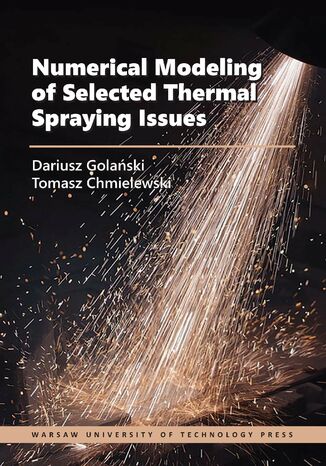
Numerical Modeling of Selected Thermal Spraying Issues
Tomasz Chmielewski, Dariusz Golański
Thermal spraying is one of the most universal techniques for depositing feedstock materials on a substrate. It allows the production of metallic, ceramic, and composite coatings on both metallic and ceramic substrates. Spray deposition involves ejecting heated or cold particles of feedstock material at high velocity toward the substrate. In the final stage of the process, the substrate and the formed coating are cooled to ambient temperature, resulting in residual stresses due to differences in the thermal, physical, and mechanical properties of the feedstock materials and the substrate. The residual stress state of the coating and substrate has a significant effect on their strength, thermal shock resistance, and fatigue life under cyclically varying thermal loads.
TABLE OF CONTENTS
List of major designations and abbreviations 9
Preface 11
Introduction 15
1. Thermal spraying of layers and coatings 17
1.1. Methods of depositing layers and coatings 18
1.2. Arc spraying 20
1.3. Plasma spraying 23
1.4. Flame spraying 26
1.4.1. Flame spraying at subsonic velocities 26
1.4.2. Flame spraying at supersonic velocities 28
1.5. Laser spraying 36
1.6. Cold spraying 39
1.7. Laser alloying and remelting 42
1.7.1. Laser alloying 42
1.7.2. Laser remelting of coatings 43
1.8. Comparison of thermal spraying methods 44
2. Selected properties of sprayed coatings 49
2.1. Coating formation process 49
2.2. Coating adhesion 51
2.2.1. Effect of surface preparation 52
2.2.2. Effect of temperature 52
2.2.3. Effect of kinetic energy 53
2.2.4. Effect of the physical and chemical properties of materials 54
2.3. Residual stresses in surface layers 55
2.4. Residual stresses due to thermal mismatch 60
3. Feedstock materials for spraying 64
4. Testing of thermally deposited coatings by flame and detonation methods 69
4.1. Preliminary testing of sprayed coatings by flame and detonation methods 71
4.2. Characterization of feedstock materials 71
4.3. Stresses in the coating–substrate system 73
4.4. Construction of an instrument for testing the deflection of a coated substrate after the spraying process 75
4.5. Spraying titanium coatings on ceramic substrates 76
4.6. Determination of residual stresses in sprayed coatings 77
4.6.1. Titanium coatings 77
4.6.2. Ti+Al2O3 composite coatings 79
4.7. Numerical analysis of residual stresses in titanium and composite coatings 80
4.8. Temperature field during cooling of the coating–substrate system 85
4.8.1. Object of study 86
4.8.2. Assumptions for numerical calculations 87
4.8.3. Calculation results 88
4.8.4. Comparative analysis of temperature distribution calculation results 93
4.9. Stress investigation in Ti and Ti+Al2O3 coatings sprayed on Al2O3 substrate by deto-nation gun method (D-gun) 99
4.9.1. Feedstock materials 99
4.9.2. Detonation spraying parameters 100
4.9.3. Measurements of deflection in specimens after detonation spraying 101
4.9.4. Stresses in the sprayed coating based on the curvature of the specimen 102
4.10. Conclusions 106
5. Residual stress modelling in the thermal spraying process 109
5.1. Introduction – physical modelling of the process and generation of residual stresses 109
5.2. Methodology adopted for modelling residual stresses in thermally sprayed coatings 112
5.3. Particle impact modelling using ANSYS-AUTODYN 115
5.4. Modelling of particle impact on the substrate 119
5.5. Impact of Ti particles on the Al2O3 substrate and particles on the sublayer by detona¬tion spraying 120
5.6. Thermo-mechanical model of the thermal spraying process 126
5.6.1. Temperature distributions in the Ti–Al2O3 coating–substrate system, detonation spraying 131
5.6.2. Stress distributions in the Ti–Al2O3 coating–substrate system, detonation spraying 133
5.6.3. The influence of the substrate preheating temperature on the stresses in the Ti–Al2O3 coating–substrate system 136
5.7. The effect of the impact velocity on the residual stresses in the Ti–Al2O3 coating–sub¬strate system 145
5.7.1. Results of dynamic calculations for the impact of a feedstock material particle on a ceramic substrate 147
5.7.2. Impact of Ti coating particles against the Ti coating sublayer 152
5.7.3. Results of temperature distribution calculations for different particle impact ve¬locities 156
5.7.4. Results of specimen deflection and stress distribution calculations for different particle impact velocities 159
5.7.5. Summary of particle spray velocity effects 163
5.8. Conclusions 164
6. Modelling the impact of a single particle on the substrate 166
6.1. Model description 166
6.2. Assumptions for the Ti particle model on ceramic and metal substrates 173
6.2.1. Mode l of spraying Ti particles on Al2O3 ceramic substrate (V = 500 m/s) 174
6.2.2. Model of spraying Ti particles on Al2O3 ceramic substrate (V = 800 m/s) 180
6.3. Comparative analysis of particle impact simulations of ceramic and metallic substra¬tes 186
6.3.1. Titanium particle 186
6.3.2. Copper particle 192
6.3.3. Particle geometry after impact 199
6.4. Modelling of the impact of a heated Ti particle on a ceramic substrate 199
6.4.1. Geometric model 199
6.4.2. Model deformation simulation results 202
6.4.3. Temperature distribution in the Ti particle–Al2O3 substrate system 206
6.4.4. Distribution of reduced stresses in the Ti particle–Al2O3 substrate system 207
6.5. Conclusions 211
7. Coating testing and modelling of residual stresses in the thermal spraying process using the HVOF method 214
7.1. Testing of metal coatings sprayed on Al2O3 ceramic substrate 214
7.2. Test object 214
7.3. Spraying station 215
7.4. Structural studies 219
7.5. Coating wettability tests 224
7.5.1. Wettability tests in argon 226
7.5.2. Wettability tests in vacuum 227
7.5.3. Conclusions 228
7.6. Residual stress tests in the coating–substrate system 228
7.6.1. Determination of residual stresses based on the curvature of the specimen 229
7.6.2. Research on residual stresses in coatings using the X-ray method 231
7.7. Conclusions 234
7.8. Numerical and experimental analysis of residual stresses generated in metallic coatings deposited by HVOF on an Al2O3 substrate 235
7.8.1. Impact of Ti particles on the Al2O3 substrate 235
7.8.2. Temperature distributions in the Ti, Cu, Ni coating system 239
7.8.3. Stress distributions in the Ti (Cu, Ni) coating–Al2O3 substrate system 241
7.8.4. Conclusions 245
8. Investigation of strains and stresses in sprayed Ti and Cu coatings using grating inter-ferometry 247
8.1. Grating interferometry method 247
8.2. Specimen grating technology 249
8.3. Automatic analysis of fringe images 250
8.4. Measuring station 251
8.5. Measurement procedure 253
8.6. Measurements on a titanium coating sprayed on an Al2O3 substrate 254
8.6.1. Measurement of displacements in the measuring field of 14.3×14.3 mm prior to cutting 255
8.6.2. Measurement of displacements in the measuring field of 14.3×14.3 mm after cutting 256
8.6.3. Measurement of displacements in the measuring field of 14.3×14.3 mm after the second cutting 259
8.6.4. Measurements in a small measuring field (3.7×3.7 mm) 262
8.7. Measurements on a copper coating sprayed on an Al2O3 substrate 264
8.7.1. Measurement of displacements in the measuring field of 14.3×14.3 mm prior to cutting 264
8.7.2. Measurement of displacements in the measuring field of 14.3×14.3 mm after cutting 265
8.7.3. Measurements in a small measuring field (3.7×3.7 mm) after the second cutting 268
8.8. Strain comparison for Cu and Ti coated specimens 270
8.9. Modelling of deflection and residual stresses in Cu/Al2O3 and Ti/Al2O3 systems before and after cutting the plate 273
8.9.1. Cu–Al2O3 coating–substrate model 274
8.9.2. Ti–Al2O3 coating–substrate model 276
8.10. Comparison of determined residual stresses 279
8.11. Conclusion 279
9. Summary and conclusions 282
Bibliography 291
- Title:Numerical Modeling of Selected Thermal Spraying Issues
- Author:Tomasz Chmielewski, Dariusz Golański
- ISBN:978-83-8156-823-4, 9788381568234
- Date of issue:2026-01-14
- Format:Ebook - PDF
- Item ID: e_4qmr
- Publisher: Oficyna Wydawnicza Politechniki Warszawskiej