
Wyniki wyszukiwania
Bartosz Brożek
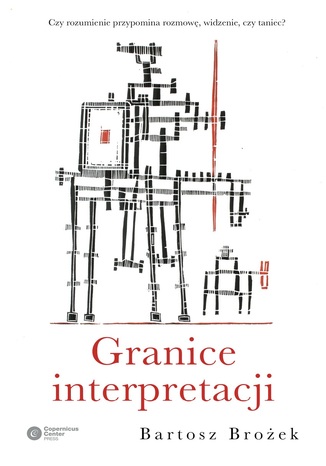
Czy rozumienie przypomina rozmowę, widzenie, czy taniec? Czy istnieje język doskonały? Czym jest interpretacja? Czy poza jej granicami leży tylko nonsens? Granice interpretacji to książka, która odpowiada na pytanie, dlaczego w świecie komunikacji jesteśmy skazani na interpretację. Autor, posiłkując się ustaleniami współczesnych nauk kognitywnych i teorii ewolucji, a także czerpiąc z tradycji filozofii analitycznej dowodzi, że nie może istnieć język doskonały niepodatny na interpretację. Zastanawia się również nad strukturą rozumienia i pokazuje, że zbyt pochopne próby interpretacji mogą nas prowadzić w krainę bełkotu. Granice interpretacji to pierwsza w literaturze polskiej próba zmierzenia się ze zjawiskiem interpretacji, oparta w znacznej mierze na tym, co biologia mówi o ludzkiej zdolności rozumienia. Jesteśmy jedynym gatunkiem, który posługuje się językiem, ale nie znaczy to, że możemy używać go w sposób dowolny.
Michał Heller, Bogdan Dembiński, George F.R. Ellis,...
A collection of essays dealing with causality, a core issue for both science and philosophy. The Reader will learn about different types of causality in complex systems and about new perspectives on this issue based on physical and cosmological considerations. In addition, the collection includes essays pertaining to the problem of causality in ancient Greek philosophy, and to the problem of God’s relation to the causal structures of nature viewed in the light of contemporary physics and cosmology.
Wojciech Załuski
Game theory is a branch of mathematics which studies strategic interactions, i.e., interactions which involve more than one agent and in which each agent makes her decision while striving to predict the decisions of other agents. Game theory has been successfully applied in many areas of both the natural and social sciences, and it is the belief of this book’s author – Wojciech Załuski – that it can also be gainfully invoked in the area of legal philosophy. In this book, Załuski analyzes such legal-philosophical concepts as legal interpretation, justice, legal rights, contract, tort and property law through the lens of game theory. Since the book does not assume any previous knowledge of game theory, it appeals mainly to its conceptual rather than the technical side, and intertwines game-theoretical analysis with the philosophical, it will be accessible to a wider circle of readers interested in legal and moral philosophy.