
Wydawca: 16
Bill Aronson
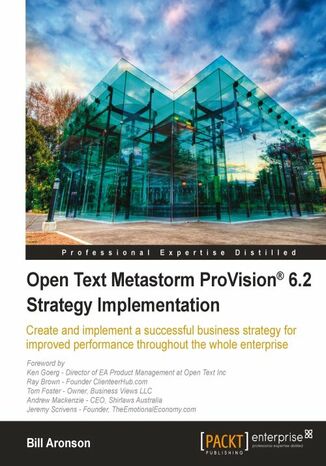
Open Text ProVision® (formerly known as Metastorm ProVision®) is an Enterprise Architecture (EA) solution allowing for effective planning and decision making throughout the enterprise. It enables an organization to have a central repository of information about the business, reducing organizational risks and better optimizing business resources.Implemented well, it enables better and more actionable decisions exactly when you need them.This book combines theory and practice to provide a step- by- step guide to building a successful customer- centric model of your business. The approach is simple and down to earth, and along the way, with various real-world examples, you will learn how to make a business case, use a framework, and adopt a methodology with Open Text ProVision®. This book draws on the experience of ProVision® experts around the world. By combining theory with practice from the field you can avoid common mistakes and develop a successful customer centric strategy for implementing ProVision®. Each chapter builds on the previous one to give you the confidence to implement a central repository, dealing with both the technical and human issues that you might face.
Henry Habib, Sam McKay, Paul Siegel
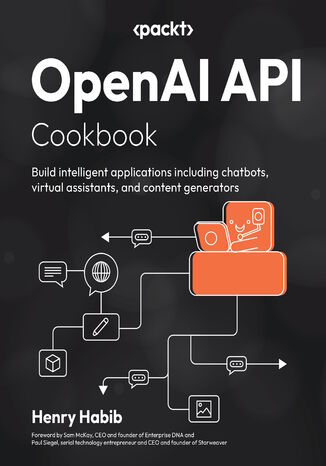
As artificial intelligence continues to reshape industries with OpenAI at the forefront of AI research, knowing how to create innovative applications such as chatbots, virtual assistants, content generators, and productivity enhancers is a game-changer. This book takes a practical, recipe-based approach to unlocking the power of OpenAI API to build high-performance intelligent applications in diverse industries and seamlessly integrate ChatGPT in your workflows to increase productivity.You’ll begin with the OpenAI API fundamentals, covering setup, authentication, and key parameters, and quickly progress to the different elements of the OpenAI API. Once you’ve learned how to use it effectively and tweak parameters for better results, you’ll follow advanced recipes for enhancing user experience and refining outputs. The book guides your transition from development to live application deployment, setting up the API for public use and application backend. Further, you’ll discover step-by-step recipes for building knowledge-based assistants and multi-model applications tailored to your specific needs.By the end of this book, you’ll have worked through recipes involving various OpenAI API endpoints and built a variety of intelligent applications, ready to apply this experience to building AI-powered solutions of your own.
Henry Habib
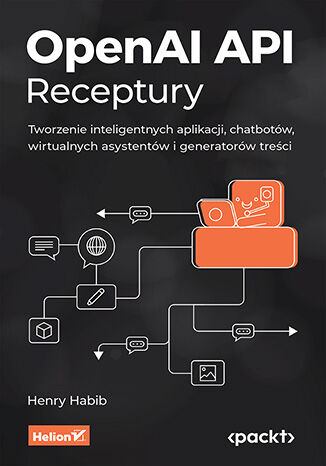
Firma OpenAI pozostaje niekwestionowanym liderem badań nad sztuczną inteligencją. Dzięki udostępnianym przez nią rozwiązaniom tworzenie innowacyjnych aplikacji, takich jak czatboty, wirtualne asystenty, generatory treści i narzędzia zwiększające produktywność, stało się o wiele prostsze. Bezsprzecznie powszechna dostępność technologii AI zmienia zasady gry! Receptury zawarte w tym zbiorze ułatwią Ci budowę szerokiej gamy inteligentnych aplikacji. Zaczniesz od podstaw OpenAI API - konfiguracji, uwierzytelniania i kluczowych parametrów - po czym szybko przejdziesz do nauki korzystania z najważniejszych elementów API. Następnie przyjdzie czas na zaawansowane receptury, dzięki którym poprawisz wrażenia użytkownika i dopracujesz dane wyjściowe. Dowiesz się, jak wdrażać aplikacje i przygotować je do publicznego użytku. Nauczysz się również budowania inteligentnych asystentów opartych na specjalistycznej wiedzy, a także aplikacji multimodalnych dostosowanych do Twoich specyficznych potrzeb. W książce: podstawy interfejsu OpenAI API, jego możliwości i ograniczenia konfiguracja OpenAI API krok po kroku zaawansowane funkcje, w tym komunikat systemowy i dostrajanie integracja OpenAI API z istniejącymi aplikacjami i procesami projektowanie aplikacji wykorzystujących w pełni możliwości OpenAI API Postęp technologii polega na dostosowaniu jej tak, abyśmy nawet jej nie zauważali i by mogła stać się częścią codziennego życia! Bill Gates
Jacek Ross
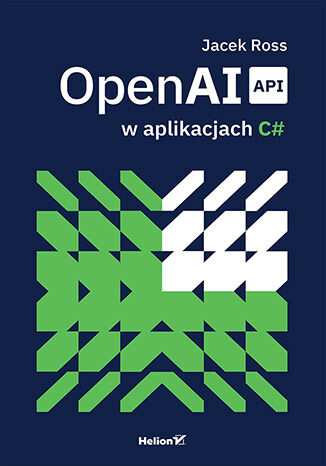
Nowy najlepszy przyjaciel programisty C# nazywa się... OpenAI Rozpowszechnienie się sztucznej inteligencji wiele zmienia na rynku usług IT. Dzięki zastosowaniu takich narzędzi jak ChatGPT część zadań, które do tej pory wymagały mozolnej pracy, można teraz zrealizować szybciej, wspomagając się odpowiednio wytrenowaną i poinstruowaną AI. Jak to zrobić? Od czego zacząć? Jak dołączyć do grona programistów, którzy w postępie technicznym dostrzegli szansę i nauczyli się z niej korzystać? Przejście na nowy poziom profesjonalizmu zacznij od lektury tej książki. Dowiesz się z niej, jak używać OpenAI API do pisania lepszych, bardziej rozbudowanych aplikacji w języku C#: Poznaj zalety korzystania ze sztucznej inteligencji w kodowaniu Naucz się używać interfejsu programistycznego OpenAI Zacznij tworzyć własne projekty z zastosowaniem AI Przyjrzyj się innym praktycznym umiejętnościom sztucznej inteligencji, takim jak zdolność do generowania grafiki Zajrzyj za zasłonę - zastanów się nad przyszłym rozwojem AI i dalszymi zmianami, jakie wywoła ona w programowaniu
Aymen El Amri
“OpenAI GPT for Python Developers” is meticulously crafted to provide Python developers with a deep dive into the mechanics and applications of GPT technology, beginning with a captivating narrative on the evolution of OpenAI and the fundamental workings of GPT models. As readers progress, they will be expertly guided through the essential steps of setting up a development environment tailored for AI innovations, coupled with insightful advice on selecting the most appropriate GPT model to suit specific project needs.The guide progresses into practical tutorials that cover the implementation of chat completions and the art of prompt engineering, providing a solid foundation in harnessing the capabilities of GPT for generating human-like text responses. Practical applications are further expanded with discussions on the creation of autonomous AI-to-AI dialogues, the development of AI avatars, and the strategic use of AI in interactive applications.In addition to technical skills, this book addresses the ethical implications and prospects of AI technologies, encouraging a holistic view of AI development. The guide is enriched with detailed examples, step-by-step tutorials, and comprehensive explanations that illuminate the theoretical aspects and emphasize practical implementation.
OpenCart Theming. Create custom themes and modules using the exciting new features of OpenCart
Rupak Nepali
This book is aimed at developers and designers who want to start developing their own themes and extensions and for those who want to know about the code workflow of the OpenCart theme and modules.
Ravishekhar Banger, Koushik Bhattacharyya
Research in parallel programming has been a mainstream topic for a decade, and will continue to be so for many decades to come. Many parallel programming standards and frameworks exist, but only take into account one type of hardware architecture. Today computing platforms come with many heterogeneous devices. OpenCL provides royalty free standard to program heterogeneous hardware.This guide offers you a compact coverage of all the major topics of OpenCL programming. It explains optimization techniques and strategies in-depth, using illustrative examples and also provides case studies from diverse fields. Beginners and advanced application developers will find this book very useful.Beginning with the discussion of the OpenCL models, this book explores their architectural view, programming interfaces and primitives. It slowly demystifies the process of identifying the data and task parallelism in diverse algorithms.It presents examples from different domains to show how the problems within different domains can be solved more efficiently using OpenCL. You will learn about parallel sorting, histogram generation, JPEG compression, linear and parabolic regression and k-nearest neighborhood, a clustering algorithm in pattern recognition. Following on from this, optimization strategies are explained with matrix multiplication examples. You will also learn how to do an interoperation of OpenGL and OpenCL.OpenCL Programming by Example explains OpenCL in the simplest possible language, which beginners will find it easy to understand. Developers and programmers from different domains who want to achieve acceleration for their applications will find this book very useful.
Joseph Howse, Steven Puttemans, Utkarsh Sinha
Computer vision is becoming accessible to a large audience of software developers who can leverage mature libraries such as OpenCV. However, as they move beyond their first experiments in computer vision, developers may struggle to ensure that their solutions are sufficiently well optimized, well trained, robust, and adaptive in real-world conditions. With sufficient knowledge of OpenCV, these developers will have enough confidence to go about creating projects in the field of computer vision.This book will help you tackle increasingly challenging computer vision problems that you may face in your careers. It makes use of OpenCV 3 to work around some interesting projects. Inside these pages, you will find practical and innovative approaches that are battle-tested in the authors’ industry experience and research. Each chapter covers the theory and practice of multiple complementary approaches so that you will be able to choose wisely in your future projects. You will also gain insights into the architecture and algorithms that underpin OpenCV’s functionality.We begin by taking a critical look at inputs in order to decide which kinds of light, cameras, lenses, and image formats are best suited to a given purpose. We proceed to consider the finer aspects of computational photography as we build an automated camera to assist nature photographers. You will gain a deep understanding of some of the most widely applicable and reliable techniques in object detection, feature selection, tracking, and even biometric recognition. We will also build Android projects in which we explore the complexities of camera motion: first in panoramic image stitching and then in video stabilization.By the end of the book, you will have a much richer understanding of imaging, motion, machine learning, and the architecture of computer vision libraries and applications!