
Verleger: 16
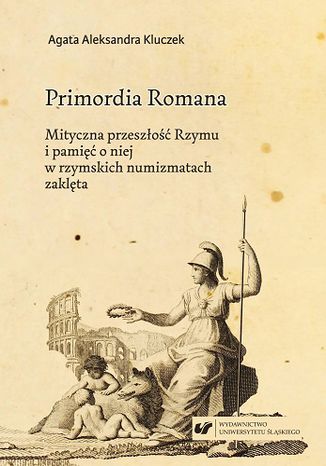
Primordia Romana. Mityczna przeszłość Rzymu i pamięć o niej w rzymskich numizmatach zaklęta
Agata Aleksandra Kluczek
W książce przeanalizowano obecność w rzymskim mennictwie motywów dotyczących początków Rzymu (primordia) i odwołania do mitu trojańsko-rzymskiego zakreślone „od Eneasza do Romulusa”. Począwszy od III wieku p.n.e. po IV stulecie na monetach i medalionach starożytni emitenci umieszczali obrazy nawiązujące do postaci oraz wątków mitycznych. W książce podjęto rozważania nad atrakcyjnością treści mityczno-fundacyjnych w zmieniającej się przez stulecia rzeczywistości historycznej, dostrzegając w takim przekazie wyraz uznania dla tradycji Miasta nad Tybrem i w taki sposób wyrażaną akceptację rzymskiej tożsamości. Publikacja jest adresowana do historyków, numizmatyków oraz miłośników starożytnego Rzymu. Agata Aleksandra Kluczek, doktor habilitowany, pracownik Zakładu Historii Starożytnej Uniwersytetu Śląskiego w Katowicach. Zajmuje się dziejami starożytnego Rzymu, historią idei oraz ideologią władzy cesarskiej. Szczególnym obszarem jej zainteresowań naukowych jest numizmatyka rzymska. Do najważniejszych jej prac należą: Polityka dynastyczna w Cesarstwie Rzymskim w latach 235–284. Katowice 2000, Studia nad propagandą polityczną w Cesarstwie Rzymskim II i III w. Toruń 2006, VNDIQVE VICTORES. Wizja rzymskiego władztwa nad światem w mennictwie złotego wieku Antoninów i doby kryzysu III wieku – studium porównawcze. Katowice 2009 oraz „Roma marmorea”. W poszukiwaniu śladów działalności budowlanej cesarzy wojskowych. Poznań 2012 oraz „Roma marmorea” (235–284). Zapomniana epoka rzymskiego budownictwa. Poznań – Gniezno 2013. [31.07.2014]

Robert Louis Stevenson
In the historical novel "Prince Otto", the romance of adventure is combined with the exact recreation of local color and historical setting. This novel is about Prince Otto, who is not very concerned about government affairs and problems, and he devotes all the time to hunting and other entertainments. Once during a hunt, he stumbles upon ordinary peasants who did not recognize him and agreed to shelter him for the night. During the evening dinner, the unrecognized prince tries to find out from the peasants what they think about their ruler, and those, as ordinary people, told him everything they think about Prince Otto.

Joseph Conrad
Prince Roman is a Pole who relinquishes his comfortable position in the aristocracy to fight as an unknown soldier, resisting Russian oppression. In captivity, he has every opportunity to avoid punishment, but he declares his unconditional commitment to the liberation of Poland. As a result, he suffers a quarter century in the imperial equivalent of the Gulag Siberian mines in the ninth century, before returning to live in modest conditions in what should have been his own property, before devoting his life to helping other people.

M.P. Shiel
Prince Zaleski (1895) represents Shiels contribution to the mystery genre, and is his answer to Sherlock Holmes. This is a set of three short detective mysteries but the stories are clever and even wonderfully creepy at times which can only be solved by Prince Zaleski the worlds greatest historian! It includes the following mysteries: The Race of Orven, The Stone of the Edmundsbury Monks, The S.S.. Prince Zaleski is an eccentric gentleman detective who suffers from ennui but might sometimes be induced to take an absorbing interest in questions that had proved themselves too profound, or too intricate, for ordinary solution. Those who like mystery/detective fiction and weird fiction with fin-de-siecle British Decadence will enjoy this blend of the genres.
Sonia Mezzetta
Data can be found everywhere, from cloud environments and relational and non-relational databases to data lakes, data warehouses, and data lakehouses. Data management practices can be standardized across the cloud, on-premises, and edge devices with Data Fabric, a powerful architecture that creates a unified view of data. This book will enable you to design a Data Fabric solution by addressing all the key aspects that need to be considered.The book begins by introducing you to Data Fabric architecture, why you need them, and how they relate to other strategic data management frameworks. You’ll then quickly progress to grasping the principles of DataOps, an operational model for Data Fabric architecture. The next set of chapters will show you how to combine Data Fabric with DataOps and Data Mesh and how they work together by making the most out of it. After that, you’ll discover how to design Data Integration, Data Governance, and Self-Service analytics architecture. The book ends with technical architecture to implement distributed data management and regulatory compliance, followed by industry best practices and principles.By the end of this data book, you will have a clear understanding of what Data Fabric is and what the architecture looks like, along with the level of effort that goes into designing a Data Fabric solution.
Sinan Ozdemir
Principles of Data Science bridges mathematics, programming, and business analysis, empowering you to confidently pose and address complex data questions and construct effective machine learning pipelines. This book will equip you with the tools to transform abstract concepts and raw statistics into actionable insights.Starting with cleaning and preparation, you’ll explore effective data mining strategies and techniques before moving on to building a holistic picture of how every piece of the data science puzzle fits together. Throughout the book, you’ll discover statistical models with which you can control and navigate even the densest or the sparsest of datasets and learn how to create powerful visualizations that communicate the stories hidden in your data.With a focus on application, this edition covers advanced transfer learning and pre-trained models for NLP and vision tasks. You’ll get to grips with advanced techniques for mitigating algorithmic bias in data as well as models and addressing model and data drift. Finally, you’ll explore medium-level data governance, including data provenance, privacy, and deletion request handling.By the end of this data science book, you'll have learned the fundamentals of computational mathematics and statistics, all while navigating the intricacies of modern ML and large pre-trained models like GPT and BERT.
Principles of Data Science. Mathematical techniques and theory to succeed in data-driven industries
Sinan Ozdemir
Need to turn your skills at programming into effective data science skills? Principles of Data Science is created to help you join the dots between mathematics, programming, and business analysis. With this book, you’ll feel confident about asking—and answering—complex and sophisticated questions of your data to move from abstract and raw statistics to actionable ideas.With a unique approach that bridges the gap between mathematics and computer science, this books takes you through the entire data science pipeline. Beginning with cleaning and preparing data, and effective data mining strategies and techniques, you’ll move on to build a comprehensive picture of how every piece of the data science puzzle fits together. Learn the fundamentals of computational mathematics and statistics, as well as some pseudocode being used today by data scientists and analysts. You’ll get to grips with machine learning, discover the statistical models that help you take control and navigate even the densest datasets, and find out how to create powerful visualizations that communicate what your data means.
Sinan Ozdemir, Sunil Kakade, Marco Tibaldeschi
Need to turn programming skills into effective data science skills? This book helps you connect mathematics, programming, and business analysis. You’ll feel confident asking—and answering—complex, sophisticated questions of your data, making abstract and raw statistics into actionable ideas.Going through the data science pipeline, you'll clean and prepare data and learn effective data mining strategies and techniques to gain a comprehensive view of how the data science puzzle fits together. You’ll learn fundamentals of computational mathematics and statistics and pseudo-code used by data scientists and analysts. You’ll learn machine learning, discovering statistical models that help control and navigate even the densest datasets, and learn powerful visualizations that communicate what your data means.