
Verleger: 24
David Cornelius
Delphi is a strongly typed, event-driven programming language with a rich ecosystem of frameworks and support tools. It comes with an extensive set of web and database libraries for rapid application development on desktop, mobile, and internet-enabled devices. This book will help you keep up with the latest IDE features and provide a sound foundation of project management and recent language enhancements to take your productivity to the next level.You’ll discover how simple it is to support popular mobile device features such as sensors, cameras, and GPS. The book will help you feel comfortable working with FireMonkey and styles and incorporating 3D user interfaces in new ways. As you advance, you’ll be able to build cross-platform solutions that not only look native but also take advantage of a wide array of device capabilities. You’ll also learn how to use embedded databases, such as SQLite and InterBase ToGo, synchronizing them with your own custom backend servers or modules using the powerful RAD Server engine. The book concludes by sharing tips for testing and deploying your end-to-end application suite for a smooth user experience.By the end of this book, you’ll be able to deliver modern enterprise applications using Delphi confidently.
Cuantum Technologies LLC
Feature engineering is essential for building robust predictive models. This book delves into practical techniques for transforming raw data into powerful features using Scikit-Learn. You'll explore automation, deep learning integrations, and advanced topics like feature selection and model evaluation. Learn to handle real-world data challenges, enhance accuracy, and streamline your workflows.Through hands-on projects, readers will gain practical experience with techniques such as clustering, pipelines, and feature selection, applied to domains like retail and healthcare. Step-by-step instructions ensure a comprehensive learning journey, from foundational concepts to advanced automation and hybrid modeling approaches.By combining theory with real-world applications, the book equips data professionals with the tools to unlock the full potential of machine learning models. Whether working with structured datasets or integrating deep learning features, this guide provides actionable insights to tackle any data transformation challenge effectively.
Sinan Ozdemir, Divya Susarla, Michael Smith
Feature engineering is the most important step in creating powerful machine learning systems. This book will take you through the entire feature-engineering journey to make your machine learning much more systematic and effective.You will start with understanding your data—often the success of your ML models depends on how you leverage different feature types, such as continuous, categorical, and more, You will learn when to include a feature, when to omit it, and why, all by understanding error analysis and the acceptability of your models. You will learn to convert a problem statement into useful new features. You will learn to deliver features driven by business needs as well as mathematical insights. You'll also learn how to use machine learning on your machines, automatically learning amazing features for your data.By the end of the book, you will become proficient in Feature Selection, Feature Learning, and Feature Optimization.

Michael Gillett
Over the past few years, DevOps has become the de facto approach for designing, building, and delivering software. Feature management is now extending the DevOps methodology to allow applications to change on demand and run experiments to validate the success of new features. If you want to make feature management happen, LaunchDarkly is the tool for you.This book explains how feature management is key to building modern software systems. Starting with the basics of LaunchDarkly and configuring simple feature flags to turn features on and off, you'll learn how simple functionality can be applied in more powerful ways with percentage-based rollouts, experimentation, and switches. You'll see how feature management can change the way teams work and how large projects, including migrations, are planned. Finally, you'll discover various uses of every part of the tool to gain mastery of LaunchDarkly. This includes tips and tricks for experimentation, identifying groups and segments of users, and investigating and debugging issues with specific users and feature flag evaluations.By the end of the book, you'll have gained a comprehensive understanding of LaunchDarkly, along with knowledge of the adoption of trunk-based development workflows and methods, multi-variant testing, and managing infrastructure changes and migrations.
Feature Store for Machine Learning. Curate, discover, share and serve ML features at scale
Jayanth Kumar M J
Feature store is one of the storage layers in machine learning (ML) operations, where data scientists and ML engineers can store transformed and curated features for ML models. This makes them available for model training, inference (batch and online), and reuse in other ML pipelines. Knowing how to utilize feature stores to their fullest potential can save you a lot of time and effort, and this book will teach you everything you need to know to get started.Feature Store for Machine Learning is for data scientists who want to learn how to use feature stores to share and reuse each other's work and expertise. You’ll be able to implement practices that help in eliminating reprocessing of data, providing model-reproducible capabilities, and reducing duplication of work, thus improving the time to production of the ML model. While this ML book offers some theoretical groundwork for developers who are just getting to grips with feature stores, there's plenty of practical know-how for those ready to put their knowledge to work. With a hands-on approach to implementation and associated methodologies, you'll get up and running in no time.By the end of this book, you’ll have understood why feature stores are essential and how to use them in your ML projects, both on your local system and on the cloud.
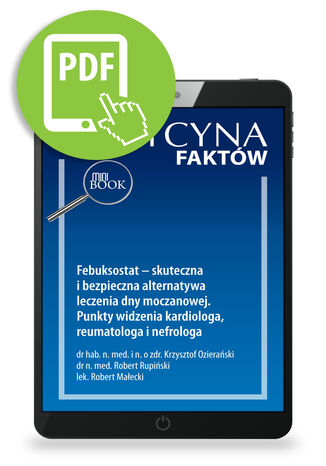
Krzysztof Ozierański, Robert Rupiński, Robert Małecki
Febuksostat to silny inhibitor oksydazy ksantynowej stosowany w leczeniu przewlekłej hiperurykemii z odkładaniem się złogów moczanowych. Stanowi bardzo ważną alternatywę ze względu na bezpieczeństwo stosowania u pacjentów z chorobami przewlekłymi oraz wyższą skuteczność terapeutyczną od allopurynolu.

Henryk Zbierzchowski
Henryk Zbierzchowski Impresye Feconditas Chwila zachodu wśród obłoków wieńca Dogasa słońce chmura zwiewna biała, Jak szept w przestrzeniach nieba skamieniała, Czeka na przyjście swego oblubieńca. Słońce, jak glorye na świętym obrazie Mieni się pasy rozrzuca pąsowe, Na pierś jej słania umęczoną głowę, Stapia się w świętej miłości ekstazie! ... Henryk Zbierzchowski Ur. 19 listopada 1881 we Lwowie Zm. 6 listopada 1942 w Krynicy Najważniejsze dzieła: Małżeństwo Loli, Żongler. Rzeczy wesołe i smutne, Człowiek o dwu twarzach Pisarz związany całe życie ze Lwowem. Debiutował w 1898 r. na łamach krakowskiego czasopisma "Życie", dwa lata później wydał pierwszy tomik poezji, Impresje. Ukończył studia prawnicze. W latach 1906--1910 pracował jako redaktor czasopisma "Nasz Kraj", publikował też w "Gazecie Porannej". Od 1920 r. prowadził czasopismo satyryczne "Szczutki". W 1928 r. miasto Lwów przyznało mu nagrodę literacką, w 1937 r. otrzymał Krzyż Kawalerski Orderu Odrodzenia Polski, rok później Złoty Wawrzyn Akademicki Polskiej Akademii Literatury. W czasie wojny znalazł się w Krynicy i tam zmarł. Pisał liryki, powieści, nowele, piosenki (patriotyczne i kabaretowe) i sztuki teatralne (przeważnie komedie i wodewile). Kupując książkę wspierasz fundację Nowoczesna Polska, która propaguje ideę wolnej kultury. Wolne Lektury to biblioteka internetowa, rozwijana pod patronatem Ministerstwa Edukacji Narodowej. W jej zbiorach znajduje się kilka tysięcy utworów, w tym wiele lektur szkolnych zalecanych do użytku przez MEN, które trafiły już do domeny publicznej. Wszystkie dzieła są odpowiednio opracowane - opatrzone przypisami oraz motywami.
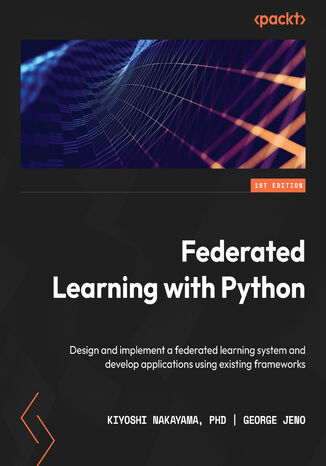
Kiyoshi Nakayama, PhD , George Jeno
Federated learning (FL) is a paradigm-shifting technology in AI that enables and accelerates machine learning (ML), allowing you to work on private data. It has become a must-have solution for most enterprise industries, making it a critical part of your learning journey. This book helps you get to grips with the building blocks of FL and how the systems work and interact with each other using solid coding examples.FL is more than just aggregating collected ML models and bringing them back to the distributed agents. This book teaches you about all the essential basics of FL and shows you how to design distributed systems and learning mechanisms carefully so as to synchronize the dispersed learning processes and synthesize the locally trained ML models in a consistent manner. This way, you’ll be able to create a sustainable and resilient FL system that can constantly function in real-world operations. This book goes further than simply outlining FL's conceptual framework or theory, as is the case with the majority of research-related literature.By the end of this book, you’ll have an in-depth understanding of the FL system design and implementation basics and be able to create an FL system and applications that can be deployed to various local and cloud environments.