
Publisher: 24
Victor Quinn
The book is intended for software developers, DevOps engineers, and other professionals who make heavy use of the terminal in their daily workflow. Some familiarity with the terminal is useful but no prior experience with tmux or other terminal multiplexers (such as GNU Screen) is required.
Emanuele Palazzetti
If you are an Android developer who wants to learn how to use UDOO to build Android applications that are capable of interacting with their surrounding environment, then this book is ideal for you. Learning UDOO is the next great step to start building your first real-world prototypes powered by the Android operating system.
Dr. Edward Lavieri Jr.
The Unity game engine has revolutionized the gaming industry with its complete set of intuitive tools and rapid workflows, which can be used to create interactive 3D content. With Unity, you can scaffold your way from the basics and make make stunning interactive games. This book will guide you through the entire process of creating a 3D game, from downloading the Unity game engine to publishing your game. It not only gives you a strong foundation, but puts you on the path to game development. Beginning with an overview of the Unity engine and its interface, you will walk through the process of creating a game environment and learn how to use built-in assets, as well as assets created with third-party 3D modeling tools such as Blender. Moving on, you will create custom scripts to control non-player character behaviors and gameplay. You will master exciting concepts such as Heads-Up-Displays, mini-maps, game navigation, sound effects, and lighting effects. Next, you’ll learn how to create your first VR experience, right from setting up the project to image effects. You'll be familiarized with all the tools that Unity has to offer to create your own immersive VR experiences. Each section is a stepping stone toward the completion of the final game. By the end of the book, you'll have learned advanced topics such as cross-platform considerations which enable your games to run on multiple platforms.
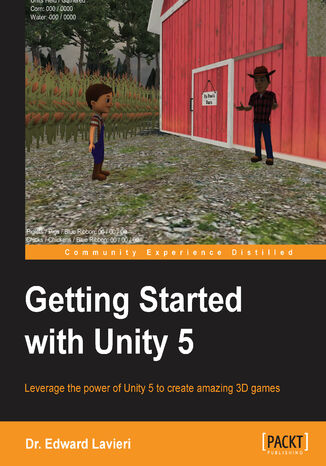
Getting Started with Unity 5. Leverage the power of Unity 5 to create amazing 3D games
Dr. Edward Lavieri Jr.
If you are a game developer interested in learning Unity 3D from scratch and becoming familiar with its core features, then this book is for you. No prior knowledge of Unity 3D is required.
Francesco Sapio
Want to get started in the world of 2D game development with Unity? This book will take your hand and guide you through this amazing journey to let you know exactly what you need to build the games you want to build, without sacrificing quality. You will build a solid understanding of Unity 5.x, by focusing with the embedded tools to develop 2D games. In learning about these, along with accurate explanations and practical examples, you will design, develop, learn how to market and publish a delectable Tower Defense game about cupcakes versus pandas.Each chapter in this book is structured to give you a full understanding on a specific aspect of the workflow pipeline. Each of these aspects are essential for developing games in Unity. In a step-by-step approach, you will learn about each of the following phases: Game Design, Asset Importing, Scripting, User Interfaces, Animations, Physics, Artificial Intelligence, Gameplay Programming, Polishing and Improving, Marketing, Publishing and much more.This book provides you with exercises and homework at the end of each chapter so that you can level up your skills as a Unity game developer. In addition, each of these parts are centered on a common point of discussion with other learners just like you. Therefore, by sharing your ideas with other people you will not only develop your skills but you will also build a network.
Navule Pavan Kumar Rao
A new language on the block, V comes with a promising set of features such as fast compilation and interoperability with other programming languages. This is the first book on the V programming language, packed with concise information and a walkthrough of all the features you need to know to get started with the language.The book begins by covering the fundamentals to help you learn about the basic features of V and the suite of built-in libraries available within the V ecosystem. You'll become familiar with primitive data types, declaring variables, arrays, and maps. In addition to basic programming, you'll develop a solid understanding of the building blocks of programming, including functions, structs, and modules in the V programming language.As you advance through the chapters, you'll learn how to implement concurrency in V Programming, and finally learn how to write test cases for functions. This book takes you through an end-to-end project that will guide you to build fast and maintainable RESTful microservices by leveraging the power of V and its built-in libraries.By the end of this V programming book, you'll be well-versed with the V programming language and be able to start writing your own programs and applications.
Cedric Rajendran
This book is intended for server administrators and storage administrators who would like to successfully build and scale a VSAN-backed vSphere infrastructure. A basic understanding of vSphere concepts and storage fundamentals will be helpful.
Prateek Jadhwani
Web Components are a set of APIs that help you build reusable UI modules that can operate in any modern browser using just Vanilla JavaScript. The power of Web Components lies in their ability to build frontend web applications with or without web frameworks.With this practical guide, you will understand how Web Components can help you build reusable UI components for your modern web apps. The book starts by explaining the fundamentals of Web Components' design and strategies for using them in your existing frontend web projects. You will also learn how to use JavaScript libraries such as Polymer.js and Stencil.js for building practical components. As you progress, you will build a single-page application using only Web Components to fully realize their potential. This practical guide demonstrates how to work with Shadow DOM and custom elements to build the standard components of a web application. Toward the end of the book, you will learn how to integrate Web Components with standard web frameworks to help you manage large-scale web applications.By the end of this book, you will have learned about the capabilities of Web Components in building custom elements and have the necessary skills for building a reusable UI for your web applications.