
Видавець: 8
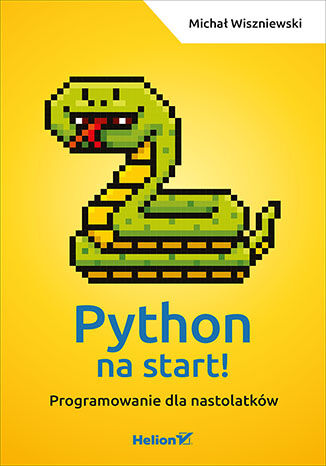
Python na start! Programowanie dla nastolatków
Michał Wiszniewski
Zacznij od skryptów, a skończysz na szczycie! Pierwsze kroki, czyli od czego zacząć przygodę z Pythonem Niezbędne gadżety, czyli z czego i jak budować programy w Pythonie Wędrówka przez style, czyli jak programować strukturalnie, obiektowo i funkcyjnie Czy kiedykolwiek zastanawiałeś się nad tym, dlaczego na świecie istnieje aż tyle języków programowania i czym różnią się one od siebie? I których z tych języków warto się nauczyć? Na pewno co najmniej kilku, ale na Twojej krótkiej liście nie może zabraknąć Pythona! Ten język ma dwie potężne zalety: po pierwsze, jest znacznie łatwiejszy w nauce i bardziej intuicyjny niż choćby C czy C++, a po drugie, umożliwia tworzenie skryptów, czyli funkcjonalnych programów, przydających się na co dzień programistom wszelkiej maści, administratorom sieci i wielu innym ludziom. Python to także fantastyczne narzędzie do tworzenia rozbudowanych projektów. Zresztą, możesz się o tym szybko przekonać. W tej książce znadziesz omówienie wszystkich najważniejszych funkcji i możliwości Pythona. Zobaczysz, jak pracować w środowisku tego języka, jak używać zmiennych, instrukcji warunkowych, funkcji i typów danych. Zobaczysz, w jakich sytuacjach warto wykorzystywać pętle i moduły, jak wykonywać operacje na plikach i jak obsługiwać wyjątki. Sprawdzisz, do czego przydaje się programowanie strukturalne, a do czego obiektowe, i zobaczysz, jak łatwo połączyć je w Pythonie! Krótko mówiąc, zanim się obejrzysz, zaczniesz samodzielnie pisać zaawansowane skrypty. Sprawdź, programuj i baw się dobrze! Pierwszy program, czyli jak zostałem programistą Zmienne są niezbędne... a zmienne znakowe jeszcze bardziej Operacje wejścia – przekaż skryptowi dowolne informacje Instrukcje warunkowe – początek prawdziwego programowania Funkcje – to jest to! Zasięg zmiennych i nieco więcej o instrukcjach warunkowych – trzeba uważać Pętle – czyli jak ułatwić sobie życie Zaawansowane typy danych – to tylko groźnie brzmi! Operacje na plikach – w końcu ciekawy rozdział! Moduły – one są wspaniałe! Wyjątki – czyli błędy w języku Python Obiekty, klasy i metody – czyli programowanie obiektowe Zaklinaj węża, czyli programuj w Pythonie!
Jalaj Thanaki
This book starts off by laying the foundation for Natural Language Processing and why Python is one of the best options to build an NLP-based expert system with advantages such as Community support, availability of frameworks and so on. Later it gives you a better understanding of available free forms of corpus and different types of dataset. After this, you will know how to choose a dataset for natural language processing applications and find the right NLP techniques to process sentences in datasets and understand their structure. You will also learn how to tokenize different parts of sentences and ways to analyze them. During the course of the book, you will explore the semantic as well as syntactic analysis of text. You will understand how to solve various ambiguities in processing human language and will come across various scenarios while performing text analysis. You will learn the very basics of getting the environment ready for natural language processing, move on to the initial setup, and then quickly understand sentences and language parts. You will learn the power of Machine Learning and Deep Learning to extract information from text data.By the end of the book, you will have a clear understanding of natural language processing and will have worked on multiple examples that implement NLP in the real world.
Zhenya Antić
Python is the most widely used language for natural language processing (NLP) thanks to its extensive tools and libraries for analyzing text and extracting computer-usable data. This book will take you through a range of techniques for text processing, from basics such as parsing the parts of speech to complex topics such as topic modeling, text classification, and visualization.Starting with an overview of NLP, the book presents recipes for dividing text into sentences, stemming and lemmatization, removing stopwords, and parts of speech tagging to help you to prepare your data. You’ll then learn ways of extracting and representing grammatical information, such as dependency parsing and anaphora resolution, discover different ways of representing the semantics using bag-of-words, TF-IDF, word embeddings, and BERT, and develop skills for text classification using keywords, SVMs, LSTMs, and other techniques. As you advance, you’ll also see how to extract information from text, implement unsupervised and supervised techniques for topic modeling, and perform topic modeling of short texts, such as tweets. Additionally, the book shows you how to develop chatbots using NLTK and Rasa and visualize text data.By the end of this NLP book, you’ll have developed the skills to use a powerful set of tools for text processing.
Zhenya Antić, Saurabh Chakravarty, Edward A. Fox
Harness the power of Natural Language Processing (NLP) to overcome real-world text analysis challenges with this recipe-based roadmap written by two seasoned NLP experts with vast experience transforming various industries with their NLP prowess.You’ll be able to make the most of the latest NLP advancements, including large language models (LLMs), and leverage their capabilities through Hugging Face transformers. Through a series of hands-on recipes, you’ll master essential techniques such as extracting entities and visualizing text data. The authors will expertly guide you through building pipelines for sentiment analysis, topic modeling, and question-answering using popular libraries like spaCy, Gensim, and NLTK. You’ll also learn to implement RAG pipelines to draw out precise answers from a text corpus using LLMs.This second edition expands your skillset with new chapters on cutting-edge LLMs like GPT-4, Natural Language Understanding (NLU), and Explainable AI (XAI)—fostering trust in your NLP models.By the end of this book, you'll be equipped with the skills to apply advanced text processing techniques, use pre-trained transformer models, build custom NLP pipelines to extract valuable insights from text data to drive informed decision-making.
Python Network Programming. Conquer all your networking challenges with the powerful Python language
Abhishek Ratan, Eric Chou, Pradeeban Kathiravelu, Dr....
This Learning Path highlights major aspects of Python network programming such as writing simple networking clients, creating and deploying SDN and NFV systems, and extending your network with Mininet. You’ll also learn how to automate legacy and the latest network devices. As you progress through the chapters, you’ll use Python for DevOps and open source tools to test, secure, and analyze your network. Toward the end, you'll develop client-side applications, such as web API clients, email clients, SSH, and FTP, using socket programming.By the end of this Learning Path, you will have learned how to analyze a network's security vulnerabilities using advanced network packet capture and analysis techniques. This Learning Path includes content from the following Packt products:• Practical Network Automation by Abhishek Ratan • Mastering Python Networking by Eric Chou • Python Network Programming Cookbook, Second Edition by Pradeeban Kathiravelu, Dr. M. O. Faruque Sarker
Pradeeban Kathiravelu, Dr. M. O. Faruque Sarker
Python Network Programming Cookbook - Second Edition highlights the major aspects of network programming in Python, starting from writing simple networking clients to developing and deploying complex Software-Defined Networking (SDN) and Network Functions Virtualization (NFV) systems. It creates the building blocks for many practical web and networking applications that rely on various networking protocols. It presents the power and beauty of Python to solve numerous real-world tasks in the area of network programming, network and system administration, network monitoring, and web-application development.In this edition, you will also be introduced to network modelling to build your own cloud network. You will learn about the concepts and fundamentals of SDN and then extend your network with Mininet. Next, you’ll find recipes on Authentication, Authorization, and Accounting (AAA) and open and proprietary SDN approaches and frameworks. You will also learn to configure the Linux Foundation networking ecosystem and deploy and automate your networks with Python in the cloud and the Internet scale.By the end of this book, you will be able to analyze your network security vulnerabilities using advanced network packet capture and analysis techniques.
Marcel Neidinger
Network automation offers a powerful new way of changing your infrastructure network. Gone are the days of manually logging on to different devices to type the same configuration commands over and over again. With this book, you'll find out how you can automate your network infrastructure using Python.You'll get started on your network automation journey with a hands-on introduction to the network programming basics to complement your infrastructure knowledge. You'll learn how to tackle different aspects of network automation using Python programming and a variety of open source libraries. In the book, you'll learn everything from templating, testing, and deploying your configuration on a device-by-device basis to using high-level REST APIs to manage your cloud-based infrastructure. Finally, you'll see how to automate network security with Cisco’s Firepower APIs.By the end of this Python network programming book, you'll have not only gained a holistic overview of the different methods to automate the configuration and maintenance of network devices, but also learned how to automate simple to complex networking tasks and overcome common network programming challenges.
Python ninja. 70 sekretnych receptur i taktyk programistycznych
Cody Jackson
Python jest językiem, którego można się nauczyć stosunkowo łatwo - a potem dość szybko przejść do praktyki. To duża zaleta: nic tak nie motywuje do dalszej pracy, jak pierwsze sukcesy na wczesnym etapie. Niemniej wielu nawet dość doświadczonych programistów Pythona nie wykorzystuje najlepszych cech tego języka. Ich aplikacje mogłyby być bardziej niezawodne, a kod - czystszy. Co gorsza, wiele ze znakomitych narzędzi i technologii powiązanych z Pythonem nie przebiło się do ogólnej świadomości społeczności skupionej wokół języka, przez co nie wykorzystuje się w pełni ich możliwości. Celem tej książki jest rozwiązanie tego problemu. To rzecz przeznaczona dla programistów Pythona, którzy chcą znacząco poprawić jakość swoich aplikacji. Wyjaśniono tu mało znane lub błędnie rozumiane aspekty implementacji modułów standardowej biblioteki Pythona. Starannie opisano dekoratory, menedżery kontekstu, współprogramy i generatory oraz szczegóły wewnętrznego działania metod specjalnych. Pokazano alternatywne powłoki interaktywne, które mogą okazać się dużym ułatwieniem podczas kodowania. Ciekawym elementem książki jest prezentacja projektu PyPy, dzięki któremu można zapewnić współbieżność kodu. Nie zabrakło przydatnych informacji o tworzeniu dokumentacji kodu Pythona. Dzięki tej książce między innymi: zrozumiesz różnice między plikami .py i .pyc wykorzystasz współprogramy do symulowania wielowątkowości zastosujesz moduł decimal do lepszego prowadzenia działań na liczbach zmiennoprzecinkowych zgłębisz tajniki podinterpreterów poprawiających współbieżność w Pythonie poprawisz funkcjonalność programu za pomocą dekoratorów Python - łatwiejszy, niż sądzisz, potężniejszy, niż myślisz!