
Видавець: 8
Adam Mico
The Tableau Desktop Specialist certification is fundamental for any data visualization professional who works in the field with Tableau.This book gets you started by covering the exam format, Tableau basics, and best practices for preparing data for analysis and visualization. It also builds on your knowledge of advanced Tableau topics to get you up to speed with the essential domains and domain objectives. Although the guide provides an outline and starting point to key in on what needs to be understood before the examination, it also delivers in context to give you a strong understanding of each piece before taking the exam. Instructions on how to get hands on with examples, a common data source, and suggested elements are also included. Understanding the concepts will not only assist you in passing the examination, but will also help you work effectively with the tool in your workspace.By the end of this book, you'll be able to efficiently prepare for the certification exam with the help of mock tests, detailed explanations, and expert advice from the author.
Tableau Prep Cookbook. Use Tableau Prep to clean, combine, and transform your data for analysis
Hendrik Kleine
Tableau Prep is a tool in the Tableau software suite, created specifically to develop data pipelines. This book will describe, in detail, a variety of scenarios that you can apply in your environment for developing, publishing, and maintaining complex Extract, Transform and Load (ETL) data pipelines.The book starts by showing you how to set up Tableau Prep Builder. You’ll learn how to obtain data from various data sources, including files, databases, and Tableau Extracts. Next, the book demonstrates how to perform data cleaning and data aggregation in Tableau Prep Builder. You’ll also gain an understanding of Tableau Prep Builder and how you can leverage it to create data pipelines that prepare your data for downstream analytics processes, including reporting and dashboard creation in Tableau. As part of a Tableau Prep flow, you’ll also explore how to use R and Python to implement data science components inside a data pipeline. In the final chapter, you’ll apply the knowledge you’ve gained to build two use cases from scratch, including a data flow for a retail store to prepare a robust dataset using multiple disparate sources and a data flow for a call center to perform ad hoc data analysis.By the end of this book, you’ll be able to create, run, and publish Tableau Prep flows and implement solutions to common problems in data pipelines.
Marcin Lis
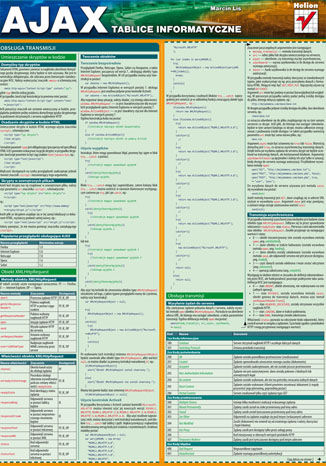
Szybka i sprawna praca z Ajaksem! Jak utworzyć obiekt w formacie JSON? Jak podzielić kod na moduły? Jak korzystać z transmisji synchronicznej? Pracujesz z Ajaksem? Ugrzązłeś przy rozwiązywaniu trudnego problemu, z którym nie możesz sobie poradzić? Potrzebujesz szybkiej podpowiedzi? Chciałbyś poszerzyć swoją wiedzę? Właśnie dla Ciebie opracowaliśmy rewelacyjne rozwiązanie - "Tablice informatyczne. Ajax". Znajdziesz tu wszystko, czego potrzebujesz, aby - bez przeglądania wielu książek - tworzyć nowoczesne, interaktywne aplikacje. Błyskawicznie dowiesz się między innymi, co oznaczają poszczególne kody, jak tworzyć węzły zwykłe i tekstowe, w jaki sposób manipulować elementami drzewa DOM, a także, jak postępować w przypadku dłuższych procedur obsługi. "Tablice informatyczne. Ajax" w zwięzły i jasny sposób prezentują praktyczne rozwiązania rozmaitych problemów związanych z tworzeniem aplikacji za pomocą tej technologii. Obsługa transmisji Umieszczanie skryptów w kodzie Obiekt XMLHttpRequest Tworzenie obiektów Metody GET i POST Kodowanie parametrów Współpraca z przeglądarką Bezpośrednie manipulowanie węzłami dokumentu Problem pamięci cache Obsługa zdarzeń AJAX i XML AJAX i PHP Kod przesyłany z serwera Jeśli chcesz pracować szybko i efektywnie -- musisz mieć je pod ręką!
Tablice informatyczne. Algorytmy
Piotr Wróblewski
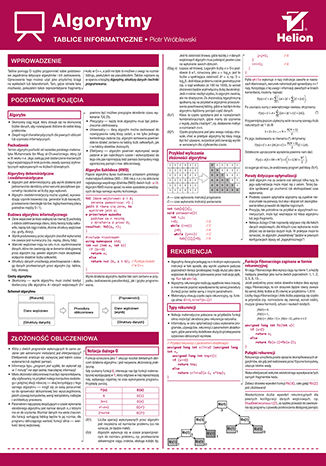
Cała wiedza w jednym miejscu! Nie pamiętasz jakiegoś algorytmu? Nie wiesz, jaką strukturę danych należy zastosować? Nie masz pojęcia, jak wyznaczyć złożoność obliczeniową algorytmu? Nie martw się, Twoje problemy należą już do przeszłości! Tablice informatyczne. Algorytmy pozwolą Ci szybko odnaleźć i przypomnieć sobie podstawowe zagadnienia dotyczące algorytmów i ich zastosowania. Będą doskonałą ściągą na wykładach lub laboratoriach, a nawet w pracy. Przykłady opracowane w C++ lub pseudokodzie pomogą właściwie zrozumieć i wdrożyć odpowiednie rozwiązania. Podstawowe pojęcia Złożoność obliczeniowa Algorytmy rekurencyjne Wyszukiwanie i sortowanie Typy i struktury danych Grafy i algorytmy grafowe Systemy liczbowe Kodowanie i kompresja Algorytmika nigdy nie była prostsza!
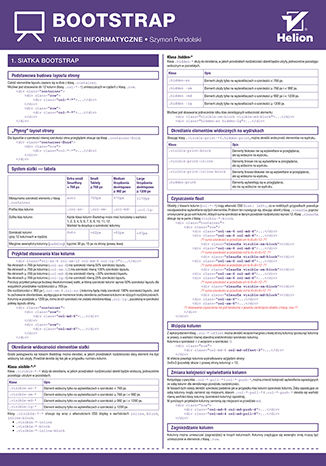
Tablice informatyczne. Bootstrap
Szymon Pendolski
Szybkie tworzenie wygodnych stron WWW? Z Bootstrapem masz to jak w banku! Projektowanie stron WWW to bardzo przyjemne zajęcie… pod warunkiem, że nie musisz wszystkiego zaczynać od podstaw i mozolnie formatować krok po kroku. Skoro gotowe rozwiązania już istnieją, nie musisz samodzielnie odkrywać Ameryki. Wystarczy Ci dobry framework: Bootstrap. Jeśli jednak chcesz posługiwać się nim na co dzień i robić to efektywnie, zawsze powinieneś mieć pod ręką tablice z najważniejszymi poleceniami, ułożonymi w sensownej kolejności. Czyli właśnie tak, jak na naszych tablicach. Ta publikacja na kilku zaledwie stronach mieści polecenia i fragmenty kodu potrzebne do pracy z Bootstrapem. Znajdziesz tu informacje o layoucie strony, właściwościach siatki i wprowadzaniu określonej typografii. Zorientujesz się, jak wykorzystać polecenia dotyczące nawigacji, list rozwijanych i etykiet. Dowiesz się, jak umieszczać na stronie formularze i elementy multimedialne, a także jak używać wtyczki Collapse. A najważniejsze, że te tablice możesz mieć zawsze pod ręką! Siatka Bootstrap Typografia, listy i tabele Formularze, przyciski i nawigacja Listy rozwijane, etykiety i bagietki Komponenty wyróżniające treść Obrazy, wideo i inne media Panele, komponent Accordion i wtyczka Collapse Bootstrap - łatwiejszy niż myślisz!
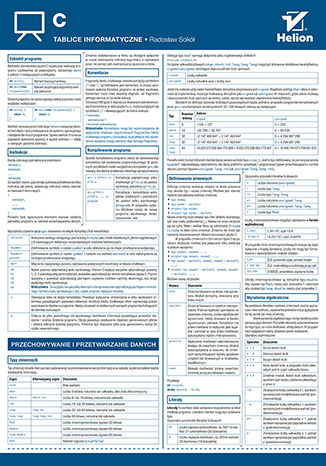
Radosław Sokół
Tablice języka C — zawsze przy komputerze! Tablice informatyczne języka C to ściąga, którą każdy programista powinien mieć zawsze w zasięgu ręki. W końcu trudno zapamiętać wszystkie komendy i metody przeprowadzania operacji, zwłaszcza jeśli nie używa się ich na co dzień. Tutaj znajdziesz informacje o instrukcjach, komentarzach, kompilowaniu programu, a także przechowywaniu i przetwarzaniu danych. Przypomnisz sobie, jak wprowadzać dane i uzyskiwać dane wyjściowe, do czego służą konkretne wyrażenia warunkowe, instrukcje pętli i skoku oraz jak w jaki sposób dynamicznie zarządzać pamięcią. Sprawdzisz, jak przetwarzać tekst, diagnozować przebieg programu, wykorzystywać strumienie i pliki, operować datą i czasem, posługiwać się biblioteką matematyczną. Nie możesz tego przegapić!
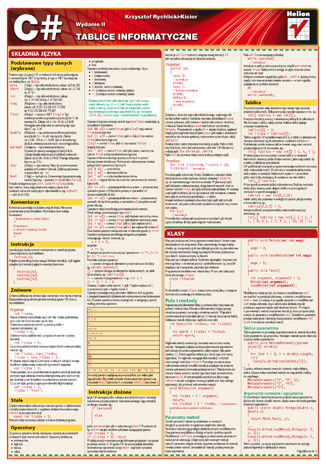
Tablice informatyczne. C#. Wydanie II
Krzysztof Rychlicki-Kicior
Koniec z wertowaniem książek i dokumentacji w poszukiwaniu składni poleceń, typów danych czy struktur języka. W tablicach informatycznych znajdziesz wszystkie podstawowe informacje, których potrzebujesz podczas codziennej pracy, podane w sposób zwięzły i treściwy. Składnia poleceń, struktura programu, funkcje i metody, obiekty, typy danych - jest tu wszystko, nad czym mógłbyś się zastanawiać. Tablice informatyczne. C# to podręczne zestawienie niezbędnych programiście informacji dotyczących języka C#. Pracując pod presją czasu, nie zawsze można znaleźć czas na wertowanie grubych książek. Niezależnie od tego, czy tworzysz aplikacje dla systemu Windows, aplikacje WWW, czy usługi sieciowe, docenisz tablice informatyczne. Znajdziesz w nich zagadnienia dotyczące obsługi w .NET: Komponentów wizualnych i niewizualnych XML (modelu DOM) Plików Strumieni Grafiki 2D LINQ
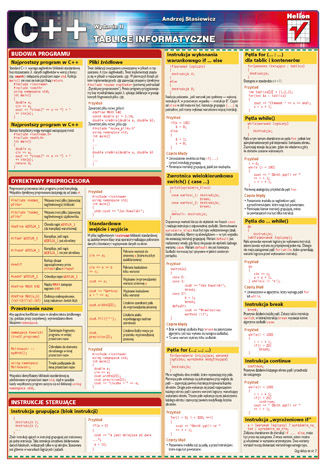
Tablice informatyczne. C++. Wydanie II
Andrzej Stasiewicz
Koniec z wertowaniem książek i dokumentacji w poszukiwaniu składni poleceń, typów danych czy struktur języka. W tablicach informatycznych znajdziesz wszystkie podstawowe informacje, których potrzebujesz podczas codziennej pracy, podane w sposób zwięzły i treściwy. Składnia poleceń, struktura programu, funkcje i metody, obiekty, typy danych -- jest tu wszystko, nad czym mógłbyś się zastanawiać. "Tablice informatyczne. C++" zawierają zestawienie najpotrzebniejszych informacji dotyczących języka C++. Każdy programista doceni je, gdy podczas pracy nie będzie miał czasu na wertowanie kilkunastu książek. W Tablicach uwzględniono najważniejsze propozycje nowego standardu języka C++ i przedstawiono następujące zagadnienia: Dyrektywy dla kompilatora Standardowe wejście i wyjście Standardowe typy danych i operacje na nich Instrukcje sterujące Funkcje Klasy Konwersje typów Wyjątki Wzorce funkcji i klas Wzorzec biblioteczny vector