
Publisher: K-i-s-publishing
Gian Marco Iodice
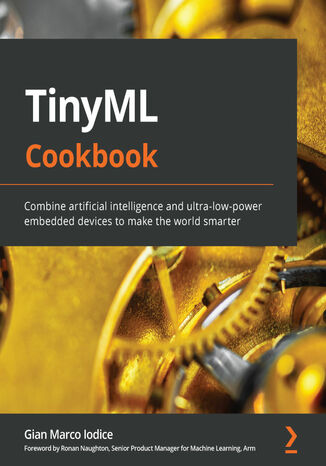
This book explores TinyML, a fast-growing field at the unique intersection of machine learning and embedded systems to make AI ubiquitous with extremely low-powered devices such as microcontrollers.The TinyML Cookbook starts with a practical introduction to this multidisciplinary field to get you up to speed with some of the fundamentals for deploying intelligent applications on Arduino Nano 33 BLE Sense and Raspberry Pi Pico. As you progress, you’ll tackle various problems that you may encounter while prototyping microcontrollers, such as controlling the LED state with GPIO and a push-button, supplying power to microcontrollers with batteries, and more. Next, you’ll cover recipes relating to temperature, humidity, and the three “V” sensors (Voice, Vision, and Vibration) to gain the necessary skills to implement end-to-end smart applications in different scenarios. Later, you’ll learn best practices for building tiny models for memory-constrained microcontrollers. Finally, you’ll explore two of the most recent technologies, microTVM and microNPU that will help you step up your TinyML game.By the end of this book, you’ll be well-versed with best practices and machine learning frameworks to develop ML apps easily on microcontrollers and have a clear understanding of the key aspects to consider during the development phase.
Gian Marco Iodice
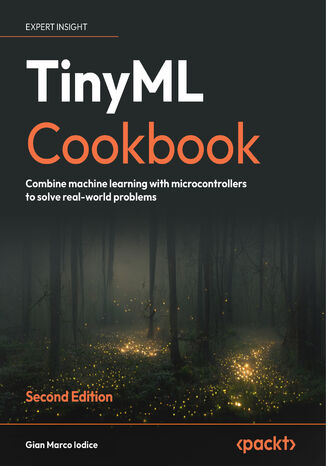
Discover the incredible world of tiny Machine Learning (tinyML) and create smart projects using real-world data sensors with the Arduino Nano 33 BLE Sense, Raspberry Pi Pico, and SparkFun RedBoard Artemis Nano.TinyML Cookbook, Second Edition, will show you how to build unique end-to-end ML applications using temperature, humidity, vision, audio, and accelerometer sensors in different scenarios. These projects will equip you with the knowledge and skills to bring intelligence to microcontrollers. You'll train custom models from weather prediction to real-time speech recognition using TensorFlow and Edge Impulse.Expert tips will help you squeeze ML models into tight memory budgets and accelerate performance using CMSIS-DSP.This improved edition includes new recipes featuring an LSTM neural network to recognize music genres and the Faster-Objects-More-Objects (FOMO) algorithm for detecting objects in a scene. Furthermore, you’ll work on scikit-learn model deployment on microcontrollers, implement on-device training, and deploy a model using microTVM, including on a microNPU. This beginner-friendly and comprehensive book will help you stay up to date with the latest developments in the tinyML community and give you the knowledge to build unique projects with microcontrollers!
Leon Anavi
If you want to enter the fascinating world of Tizen and learn how to develop engaging and successful applications then this book is for you. It'll benefit novices and experienced application developers alike.
Bhaskar Chaudhary
Tkinter is the built-in GUI package that comes with standard Python distributions. It is a cross-platform package, which means you build once and deploy everywhere. It is simple to use and intuitive in nature, making it suitable for programmers and non-programmers alike.This book will help you master the art of GUI programming. It delivers the bigger picture of GUI programming by building real-world, productive, and fun applications such as a text editor, drum machine, game of chess, audio player, drawing application, piano tutor, chat application, screen saver, port scanner, and much more. In every project, you will build on the skills acquired in the previous project and gain more expertise. You will learn to write multithreaded programs, network programs, database-driven programs, asyncio based programming and more. You will also get to know the modern best practices involved in writing GUI apps. With its rich source of sample code, you can build upon the knowledge gained with this book and use it in your own projects in the discipline of your choice.
Bhaskar Chaudhary
Tkinter is the built-in GUI package that comes with standard Python distributions. It is a cross-platform package, which means you build once and deploy everywhere. It is simple to use and intuitive in nature, making it suitable for programmers and non-programmers alike. This book will help you master the art of GUI programming. It delivers the bigger picture of GUI programming by building real-world, productive, and fun applications such as a text editor, drum machine, game of chess, media player, drawing application, chat application, screen saver, port scanner, and many more. In every project, you will build on the skills acquired in the previous project and gain more expertise. You will learn to write multithreaded programs, network programs, database driven programs and more. You will also get to know the modern best practices involved in writing GUI apps. With its rich source of sample code, you can build upon the knowledge gained with this book and use it in your own projects in the discipline of your choice.
Alejandro Rodas de Paz
As one of the more versatile programming languages, Python is well-known for its batteries-included philosophy, which includes a rich set of modules in its standard library; Tkinter is the library included for building desktop applications. Due to this, Tkinter is a common choice for rapid GUI development, and more complex applications can benefit from the full capabilities of this library. This book covers all of your Tkinter and Python GUI development problems and solutions.Tkinter GUI Application Development Cookbook starts with an overview of Tkinter classes and at the same time provides recipes for basic topics, such as layout patterns and event handling. Next, we cover how to develop common GUI patterns, such as entering and saving data, navigating through menus and dialogs, and performing long-running actions in the background.You can then make your apps leverage network resources effectively and perform graphical operations on a canvas and related tasks such as detecting collisions between items. Finally, this book covers using themed widgets, an extension of Tk widgets that have a more native look and feel. Finally, this book covers using the canvas and themed widgets.By the end of the book, you will have an in-depth knowledge of Tkinter classes, and will know how to use them to build efficient and rich GUI applications.
David Love
Tkinter is a modular, cross-platform application development toolkit for Python. When developing GUI-rich applications, the most important choices are which programming language(s) and which GUI framework to use. Python and Tkinter prove to be a great combination. This book will get you familiar with Tkinter by having you create fun and interactive projects. These projects have varying degrees of complexity. We'll start with a simple project, where you'll learn the fundamentals of GUI programming and the basics of working with a Tkinter application. After getting the basics right, we'll move on to creating a project of slightly increased complexity, such as a highly customizable Python editor. In the next project, we'll crank up the complexity level to create an instant messaging app. Toward the end, we'll discuss various ways of packaging our applications so that they can be shared and installed on other machines without the user having to learn how to install and run Python programs.
Dr. Paul Duplys, Dr. Roland Schmitz
TLS is the most widely used cryptographic protocol today, enabling e-commerce, online banking, and secure online communication. Written by Dr. Paul Duplys, Security, Privacy & Safety Research Lead at Bosch, and Dr. Roland Schmitz, Internet Security Professor at Stuttgart Media University, this book will help you gain a deep understanding of how and why TLS works, how past attacks on TLS were possible, and how vulnerabilities that enabled them were addressed in the latest TLS version 1.3. By exploring the inner workings of TLS, you’ll be able to configure it and use it more securely.Starting with the basic concepts, you’ll be led step by step through the world of modern cryptography, guided by the TLS protocol. As you advance, you’ll be learning about the necessary mathematical concepts from scratch. Topics such as public-key cryptography based on elliptic curves will be explained with a view on real-world applications in TLS. With easy-to-understand concepts, you’ll find out how secret keys are generated and exchanged in TLS, and how they are used to creating a secure channel between a client and a server.By the end of this book, you’ll have the knowledge to configure TLS servers securely. Moreover, you’ll have gained a deep knowledge of the cryptographic primitives that make up TLS.

Tokenomics. The Crypto Shift of Blockchains, ICOs, and Tokens
Sean Au, Thomas Power(GBP)
Tokenomics is the economy of this new world. This is a no-holds-barred, in-depth exploration of the way in which we can participate in the blockchain economy. The reader will learn the basics of bitcoin, blockchains, and tokenomics; what the very first ICO was; and how over a period of 5 years, various projects managed to raise the enormous sums of money they did. The book then provides insights from ICO experts and looks at what the future holds. By comparing the past, current, and future of this technology, the book will inform anyone, whatever motivates their interest.The crypto shift of blockchains, ICOs, and tokens is much more than just buying bitcoins, creating tokens, or raising millions in a minute in an ICO. It is a new paradigm shift from centralized to decentralized, from closed to open, and from opaqueness to transparency. ICOs and the creation of tokens during the craze of 2017 needed a lot of preparation, an understanding of cryptocurrencies and of emerging legal frameworks, but this has spurred a new movement to tokenize the world.The author gives an unbiased, authoritative picture of the current playing field, exploring the token opportunities and provides a unique insight into the developing world of this tokenized economy. This book will nourish hungry minds wanting to grow their knowledge in this fascinating area.
Damodar Chetty
While Tomcat is one of the most popular servlet containers, its inner workings still remain a mystery to many developers. If you only have a superficial familiarity of how this container actually functions, much of its power remains untapped and underutilized. This book will provide you with all that you need to undertand how to effectively use Apache Tomcat. This book begins by providing detailed instructions on building a Tomcat distribution. The next few chapters introduce you to the conceptual underpinnings of web servers, the Java EE and servlet specifications, and the Tomcat container. Subsequent chapters address the key Tomcat components, taking care to provide you with the information needed to understand the internal workings of each component. Detailed examples let you walk through a Tomcat installation, stepping into key Tomcat components, as well as into your own custom servlets.During the course of the book you will encounter various structural components such as the Server and Service; containers such as the Engine, Host, Context, and Wrapper; and helpers such as the Loader, Manager, and Valve. You will also see how Tomcat implements the JNDI API to provide both a directory service for storage agnostic access to its resources, as well as a naming service that implements the Java EE Environment Naming Context.Along the way you will learn how various elements of the servlet 2.5 specification, as well as the HTTP RFCs are implemented by a servlet container. By the end of your journey, you will be able to count yourself as part of the elite minority of Java EE web developers who truly understand what goes on under the covers of a servlet container.
Mark J. Price
.NET is more powerful—and more complex—than ever. As the ecosystem evolves, so do the expectations from developers. Mastering the tools and patterns of professional .NET development can be the difference between simply shipping code and delivering resilient, scalable software. Tools and Skills for .NET 10 is a practical guide to leveling up in today’s .NET world, offering both hard technical skills and career strategies to help you thrive.Inside, you’ll learn how to manage codebases with Git and implement debugging and memory analysis techniques that save hours of guesswork. The book also covers best practices for writing and maintaining documentation for your code, services, and APIs, which is crucial for team collaboration. You’ll explore cryptography for securing data and concurrency for building responsive apps. Further chapters explore dependency injection, testing for performance and reliability, and packaging your apps in Docker containers.By the end of this book, you’ll be equipped not only with technical skills but also with the confidence to apply them in real environments. Whether you're aiming for a promotion, switching jobs, or preparing for technical interviews, you'll have the skills and the language to present yourself as a capable, well-rounded .NET developer ready for anything the industry throws at you.
Mark J. Price
Unlock the full potential of .NET development with Tools and Skills for .NET 8.Dive into source code management using Git and learn how to navigate projects while ensuring version control. Discover advanced debugging techniques and troubleshooting strategies to identify and resolve issues, and gain practical insights on documenting your code, APIs, and services, fostering project clarity and maintainability. Delve into the world of cryptography, ensuring confidentiality and integrity throughout your development lifecycle.Elevate your skills as you explore cutting-edge topics such as building intelligent apps using custom LLM-based chat services, mastering dependency injection, optimizing performance through testing, and Docker containerization. Harness the power of cloud-native development with .NET Aspire, unlocking the benefits of modern cloud platforms. With guidance on software architecture best practices, this book empowers you to build robust, scalable and maintainable applications.Advance your career with invaluable insights on job readiness and interview preparation, positioning yourself as a top-tier candidate in today's competitive job market.Whether you're a seasoned .NET professional or an aspiring developer looking to enhance your skills, this book is your ultimate companion on the journey to .NET mastery.
DAVID WYAND
Torque 3D is a popular game engine that supports you in every step along the way to making your game a reality. Even with all of the power and tools that Torque 3D provides, finishing a high quality 3D game requires time and knowledge.Torque 3D Game Development Cookbook is a practical guide that takes you through each of the major steps on the journey to creating your game, while learning a few tricks along the way.The recipes in this book start off with learning some of the finer points about TorqueScript. The book then moves on to each of Torque 3D's subsystems and ends with a variety of game play recipes.The various topics covered include activating level-specific game code and scheduling game events, dragging and dropping items between windows to work with an in-game inventory system, and covering the seams between objects with well placed decals. Some of the advanced topics include writing custom shaders and postFX, using zones to improve rendering performance, and enhancing your game's ambience through sound.Once you are done with Torque 3D Game Development Cookbook you'll be on your way to creating amazing 3D games and gain expert knowledge of Torque 3D.
Eric Richardson, Filipi Pires
Modern organizations rely on complex vendor ecosystems, but third-party risk management (TPRM) and cybersecurity often operate in silos. This book shows how to connect vendor risk management with supply chain cybersecurity using a practical, lifecycle-driven approach.You’ll design a program covering onboarding, vendor risk assessment, continuous monitoring, and offboarding. You’ll begin by examining why TPRM and cybersecurity often operate in separate lanes, and what that gap costs in downtime, breach impact, and compliance exposure. Next, you’ll develop a modern taxonomy of supply chain risk, including fourth-party dependencies and software supply chain concerns, so risk discussions use consistent categories and measurable assumptions.From there, you’ll adopt a lifecycle-based model to structure vendor onboarding, assessment, monitoring, and offboarding—supported by vendor tiering, segmentation, and control mapping. The final chapter focuses on the regulatory blueprint: how to interpret NIST C-SCRM, ISO/IEC 27036, DORA, GDPR, and Executive Order 14028, then convert them into evidence-driven controls and audit-ready documentation.
Domenico D'Errico
With AI revolutionizing financial markets, every trader will soon get easy access to AI models through free Python libraries and datasets, with all of them making the same trades! This behavior will modify prices and trading volumes, potentially altering future datasets, leading to major corporations investing heavily in technology, big data, and expert teams.However, individual traders need not be intimidated because this dynamic has been seen before whenever new technologies have entered the trading market. Written by a quantitative algorithmic trading developer with over 15 years of experience in the finance industry, this book will ground you by taking a rational approach to algorithmic trading, where EasyLanguage, datasets, charts, and AI are tools for your journey toward mastering the markets. Your unique human intelligence remains invaluable in navigating and understanding market complexities as you explore the realm of institutional insights, satisfying your hunger to learn real-world algorithmic trading applications from the institutional perspective.By the end of this book, you’ll be able to confidently apply TradeStation EasyLanguage to algorithmic trading, integrate machine learning to refine your strategies, and craft a personalized approach to confidently navigate the financial markets.
Curtis Miller
Python's ease-of-use and multi-purpose nature has made it one of the most popular tools for data scientists and machine learning developers. Its rich libraries are widely used for data analysis, and more importantly, for building state-of-the-art predictive models. This book is designed to guide you through using these libraries to implement effective statistical models for predictive analytics.You’ll start by delving into classical statistical analysis, where you will learn to compute descriptive statistics using pandas. You will focus on supervised learning, which will help you explore the principles of machine learning and train different machine learning models from scratch. Next, you will work with binary prediction models, such as data classification using k-nearest neighbors, decision trees, and random forests. The book will also cover algorithms for regression analysis, such as ridge and lasso regression, and their implementation in Python. In later chapters, you will learn how neural networks can be trained and deployed for more accurate predictions, and understand which Python libraries can be used to implement them.By the end of this book, you will have the knowledge you need to design, build, and deploy enterprise-grade statistical models for machine learning using Python and its rich ecosystem of libraries for predictive analytics.