
Publisher: K-i-s-publishing
Mark J. Price
This latest edition of the bestselling Packt series will give you a solid foundation to start building projects using modern C# and .NET with confidence.You'll learn about object-oriented programming; writing, testing, and debugging functions; and implementing interfaces. You'll take on .NET APIs for managing and querying data, working with the fi lesystem, and serialization. As you progress, you'll explore examples of cross-platform projects you can build and deploy, such as websites and services using ASP.NET Core.This latest edition integrates .NET 8 enhancements into its examples: type aliasing and primary constructors for concise and expressive code. You'll handle errors robustly through the new built-in guard clauses and explore a simplified implementation of caching in ASP.NET Core 8.If that's not enough, you'll also see how native ahead-of-time (AOT) compiler publish lets web services reduce memory use and run faster. You'll work with the seamless new HTTP editor in Visual Studio 2022 to enhance the testing and debugging process. You'll even get introduced to Blazor Full Stack with its new unified hosting model for unparalleled web development flexibility.
Mark J. Price
This Packt bestseller continues to be the definitive guide to modern cross-platform development. The 9th edition of C# 13 and .NET 9 – Modern Cross-Platform Development Fundamentals has been updated to cover the latest features and improvements in .NET 9 and C# 13. You'll start by mastering object-oriented programming, learning how to write, test, and debug functions, and implementing interfaces. You'll then dive into .NET APIs for data management, filesystem operations, and serialization.This latest edition integrates .NET 9 enhancements into its examples: faster exceptions and new LINQ methods. New ASP.NET Core 9 features include optimized static assets, built-in OpenAPI document generation, and the HybridCache.Practical examples, such as building websites and services with ASP.NET Core, have been refreshed to utilize the latest .NET 9 features. The book also introduces Blazor, with its new unified hosting model for unparalleled code reusability. With these updates, you'll learn how to build robust applications and services efficiently and effectively.By the end of this book, you'll have the knowledge and confidence to create professional and high-performance web applications using the latest technologies in C# 13 and .NET 9.
Mark J. Price
C# and .NET continue to power modern cross-platform and enterprise development. With the release of C# 14 and .NET 10, developers gain access to a more capable, efficient, and future-ready platform for building websites, services, and applications across Windows, Linux, and macOS.This fully updated tenth edition takes a practical, hands-on approach. You’ll start with core C# and object-oriented programming concepts, then progress through building, testing, and debugging applications while working with .NET libraries, filesystems, serialization, and LINQ. The book covers key C# 14 enhancements—such as field modifiers, partial events, and instance constructors, explained through real-world examples.You’ll also build modern web solutions using ASP.NET Core 10, Blazor, and Minimal APIs, including support for native AOT compilation, making this book well suited for cloud-native, microservice, and container-based development.By the end of the book, you’ll be confident in building maintainable, high-performance websites and services aligned with modern .NET development practices.
C# 6 and .NET Core 1.0. Modern Cross-Platform Development
Mark J. Price
With the release of .NET Core 1.0, you can now create applications for Mac OS X and Linux, as well as Windows, using the development tools you know and love. C# 6 and .NET Core 1.0 has been divided into three high-impact sections to help start putting these new features to work. First, we'll run you through the basics of C#, as well as object-orient programming, before taking a quick tour through the latest features of C# 6 such as string interpolation for easier variable value output, exception filtering, and how to perform static class imports. We'll also cover both the full-feature, mature .NET Framework and the new, cross-platform .NET Core.After quickly taking you through C# and how .NET works, we'll dive into the internals of the .NET class libraries, covering topics such as performance, monitoring, debugging, internationalization, serialization, and encryption. We'll look at Entity Framework Core 1.0 and how to develop Code-First entity data models, as well as how to use LINQ to query and manipulate that data. The final section will demonstrate the major types of applications that you can build and deploy cross-device and cross-platform. In this section, we'll cover Universal Windows Platform (UWP) apps, web applications, and web services. Lastly, we'll help you build a complete application that can be hosted on all of today's most popular platforms, including Linux and Docker.By the end of the book, you'll be armed with all the knowledge you need to build modern, cross-platform applications using C# and .NET Core.
Dirk Strauss, Jas Rademeyer
.NET Core is a general purpose, modular, cross-platform, and open source implementation of .NET. With the latest release of .NET Core, many more APIs are expected to show up, which will make APIs consistent across .Net Framework, .NET Core, and Xamarin. This step-by-step guide will teach you the essential .NET Core and C# concepts with the help of real-world projects.The book starts with a brief introduction to the latest features of C# 7 and .NET Core 2.0 before moving on to explain how C# 7 can be implemented using the object-oriented paradigm. You'll learn to work with relational data using Entity Framework and see how to use ASP.NET Core practically. This book will show you how .NET Core allows the creations of cross-platform applications.You'll also learn about SignalR to add real-time functionality to your application. Then you will see how to use MongoDB and how to implement MongoDB into your applications. You'll learn about serverless computing and OAuth concepts, along with running ASP.NET Core applications with Docker Compose.This project-based guide uses practical applications to demonstrate these concepts. By the end of the book, you'll be proficient in developing applications using .NET Core 2.0.
Ovais Mehboob Ahmed Khan
While writing an application, performance is paramount. Performance tuning for realworld applications often involves activities geared toward fnding bottlenecks; however, this cannot solve the dreaded problem of slower code. If you want to improve the speed of your code and optimize an application's performance, then this book is for you. C# 7 and .NET Core 2.0 High Performance begins with an introduction to the new features of what?explaining how they help in improving an application's performance. Learn to identify the bottlenecks in writing programs and highlight common performance pitfalls, and learn strategies to detect and resolve these issues early. You will explore multithreading and asynchronous programming with .NET Core and learn the importance and effcient use of data structures. This is followed with memory management techniques and design guidelines to increase an application’s performance. Gradually, the book will show you the importance of microservices architecture for building highly performant applications and implementing resiliency and security in .NET Core. After reading this book, you will learn how to structure and build scalable, optimized, and robust applications in C#7 and .NET.
C# 7 and .NET Core Cookbook. Serverless programming, Microservices and more - Second Edition
Fabio Claudio Ferracchiati, Dirk Strauss
C# has recently been open-sourced and C# 7 comes with a host of new features for building powerful, cross-platform applications. This book will be your solution to some common programming problems that you come across with C# and will also help you get started with .NET Core 1.1. Through a recipe-based approach, this book will help you overcome common programming challenges and get your applications ready to face the modern world. We start by running you through new features in C# 7, such as tuples, pattern matching, and so on, giving you hands-on experience with them. Moving forward, you will work with generics and the OOP features in C#. You will then move on to more advanced topics, such as reactive extensions, Regex, code analyzers, and asynchronous programming. This book will also cover new, cross-platform .NET Core 1.1 features and teach you how to utilize .NET Core on macOS. Then, we will explore microservices as well as serverless computing and how these benefit modern developers. Finally, you will learn what you can do with Visual Studio 2017 to put mobile application development across multiple platforms within the reach of any developer.
Mark J. Price
If you want to build powerful cross-platform applications with C# 7 and .NET Core, then this book is for you.First, we’ll run you through the basics of C#, as well as object-oriented programming, before taking a quick tour through the latest features of C# 7 such as tuples, pattern matching, out variables, and so on.After quickly taking you through C# and how .NET works, we’ll dive into the .NET Standard 1.6 class libraries, covering topics such as performance, monitoring, debugging, serialization and encryption.The final section will demonstrate the major types of application that you can build and deploy cross-device and cross-platform. In this section, we’ll cover Universal Windows Platform (UWP) apps, web applications, mobile apps, and web services. Lastly, we’ll look at how you can package and deploy your applications so that they can be hosted on all of today’s most popular platforms, including Linux and Docker.By the end of the book, you’ll be armed with all the knowledge you need to build modern, cross-platform applications using C# and .NET Core.
C# 7 and .NET: Designing Modern Cross-platform Applications. The Open Source revolution of .NET Core
Mark J. Price, Ovais Mehboob Ahmed Khan
C# is a widely used programming language, thanks to its easy learning curve, versatility, and support for modern paradigms. The language is used to create desktop apps, background services, web apps, and mobile apps. .NET Core is open source and compatible with Mac OS and Linux. There is no limit to what you can achieve with C# and .NET Core.This Learning Path begins with the basics of C# and object-oriented programming (OOP) and explores features of C#, such as tuples, pattern matching, and out variables. You will understand.NET Standard 2.0 class libraries and ASP.NET Core 2.0, and create professional websites, services, and applications. You will become familiar with mobile app development using Xamarin.Forms and learn to develop high-performing applications by writing optimized code with various profiling techniques.By the end of C# 7 and .NET: Designing Modern Cross-platform Applications, you will have all the knowledge required to build modern, cross-platform apps using C# and .NET.This Learning Path includes content from the following Packt products:• C# 7.1 and .NET Core 2.0 - Modern Cross-Platform Development - Third Edition by Mark J. Price • C# 7 and .NET Core 2.0 High Performance by Ovais Mehboob Ahmed Khan
Mark J. Price, Dustin Heffron, Efraim Kyriakidis
C# 7.1 and .NET Core 2.0 – Modern Cross-Platform Development, Third Edition, is a practical guide to creating powerful cross-platform applications with C# 7.1 and .NET Core 2.0. It gives readers of any experience level a solid foundation in C# and .NET. The first part of the book runs you through the basics of C#, as well as debugging functions and object-oriented programming, before taking a quick tour through the latest features of C# 7.1 such as default literals, tuples, inferred tuple names, pattern matching, out variables, and more.After quickly taking you through C# and how .NET works, this book dives into the .NET Standard 2.0 class libraries, covering topics such as packaging and deploying your own libraries, and using common libraries for working with collections, performance, monitoring, serialization, files, databases, and encryption. The final section of the book demonstrates the major types of application that you can build and deploy cross-device and cross-platform. In this section, you'll learn about websites, web applications, web services, Universal Windows Platform (UWP) apps, and mobile apps. By the end of the book, you'll be armed with all the knowledge you need to build modern, cross-platform applications using C# and .NET.
Paul Michaels, Dirk Strauss, Jas Rademeyer
.NET Core is a general-purpose, modular, cross-platform, and opensource implementation of .NET. The latest release of .NET Core 3 comes with improved performance and security features, along with support for desktop applications. .NET Core 3 is not only useful for new developers looking to start learning the framework, but also for legacy developers interested in migrating their apps. Updated with the latest features and enhancements, this updated second edition is a step-by-step, project-based guide.The book starts with a brief introduction to the key features of C# 8 and .NET Core 3.You'll learn to work with relational data using Entity Framework Core 3, before understanding how to use ASP.NET Core. As you progress, you’ll discover how you can use .NET Core to create cross-platform applications. Later, the book will show you how to upgrade your old WinForms apps to .NET Core 3. The concluding chapters will then help you use SignalR effectively to add real-time functionality to your applications, before demonstrating how to implement MongoDB in your apps. Finally, you'll delve into serverless computing and how to build microservices using Docker and Kubernetes.By the end of this book, you'll be proficient in developing applications using .NET Core 3.
Mark J. Price
In C# 8.0 and .NET Core 3.0 – Modern Cross-Platform Development, Fourth Edition, expert teacher Mark J. Price gives you everything you need to start programming C# applications.This latest edition uses the popular Visual Studio Code editor to work across all major operating systems. It is fully updated and expanded with new chapters on Content Management Systems (CMS) and machine learning with ML.NET.The book covers all the topics you need. Part 1 teaches the fundamentals of C#, including object-oriented programming, and new C# 8.0 features such as nullable reference types, simplified switch pattern matching, and default interface methods. Part 2 covers the .NET Standard APIs, such as managing and querying data, monitoring and improving performance, working with the filesystem, async streams, serialization, and encryption. Part 3 provides examples of cross-platform applications you can build and deploy, such as web apps using ASP.NET Core or mobile apps using Xamarin.Forms. The book introduces three technologies for building Windows desktop applications including Windows Forms, Windows Presentation Foundation (WPF), and Universal Windows Platform (UWP) apps, as well as web applications, web services, and mobile apps.
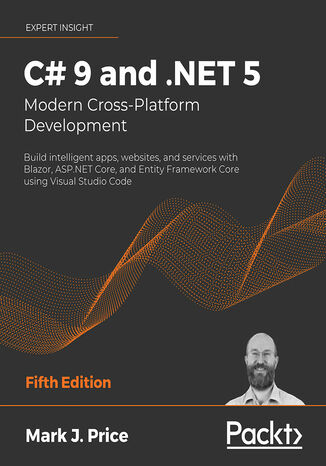
Mark J. Price
In C# 9 and .NET 5 – Modern Cross-Platform Development, Fifth Edition, expert teacher Mark J. Price gives you everything you need to start programming C# applications.This latest edition uses the popular Visual Studio Code editor to work across all major operating systems. It is fully updated and expanded with a new chapter on the Microsoft Blazor framework.The book’s first part teaches the fundamentals of C#, including object-oriented programming and new C# 9 features such as top-level programs, target-typed new object instantiation, and immutable types using the record keyword. Part 2 covers the .NET APIs, for performing tasks like managing and querying data, monitoring and improving performance, and working with the file system, async streams, serialization, and encryption. Part 3 provides examples of cross-platform apps you can build and deploy, such as websites and services using ASP.NET Core or mobile apps using Xamarin.Forms. The best type of application for learning the C# language constructs and many of the .NET libraries is one that does not distract with unnecessary application code. For that reason, the C# and .NET topics covered in Chapters 1 to 13 feature console applications. In Chapters 14 to 20, having mastered the basics of the language and libraries, you will build practical applications using ASP.NET Core, Model-View-Controller (MVC), and Blazor.By the end of the book, you will have acquired the understanding and skills you need to use C# 9 and .NET 5 to create websites, services, and mobile apps.
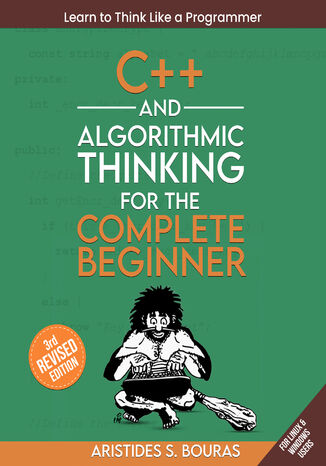
Aristides Bouras
Embark on your programming journey with a thorough introduction to how computers work, setting the stage for understanding C++ and its applications. This course begins with the basics, including setting up your development environment and installing necessary software packages. As you progress, you'll delve into fundamental algorithmic concepts, variables, constants, and handling input and output efficiently.As you build your knowledge, the course introduces more complex topics such as sequence control structures, decision-making processes, and loop control structures. You will learn to manipulate numbers, strings, and understand the intricacies of operators through practical exercises and real-world examples. Visual aids like trace tables and flowcharts will help you visualize the flow of your programs and improve your debugging skills.Towards the end of the course, you'll explore advanced topics such as arrays, data structures, subprograms, and an introduction to object-oriented programming. By the conclusion, you will also gain insights into file handling and advanced algorithmic strategies. Each chapter is designed to build on the previous one, ensuring a cohesive and comprehensive learning experience that equips you with the skills needed to excel in C++ programming and algorithmic thinking.
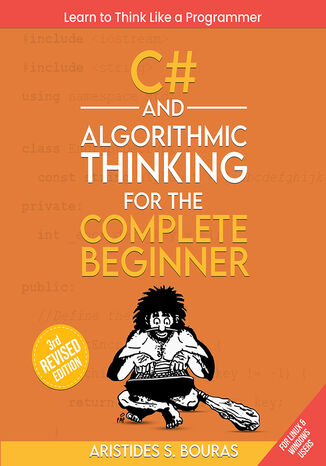
Aristides Bouras
This course takes you on a journey through the basics of C# programming and algorithmic thinking, tailored specifically for complete beginners. Starting with an understanding of how a computer works, you will explore integrated development environments, essential software packages, and basic algorithmic concepts.As you progress, you will delve deeper into key programming constructs such as variables, constants, input and output handling, operators, and control structures. The course emphasizes practical application, guiding you through exercises involving complex mathematical expressions, string manipulations, decision structures, and loop control structures. By the time you reach the advanced sections, you will have a comprehensive understanding of data structures, subprograms, and object-oriented programming.Designed to be engaging and informative, this course offers tips, tricks, and detailed explanations to help you master each concept. The use of Visual Studio Code is seamlessly integrated, providing you with hands-on experience in a real-world development environment. By the end of the course, you will be well-equipped to tackle more advanced programming challenges and continue your journey in the world of software development.
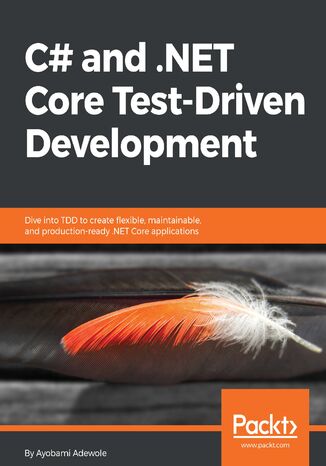
Ayobami Adewole
This book guides developers to create robust, production-ready C# 7 and .NET Core applications through the practice of test-driven development process. In C# and .NET Core Test-Driven Development, you will learn the different stages of the TDD life cycle, basics of TDD, best practices, and anti-patterns. It will teach you how to create an ASP.NET Core MVC sample application, write testable code with SOLID principles and set up a dependency injection for your sample application. Next, you will learn the xUnit testing framework and learn how to use its attributes and assertions. You’ll see how to create data-driven unit tests and mock dependencies in your code. You will understand the difference between running and debugging your tests on .NET Core on LINUX versus Windows and Visual Studio. As you move forward, you will be able to create a healthy continuous integration process for your sample application using GitHub, TeamCity, Cake, and Microsoft VSTS.By the end of this book, you will have learned how to write clean and robust code through the effective practice of TDD, set up CI build steps to test and build applications as well as how to package application for deployment on NuGet.