
Publisher: K-i-s-publishing
Puppet 8 for DevOps Engineers. Automate your infrastructure at an enterprise scale
David Sandilands
As DevOps and platform engineering drive the demand for robust internal development platforms, the need for infrastructure configuration tools has never been greater. Puppet, a powerful configuration management tool, is widely used by leading enterprises and boasts a thriving open source community.This book provides a comprehensive explanation of both the Puppet language and the platform. It begins by helping you grasp the basic concepts and approach of Puppet as a stateful language, and then builds up to explaining how to structure Puppet code to scale and allow flexibility and collaboration among teams. As you advance, you’ll find out how the Puppet platform allows the management and reporting of infrastructure configuration. The book also shows you how the platform can be integrated with other tooling, such as ServiceNow and Splunk. The concluding chapters help you implement Puppet to fit in heavily regulated and audited environments as well as modern hybrid cloud environments.By the end of this book, you’ll have gained a solid understanding of the capabilities of both the Puppet language and platform, and you will have learned how to structure and scale Puppet to create a platform to provide enterprise-grade infrastructure configuration.
Thomas Uphill, John Arundel
This book is for anyone who builds and administers servers, especially in a web operations context. It requires some experience of Linux systems administration, including familiarity with the command line, file system, and text editing. No programming experience is required.
Puppet for Containerization. Manage, orchestrate, and deploy containers with Puppet
Scott Coulton
This book teaches you how to take advantage of the new benefits of containerization systems such as Docker, Kubernetes, Docker Swarm, and Docker UCP, without losing the panoptical power of proper configuration management. You will learn how to integrate your containerized applications and modules with your Puppet workflow. You will also understand how to manage, monitor, and orchestrate hosts to keep deployed containers running seamlessly. With the help of this book, you can efficiently automate and document with containers, as a part of your system.The book will also cover use cases of deploying Puppet within a containerized environment.
Puppet: Mastering Infrastructure Automation
Jaime Soriano Pastor
Puppet is a configuration management tool that allows you to automate all your IT configurations, giving you control. It was written for and by system administrators to manage large numbers of systems efficiently and prevent configuration drifts. Puppet gives you control of what you do to each node, when you do it, and how you do it.This Learning Path will take you from the basics of Puppet to extending it and then mastering it. We will start off with a primer on Puppet, its installation and get a sneak peek under its hood. We will then move on to designing and deploying your Puppet architecture, learning best practices for writing reusable and maintainable code, and executing, testing, and deploying Puppet across your systems. Finally, we will deal with problems of scale and exceptions in your code, automate workflows, and support multiple developers working simultaneously.This course is based on the following books: 1)Puppet 4 Essentials - Second Edition 2)Extending Puppet - Second Edition 3)Mastering Puppet - Second Edition
Michael Duffy
An easy to follow guide with extensive examples to explain Puppet's reporting capabilities to facilitate effective implementation of Puppet in the real world as a reporting tool.If you are a Puppet developer or a system administrator using Puppet, and you want to extend your expertise to manage and optimize your server resources, then this book is for you.
David Routin, Simon Thoores, Samuel Rossier
With small to large companies focusing on hardening their security systems, the term purple team has gained a lot of traction over the last couple of years. Purple teams represent a group of individuals responsible for securing an organization’s environment using both red team and blue team testing and integration – if you’re ready to join or advance their ranks, then this book is for you. Purple Team Strategies will get you up and running with the exact strategies and techniques used by purple teamers to implement and then maintain a robust environment. You’ll start with planning and prioritizing adversary emulation, and explore concepts around building a purple team infrastructure as well as simulating and defending against the most trendy ATT&CK tactics. You’ll also dive into performing assessments and continuous testing with breach and attack simulations. Once you’ve covered the fundamentals, you'll also learn tips and tricks to improve the overall maturity of your purple teaming capabilities along with measuring success with KPIs and reporting.With the help of real-world use cases and examples, by the end of this book, you'll be able to integrate the best of both sides: red team tactics and blue team security measures.
Venkateshwaran Loganathan, Gopinath Jaganmohan
Elegantly-built GUI applications are always a massive hit among users. PySide is an open source software project that provides Python bindings for the Qt cross-platform UI framework. Combining the power of Qt and Python, PySide provides easy access to the Qt framework for Python developers and also acts as an excellent rapid application development platform.This book will take you through everything you need to know to develop UI applications. You will learn about installing and building PySide in various major operating systems as well as the basics of GUI programming. The book will then move on to discuss event management, signals and slots, and the widgets and dialogs available with PySide. Database interaction and manipulation is also covered.By the end of this book, you will be able to program GUI applications efficiently and master how to develop your own applications and how to run them across platforms.
Denny Lee, Tomasz Drabas
Apache Spark is an open source framework for efficient cluster computing with a strong interface for data parallelism and fault tolerance. The PySpark Cookbook presents effective and time-saving recipes for leveraging the power of Python and putting it to use in the Spark ecosystem.You’ll start by learning the Apache Spark architecture and how to set up a Python environment for Spark. You’ll then get familiar with the modules available in PySpark and start using them effortlessly. In addition to this, you’ll discover how to abstract data with RDDs and DataFrames, and understand the streaming capabilities of PySpark. You’ll then move on to using ML and MLlib in order to solve any problems related to the machine learning capabilities of PySpark and use GraphFrames to solve graph-processing problems. Finally, you will explore how to deploy your applications to the cloud using the spark-submit command.By the end of this book, you will be able to use the Python API for Apache Spark to solve any problems associated with building data-intensive applications.
pytest Quick Start Guide. Write better Python code with simple and maintainable tests
Bruno Oliveira
Python's standard unittest module is based on the xUnit family of frameworks, which has its origins in Smalltalk and Java, and tends to be verbose to use and not easily extensible.The pytest framework on the other hand is very simple to get started, but powerful enough to cover complex testing integration scenarios, being considered by many the true Pythonic approach to testing in Python.In this book, you will learn how to get started right away and get the most out of pytest in your daily work?ow, exploring powerful mechanisms and plugins to facilitate many common testing tasks. You will also see how to use pytest in existing unittest-based test suites and will learn some tricks to make the jump to a pytest-style test suite quickly and easily.
Mike Ohlson de Fine
Python is a great object-oriented and interactive programming language that lets you develop graphics, both static and animated, using built-in vector graphics functions that are provided with Python.Python 2.6 Graphics Cookbook is a collection of straightforward recipes and illustrative screenshots for creating and animating graphic objects using the Python language. This book makes the process of developing graphics interesting and entertaining by working in a graphic workspace without the burden of mastering complicated language definitions and opaque examples.If you choose to work through all the recipes from the beginning, you will learn to install Python and create basic programs for making lines and shapes using the built-in Tkinter module. The confusing topic of color manipulation is explored in detail using existing Python tools as well as some new tools in the recipes. Next you will learn to manipulate font size, color, and placement of text as placing text exactly where you want on a screen can be tricky because font height, inter-character spacing, and text window dimensions all interfere with each other. Then you will learn how to animate graphics, for example having more than one independent graphic object co-exist and interact using various Python methods.You will also learn how you can work with raster images, such as converting their formats using the Python Imaging Library. Next you will learn how you can combine vector images with raster images so that you can animate the raster images with ease. You will also walk through a set of recipes with the help of which you can handle and manipulate blocks of raw data that may be hundreds of megabytes in size using datastreams, files, and hard drives. You will also learn how you can use Inkscape to dismantle existing images and use parts of them for your own graphics and Python programs. At the end of the book you will learn how you can create GUIs for different purposes.
Python 3 Object Oriented Programming. Harness the power of Python 3 objects
Dusty Phillips
Object Oriented Programming is a very important aspect of modern programming languages. The basic principles of Object Oriented Programming are relatively easy to learn. Putting them together into working designs can be challenging.This book makes programming more of a pleasure than a chore using powerful Python 3 object-oriented features of Python 3. It clearly demonstrates the core OOP principles and how to correctly implement OOP in Python. Object Oriented Programming ranks high in importance among the many models Python supports. Yet, many programmers never bother learning the powerful features that make this language object oriented.The book teaches when and how OOP should be correctly applied. It emphasizes not only the simple syntax of OOP in Python, but also how to combine these objects into well-designed software.This book will introduce you to the terminology of the object-oriented paradigm, focusing on object-oriented design with step-by-step examples. It will take you from simple inheritance, one of the most useful tools in the object-oriented programmer's toolbox, all the way through to cooperative inheritance, one of the most complicated. You will be able to raise, handle, define, and manipulate exceptions.You will be able to integrate the object-oriented and the not-so-object-oriented aspects of Python. You will also be able to create maintainable applications by studying higher level design patterns. You'll learn the complexities of string and file manipulation, and how Python distinguishes between binary and textual data. Not one, but two very powerful automated testing systems will be introduced to you. You'll understand the joy of unit testing and just how easy they are to create. You'll even study higher level libraries such as database connectors and GUI toolkits and how they apply object-oriented principles.
Dusty Phillips
Object-oriented programming (OOP) is a popular design paradigm in which data and behaviors are encapsulated in such a way that they can be manipulated together. This third edition of Python 3 Object-Oriented Programming fully explains classes, data encapsulation, and exceptions with an emphasis on when you can use each principle to develop well-designed software.Starting with a detailed analysis of object-oriented programming, you will use the Python programming language to clearly grasp key concepts from the object-oriented paradigm. You will learn how to create maintainable applications by studying higher level design patterns. The book will show you the complexities of string and file manipulation, and how Python distinguishes between binary and textual data. Not one, but two very powerful automated testing systems, unittest and pytest, will be introduced in this book. You'll get a comprehensive introduction to Python's concurrent programming ecosystem.By the end of the book, you will have thoroughly learned object-oriented principles using Python syntax and be able to create robust and reliable programs confidently.
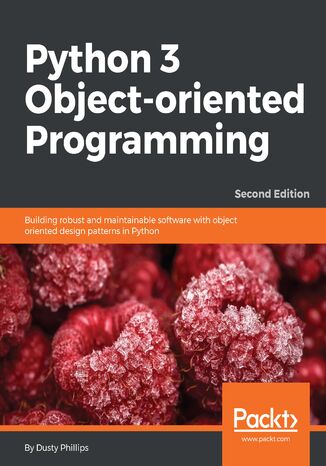
Dusty Phillips
Python 3 is more versatile and easier to use than ever. It runs on all major platforms in a huge array of use cases. Coding in Python minimizes development time and increases productivity in comparison to other languages. Clean, maintainable code is easy to both read and write using Python's clear, concise syntax.Object-oriented programming is a popular design paradigm in which data and behaviors are encapsulated in such a way that they can be manipulated together. Many modern programming languages utilize the powerful concepts behind object-oriented programming and Python is no exception.Starting with a detailed analysis of object-oriented analysis and design, you will use the Python programming language to clearly grasp key concepts from the object-oriented paradigm. This book fully explains classes, data encapsulation, inheritance, polymorphism, abstraction, and exceptions with an emphasis on when you can use each principle to develop well-designed software.You'll get an in-depth analysis of many common object-oriented design patterns that are more suitable to Python's unique style. This book will not just teach Python syntax, but will also build your confidence in how to program.You will also learn how to create maintainable applications by studying higher level design patterns. Following this, you'll learn the complexities of string and file manipulation, and how Python distinguishes between binary and textual data. Not one, but two very powerful automated testing systems will be introduced in the book. After you discover the joy of unit testing and just how easy it can be, you'll study higher level libraries such as database connectors and GUI toolkits and learn how they uniquely apply object-oriented principles. You'll learn how these principles will allow you to make greater use of key members of the Python eco-system such as Django and Kivy.This new edition includes all the topics that made Python 3 Object-oriented Programming an instant Packt classic. It's also packed with updated content to reflect recent changes in the core Python library and covers modern third-party packages that were not available on the Python 3 platform when the book was first published.
Python 3 Text Processing with NLTK 3 Cookbook. - Second Edition
Jacob Perkins
This book is intended for Python programmers interested in learning how to do natural language processing. Maybe you’ve learned the limits of regular expressions the hard way, or you’ve realized that human language cannot be deterministically parsed like a computer language. Perhaps you have more text than you know what to do with, and need automated ways to analyze and structure that text. This Cookbook will show you how to train and use statistical language models to process text in ways that are practically impossible with standard programming tools. A basic knowledge of Python and the basic text processing concepts is expected. Some experience with regular expressions will also be helpful.
Python 3. The Comprehensive Guide
Rheinwerk Publishing, Inc, Johannes Ernesti, Peter Kaiser
This in-depth guide to Python 3 begins by helping readers install the language and understand its core syntax through interactive exploration. Early chapters cover variables, control structures, functions, and data types like lists, tuples, dictionaries, and sets. Readers then move into file handling, error management, and object-oriented programming, building a solid foundation for real-world development.As the journey continues, the book introduces advanced concepts including decorators, generators, type hints, structural pattern matching, and context managers. It thoroughly explores the Python standard library, with practical applications in math, file systems, logging, regular expressions, parallel processing, and debugging. Readers also learn how to manage packages, virtual environments, and distributions.Later chapters shift to applied development—building GUIs with tkinter and PySide6, creating web applications with Django, and working with scientific tools like NumPy, pandas, and SciPy. The book concludes with insights on using alternative interpreters, localization, and migrating from Python 2 to 3. This resource grows with the reader, from basics to expert-level Python programming.
Giuseppe Bonaccorso, Rajalingappaa Shanmugamani
This Learning Path is your complete guide to quickly getting to grips with popular machine learning algorithms. You'll be introduced to the most widely used algorithms in supervised, unsupervised, and semi-supervised machine learning, and learn how to use them in the best possible manner. Ranging from Bayesian models to the MCMC algorithm to Hidden Markov models, this Learning Path will teach you how to extract features from your dataset and perform dimensionality reduction by making use of Python-based libraries. You'll bring the use of TensorFlow and Keras to build deep learning models, using concepts such as transfer learning, generative adversarial networks, and deep reinforcement learning. Next, you'll learn the advanced features of TensorFlow1.x, such as distributed TensorFlow with TF clusters, deploy production models with TensorFlow Serving. You'll implement different techniques related to object classification, object detection, image segmentation, and more. By the end of this Learning Path, you'll have obtained in-depth knowledge of TensorFlow, making you the go-to person for solving artificial intelligence problemsThis Learning Path includes content from the following Packt products:• Mastering Machine Learning Algorithms by Giuseppe Bonaccorso• Mastering TensorFlow 1.x by Armando Fandango• Deep Learning for Computer Vision by Rajalingappaa Shanmugamani
Ashish Kumar, Joseph Babcock
Social Media and the Internet of Things have resulted in an avalanche of data. Data is powerful but not in its raw form; it needs to be processed and modeled, and Python is one of the most robust tools out there to do so. It has an array of packages for predictive modeling and a suite of IDEs to choose from. Using the Python programming language, analysts can use these sophisticated methods to build scalable analytic applications. This book is your guide to getting started with predictive analytics using Python.You'll balance both statistical and mathematical concepts, and implement them in Python using libraries such as pandas, scikit-learn, and NumPy. Through case studies and code examples using popular open-source Python libraries, this book illustrates the complete development process for analytic applications. Covering a wide range of algorithms for classification, regression, clustering, as well as cutting-edge techniques such as deep learning, this book illustrates explains how these methods work. You will learn to choose the right approach for your problem and how to develop engaging visualizations to bring to life the insights of predictive modeling.Finally, you will learn best practices in predictive modeling, as well as the different applications of predictive modeling in the modern world. The course provides you with highly practical content from the following Packt books:1. Learning Predictive Analytics with Python2. Mastering Predictive Analytics with Python
Pushpak Dagade
If you want to find out how you can build a solid foundation in algorithmic trading using Python, this cookbook is here to help.Starting by setting up the Python environment for trading and connectivity with brokers, you’ll then learn the important aspects of financial markets. As you progress, you’ll learn to fetch financial instruments, query and calculate various types of candles and historical data, and finally, compute and plot technical indicators. Next, you’ll learn how to place various types of orders, such as regular, bracket, and cover orders, and understand their state transitions. Later chapters will cover backtesting, paper trading, and finally real trading for the algorithmic strategies that you've created. You’ll even understand how to automate trading and find the right strategy for making effective decisions that would otherwise be impossible for human traders.By the end of this book, you’ll be able to use Python libraries to conduct key tasks in the algorithmic trading ecosystem.Note: For demonstration, we're using Zerodha, an Indian Stock Market broker. If you're not an Indian resident, you won't be able to use Zerodha and therefore will not be able to test the examples directly. However, you can take inspiration from the book and apply the concepts across your preferred stock market broker of choice.
Aristides Bouras
This course is meticulously designed to take beginners on a journey through the fascinating world of Python programming and algorithmic thinking. The initial chapters lay a strong foundation, starting with the basics of how computers operate, moving into Python programming, and familiarizing learners with integrated development environments like IDLE and Visual Studio Code.Further, the course delves into essential programming constructs such as variables, constants, input/output handling, and operators. You'll gain practical experience with trace tables, sequence control structures, and decision control structures through comprehensive exercises and examples. The curriculum emphasizes hands-on learning with chapters dedicated to manipulating numbers, strings, and understanding complex mathematical expressions. By mastering these concepts, you'll be well-prepared to tackle more advanced topics.The final chapters introduce you to object-oriented programming and file manipulation, rounding out your skill set. Throughout the course, practical tips and tricks are provided to enhance your coding efficiency and problem-solving skills. By the end of this course, you will have a robust understanding of Python programming and the ability to apply algorithmic thinking to solve real-world problems.
Cuantum Technologies LLC
Embark on a transformative journey with this course designed to equip you with robust Python and SQL skills. Starting with an introduction to Python, you'll delve into fundamental building blocks, control flow, functions, and object-oriented programming. As you progress, you'll master data structures, file I/O, exception handling, and the Python Standard Library, ensuring a solid foundation in Python.The course then transitions to SQL, beginning with an introduction and covering basics, and proceeding to advanced querying techniques. You'll learn about database administration and how Python integrates seamlessly with SQL, enhancing your data manipulation capabilities. By combining Python with SQLAlchemy, you'll perform advanced database operations and execute complex data analysis tasks, preparing you for real-world challenges.By the end of this course, you will have developed the expertise to utilize Python and SQL for scientific computing, data analysis, and database management. This comprehensive learning path ensures you can tackle diverse projects, from basic scripting to sophisticated data operations, making you a valuable asset in the tech industry. You'll also gain hands-on experience with real-world datasets, enhancing your problem-solving skills and boosting your confidence.
Python API Development Fundamentals. Develop a full-stack web application with Python and Flask
Jack Chan, Ray Chung , Jack Huang
Python is a flexible language that can be used for much more than just script development. By knowing the Python RESTful APIs work, you can build a powerful backend for web applications and mobile applications using Python.You'll take your first steps by building a simple API and learning how the frontend web interface can communicate with the backend. You'll also learn how to serialize and deserialize objects using the marshmallow library. Then, you'll learn how to authenticate and authorize users using Flask-JWT. You'll also learn how to enhance your APIs by adding useful features, such as email, image upload, searching, and pagination. You'll wrap up the whole book by deploying your APIs to the cloud.By the end of this book, you'll have the confidence and skill to leverage the power of RESTful APIs and Python to build efficient web applications.
Jaime Buelta
Developing large-scale systems that continuously grow in scale and complexity requires a thorough understanding of how software projects should be implemented. Software developers, architects, and technical management teams rely on high-level software design patterns such as microservices architecture, event-driven architecture, and the strategic patterns prescribed by domain-driven design (DDD) to make their work easier.This book covers these proven architecture design patterns with a forward-looking approach to help Python developers manage application complexity—and get the most value out of their test suites.Starting with the initial stages of design, you will learn about the main blocks and mental flow to use at the start of a project. The book covers various architectural patterns like microservices, web services, and event-driven structures and how to choose the one best suited to your project. Establishing a foundation of required concepts, you will progress into development, debugging, and testing to produce high-quality code that is ready for deployment. You will learn about ongoing operations on how to continue the task after the system is deployed to end users, as the software development lifecycle is never finished.By the end of this Python book, you will have developed architectural thinking: a different way of approaching software design, including making changes to ongoing systems.
Dr. Joshua Eckroth
Artificial Intelligence (AI) is the newest technology that’s being employed among varied businesses, industries, and sectors. Python Artificial Intelligence Projects for Beginners demonstrates AI projects in Python, covering modern techniques that make up the world of Artificial Intelligence.This book begins with helping you to build your first prediction model using the popular Python library, scikit-learn. You will understand how to build a classifier using an effective machine learning technique, random forest, and decision trees. With exciting projects on predicting bird species, analyzing student performance data, song genre identification, and spam detection, you will learn the fundamentals and various algorithms and techniques that foster the development of these smart applications. In the concluding chapters, you will also understand deep learning and neural network mechanisms through these projects with the help of the Keras library.By the end of this book, you will be confident in building your own AI projects with Python and be ready to take on more advanced projects as you progress
Jaime Buelta
In this updated and extended version of Python Automation Cookbook, each chapter now comprises the newest recipes and is revised to align with Python 3.8 and higher. The book includes three new chapters that focus on using Python for test automation, machine learning projects, and for working with messy data.This edition will enable you to develop a sharp understanding of the fundamentals required to automate business processes through real-world tasks, such as developing your first web scraping application, analyzing information to generate spreadsheet reports with graphs, and communicating with automatically generated emails.Once you grasp the basics, you will acquire the practical knowledge to create stunning graphs and charts using Matplotlib, generate rich graphics with relevant information, automate marketing campaigns, build machine learning projects, and execute debugging techniques.By the end of this book, you will be proficient in identifying monotonous tasks and resolving process inefficiencies to produce superior and reliable systems.