
Wydawca: K-i-s-publishing
R Statistics Cookbook. Over 100 recipes for performing complex statistical operations with R 3.5
Francisco Juretig
R is a popular programming language for developing statistical software. This book will be a useful guide to solving common and not-so-common challenges in statistics. With this book, you'll be equipped to confidently perform essential statistical procedures across your organization with the help of cutting-edge statistical tools.You'll start by implementing data modeling, data analysis, and machine learning to solve real-world problems. You'll then understand how to work with nonparametric methods, mixed effects models, and hidden Markov models. This book contains recipes that will guide you in performing univariate and multivariate hypothesis tests, several regression techniques, and using robust techniques to minimize the impact of outliers in data.You'll also learn how to use the caret package for performing machine learning in R. Furthermore, this book will help you understand how to interpret charts and plots to get insights for better decision making.By the end of this book, you will be able to apply your skills to statistical computations using R 3.5. You will also become well-versed with a wide array of statistical techniques in R that are extensively used in the data science industry.
R: Unleash Machine Learning Techniques. Smarter data analytics
Dipanjan Sarkar, Brett Lantz, Raghav Bali, Cory...
R is the established language of data analysts and statisticians around the world. And you shouldn’t be afraid to use it…This Learning Path will take you through the fundamentals of R and demonstrate how to use the language to solve a diverse range of challenges through machine learning. Accessible yet comprehensive, it provides you with everything you need to become more a more fluent data professional, and more confident with R. In the first module you’ll get to grips with the fundamentals of R. This means you’ll be taking a look at some of the details of how the language works, before seeing how to put your knowledge into practice to build some simple machine learning projects that could prove useful for a range of real world problems.For the following two modules we’ll begin to investigate machine learning algorithms in more detail. To build upon the basics, you’ll get to work on three different projects that will test your skills. Covering some of the most important algorithms and featuring some of the most popular R packages, they’re all focused on solving real problems in different areas, ranging from finance to social media.This Learning Path has been curated from three Packt products:• R Machine Learning By Example By Raghav Bali, Dipanjan Sarkar• Machine Learning with R - Second Edition By Brett Lantz• Mastering Machine Learning with R By Cory Lesmeister
R Web Scraping Quick Start Guide. Techniques and tools to crawl and scrape data from websites
Olgun Aydin
Web scraping is a technique to extract data from websites. It simulates the behavior of a website user to turn the website itself into a web service to retrieve or introduce new data. This book gives you all you need to get started with scraping web pages using R programming.You will learn about the rules of RegEx and Xpath, key components for scraping website data. We will show you web scraping techniques, methodologies, and frameworks. With this book's guidance, you will become comfortable with the tools to write and test RegEx and XPath rules. We will focus on examples of dynamic websites for scraping data and how to implement the techniques learned. You will learn how to collect URLs and then create XPath rules for your first web scraping script using rvest library. From the data you collect, you will be able to calculate the statistics and create R plots to visualize them. Finally, you will discover how to use Selenium drivers with R for more sophisticated scraping. You will create AWS instances and use R to connect a PostgreSQL database hosted on AWS. By the end of the book, you will be sufficiently confident to create end-to-end web scraping systems using R.
Sigismondo Boschi, Gabriele Santomaggio
RabbitMQ is an open source message broker software (sometimes called message-oriented middleware) that implements the Advanced Message Queuing Protocol (AMQP). The RabbitMQ server is written in the Erlang programming language and is built on the Open Telecom Platform framework for clustering and failover. Messaging enables software applications to connect and scale. Applications can connect to each other as components of a larger application or to user devices and data.RabbitMQ Cookbook touches on all the aspects of RabbitMQ messaging. You will learn how to use this enabling technology for the solution of highly scalable problems dictated by the dynamic requirements of Web and mobile architectures, based for example on cloud computing platforms. This is a practical guide with several examples that will help you to understand the usefulness and the power of RabbitMQ.This book helps you learn the basic functionalities of RabbitMQ with simple examples which describe the use of RabbitMQ client APIs and how a RabbitMQ server works. You will find examples of RabbitMQ deployed in real-life use-cases, where its functionalities will be exploited combined with other technologies. This book helps you understand the advanced features of RabbitMQ that are useful for even the most demanding programmer. Over the course of the book, you will learn about the usage of basic AMQP functionalities and use RabbitMQ to let decoupled applications exchange messages as per enterprise integration applications. The same building blocks are used to implement the architecture of highly scalable applications like today's social networks, and they are presented in the book with some examples. You will also learn how to extend RabbitMQ functionalities by implementing Erlang plugins.This book combines information with detailed examples coupled with screenshots and diagrams to help you create a messaging application with ease.
Lovisa Johansson, David Dossot
RabbitMQ is an open source message queuing software that acts as a message broker using the Advanced Message Queuing Protocol (AMQP). This book will help you to get to grips with RabbitMQ to build your own applications with a message queue architecture. You’ll learn from the experts from CloudAMQP as they share what they've learned while managing the largest fleet of RabbitMQ clusters in the world.Following the case study of Complete Car, you’ll discover how you can use RabbitMQ to provide exceptional customer service and user experience, and see how a message queue architecture makes it easy to upgrade the app and add features as the company grows. From implementing simple synchronous operations through to advanced message routing and tracking, you’ll explore how RabbitMQ streamlines scalable operations for fast distribution. This book will help you understand the advantages of message queue architecture, including application scalability, resource efficiency, and user reliability. Finally, you’ll learn best practices for working with RabbitMQ and be able to use this book as a reference guide for your future app development projects.By the end of this book, you’ll have learned how to use message queuing software to streamline the development of your distributed and scalable applications.
David Dossot
This book is a quick and concise introduction to RabbitMQ. Follow the unique case study of Clever Coney Media as they progressively discover how to fully utilize RabbitMQ, containing clever examples and detailed explanations. Whether you are someone who develops enterprise messaging products professionally or a hobbyist who is already familiar with open source Message Queuing software and you are looking for a new challenge, then this is the book for you. Although you should be familiar with Java, Ruby, and Python to get the most out of the examples, RabbitMQ Essentials will give you the push you need to get started that no other RabbitMQ tutorial can provide you with.
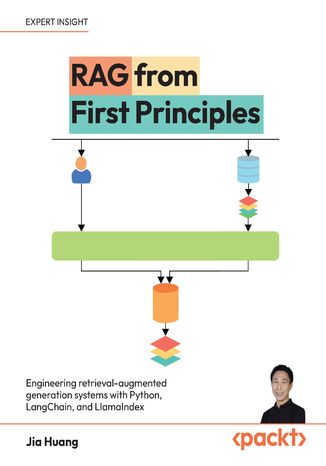
Jia Huang
Most developers can spin up a RAG pipeline in an afternoon using LangChain or LlamaIndex. Far fewer understand why retrieval fails or how to fix it. This book is for those who want to go deeper.'RAG From First Principles' dismantles the retrieval-augmented generation stack layer by layer, how documents are ingested and parsed, why chunking strategy directly impacts answer quality, how embedding models encode meaning, what happens inside a vector database, and how sparse and dense retrieval interact in a hybrid system. Written by Jia Huang, a research engineer and bestselling AI author, it brings research depth and production experience to one of AI's most critical engineering disciplines.Structured as a progressive dialogue between a seasoned engineer and two students, the book surfaces the questions practitioners actually ask. Each chapter builds on the last, from data import and chunking through embedding selection, index design, hybrid search, and post-retrieval processing, into response generation, evaluation, and advanced paradigms including GraphRAG, Agentic RAG, and Modular RAG.By the end, you'll have the architectural understanding to optimize, debug, and extend your RAG systems with confidence.
Denis Rothman
RAG-Driven Generative AI provides a roadmap for building effective LLM, computer vision, and generative AI systems that balance performance and costs.This book offers a detailed exploration of RAG and how to design, manage, and control multimodal AI pipelines. By connecting outputs to traceable source documents, RAG improves output accuracy and contextual relevance, offering a dynamic approach to managing large volumes of information. This AI book shows you how to build a RAG framework, providing practical knowledge on vector stores, chunking, indexing, and ranking. You’ll discover techniques to optimize your project’s performance and better understand your data, including using adaptive RAG and human feedback to refine retrieval accuracy, balancing RAG with fine-tuning, implementing dynamic RAG to enhance real-time decision-making, and visualizing complex data with knowledge graphs.You’ll be exposed to a hands-on blend of frameworks like LlamaIndex and Deep Lake, vector databases such as Pinecone and Chroma, and models from Hugging Face and OpenAI. By the end of this book, you will have acquired the skills to implement intelligent solutions, keeping you competitive in fields from production to customer service across any project.*Email sign-up and proof of purchase required
Denis Rothman
Stop moving your data to the AI. This second edition defines a revolutionary architectural shift: bringing the AI to the data. By using Oracle Database 23ai as a converged engine in this book, you will architect Sovereign AI systems that eliminate the fragmentation, latency, and massive security risks inherent in traditional data extraction.You’ll work with DualRAG, synchronizing unstructured vector semantics with the deterministic truth of structured SQL, Graph, and Spatial retrieval. This allows your systems to reason over verified corporate data rather than probabilistic guesses, reducing hallucinations at the source. Moving beyond simple pipelines, you’ll also build MAS-RAG (multi-agent systems for RAG), where autonomous agents coordinate across hybrid retrieval workflows, multimodal video pipelines, and graph-based knowledge structures.Designed for developers and architects, these blueprints transform disconnected data silos into a unified engine to architect autonomous enterprise intelligence that scales with RLHF and model fine-tuning. By the end of the book, you’ll be able to design and deploy enterprise AI systems that combine retrieval, reasoning, and structured data to build reliable generative AI applications.*Email sign-up and proof of purchase required
Andrey Koleshko
A step-by-step and interactive approach explaining the Rake essentials along with code examples and advanced features. If you are a developer who is acquainted with the Ruby language and want to speed up writing the code concerned with files, then this book is for you. To start reading this book, basic Ruby knowledge is required; however, a huge amount of experience with the language is not necessary.
Rancher Deep Dive. Manage enterprise Kubernetes seamlessly with Rancher
Matthew Mattox
Knowing how to use Rancher enables you to manage multiple clusters and applications without being locked into a vendor’s platform. This book will guide you through Rancher’s capabilities while deepening your understanding of Kubernetes and helping you to take your applications to a new level.The book begins by introducing you to Rancher and Kubernetes, helping you to learn and implement best practices. As you progress through the chapters, you’ll understand the strengths and limitations of Rancher and Kubernetes and discover all the different ways to deploy Rancher. You’ll also find out how to design and deploy Kubernetes clusters to match your requirements. The concluding chapters will show you how to set up a continuous integration and continuous deployment (CI/CD) pipeline for deploying applications into a Rancher cluster, along with covering supporting services such as image registries and Helm charts.By the end of this Kubernetes book, you’ll be able to confidently deploy your mission-critical production workloads on Rancher-managed Kubernetes clusters.
Rapid - Apache Mahout Clustering designs. Explore clustering algorithms used with Apache Mahout
Ashish Gupta
As more and more organizations are discovering the use of big data analytics, interest in platforms that provide storage, computation, and analytic capabilities has increased. Apache Mahout caters to this need and paves the way for the implementation of complex algorithms in the field of machine learning to better analyse your data and get useful insights into it.Starting with the introduction of clustering algorithms, this book provides an insight into Apache Mahout and different algorithms it uses for clustering data. It provides a general introduction of the algorithms, such as K-Means, Fuzzy K-Means, StreamingKMeans, and how to use Mahout to cluster your data using a particular algorithm. You will study the different types of clustering and learn how to use Apache Mahout with real world data sets to implement and evaluate your clusters.This book will discuss about cluster improvement and visualization using Mahout APIs and also explore model-based clustering and topic modelling using Dirichlet process. Finally, you will learn how to build and deploy a model for production use.
Rapid Application Development with AWS Amplify. Full stack web development on Amazon Web Servics
Adrian Leung
AWS Amplify is a modern toolkit that includes a command line interface (CLI); libraries for JS, iOS, and Android programming; UI component libraries for frameworks like React, Angular, and Vue.js for web development, and React Native and Flutter for mobile development.You'll begin by learning how to build AWS Amplify solutions with React and React Native with TypeScript from scratch, along with integrating it with existing solutions. This book will show you the fastest way to build a production-ready minimum viable product (MVP) within days instead of years. You'll also discover how to increase development speed without compromising on quality by adopting behavior-driven development (BDD) and Cypress for end-to-end test automation, as well as the Amplify build pipeline (DevOps or CI/CD pipeline) to ensure optimal quality throughout continuous test automation and continuous delivery. As you advance, you'll work with React to determine how to build progressive web apps (PWAs) with Amplify and React Native for cross-platform mobile apps. In addition to this, you'll find out how to set up a custom domain name for your new website and set up the AWS Amplify Admin UI for managing the content of your app effectively.By the end of this AWS book, you'll be able to build a full-stack AWS Amplify solution all by yourself.
Ricardo Pereira, Paulo Moreira, Taiji Hagino
OutSystems is a software development platform that speeds up the build phase by abstracting code and making almost everything visual. This means replacing textual language with visual artifacts that avoid lexical errors and speed up code composition using accelerators and predefined templates.The book begins by walking you through the fundamentals of the technology, along with a general overview of end-to-end web and mobile software development. You'll learn how to configure your personal area in the cloud and use the OutSystems IDE to connect with it. The book then shows you how to build a web application based on the best architectural and developmental practices in the market, and takes the same approach for the mobile paradigm. As you advance, you'll find out how to develop the same application, and the great potential of reusing code from one paradigm in another and the symbiosis between them is showcased.The only application that'll differ from the application in the exercise is the one used in business process technology (BPT), with a focus on a common market use case.By the end of this OutSystems book, you'll be able to develop enterprise-level applications on the web and mobile, integrating them with third parties and other systems on the market. You'll also understand the concepts of performance, security, and software construction and be able to apply them effectively.
Xuewu Dai, Fei Qin
As an open source embedded single-board computer with many standard interfaces, Beagleboard is ideal for building embedded audio/video systems to realize your practical ideas. The challenge is how to design and implement a good digital processing algorithm on Beagleboard quickly and easily without intensive low-level coding.Rapid BeagleBoard Prototyping with MATLAB and Simulink is a practical, hands-on guide providing you with a number of clear, step-by-step exercises which will help you take advantage of the power of Beagleboard and give you a good grounding in rapid prototyping techniques for your audio/video applications.Rapid BeagleBoard Prototyping with MATLAB and Simulink looks at rapid prototyping and how to apply these techniques to your audio/video applications with Beagleboard quickly and painlessly without intensive manual low-level coding. It will take you through a number of clear, practical recipes that will help you to take advantage of both the Beagleboard hardware platform and Matlab/Simulink signal processing. We will also take a look at building S-function blocks that work as hardware drivers and interfaces for Matlab/Simulink. This gives you more freedom to explore the full range of advantages provided by Beagleboard.By the end of this book, you will have a clear idea about Beagleboard and Matlab/Simulink rapid prototyping as well as how to develop voice recognition systems, motion detection systems with I/O access, and serial communication for your own applications such as a smart home.
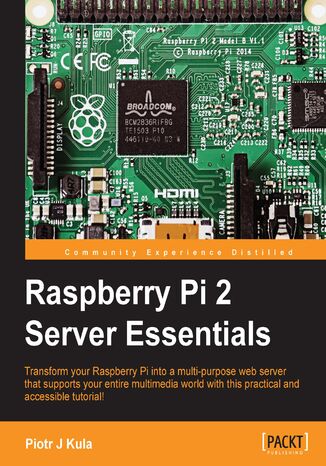
Piotr J Kula
There’s no end to what you can do with a Raspberry Pi – it makes a huge range of tech projects possible. This book shows you how to transform it into a multipurpose web server, able to store and manage resources that lets you build some truly innovative and impressive computing creations. You’ll learn how to use your Raspberry Pi 2 to host a website using a range of different languages, host a game server, store files, and run everything from a media center to a cloud network. If you want to take control of your technological world, start building your own server and find out what’s possible with the Raspberry Pi microcomputer.Begin by getting your Pi set up – follow each step as the book shows you how to prepare a network and configure the additional features that you’ll need to build your projects. Once you’ve done this you’ll dig a little deeper and set up your pi as a file server, making sure it’s built for speed using a range of different tools, including Python, Node.js and ASP.NET. Following this the book shows you how to extend your server to allow you to host games, and stream live HD video before customizing it even further to create a fully-fledged media center.It doesn’t stop there however – the book then dives into the exciting world of the Internet of Things (IoT). You’ll learn how to install Windows IoT onto your Raspberry Pi, the operating system that’s driving embedded software projects all around the world. Once you’ve done this you’ll be ready to explore IoT further, as the book shows you how to use your device to host a cloud network that can form the basis of a wider IoT project.
Steven Lawrence Fernandes, Tim Cox
Raspberry Pi 3 Cookbook for Python Programmers – Third Edition begins by guiding you through setting up Raspberry Pi 3, performing tasks using Python 3.6, and introducing the first steps to interface with electronics. As you work through each chapter, you will build your skills and apply them as you progress. You will learn how to build text classifiers, predict sentiments in words, develop applications using the popular Tkinter library, and create games by controlling graphics on your screen. You will harness the power of a built in graphics processor using Pi3D to generate your own high-quality 3D graphics and environments.You will understand how to connect Raspberry Pi’s hardware pins directly to control electronics, from switching on LEDs and responding to push buttons to driving motors and servos. Get to grips with monitoring sensors to gather real-life data, using it to control other devices, and viewing the results over the internet. You will apply what you have learned by creating your own Pi-Rover or Pi-Hexipod robots. You will also learn about sentiment analysis, face recognition techniques, and building neural network modules for optical character recognition.Finally, you will learn to build movie recommendations system on Raspberry Pi 3.
Shantanu Bhadoria, Ruben Oliva Ramos
Raspberry Pi 3 Home Automation Projects addresses the challenge of applying real-world projects to automate your house using Raspberry Pi 3 and Arduino. You will learn how to customize and program the Raspberry Pi 3 and Arduino-based boards in several home automation projects around your house.This book aims to help you integrate different microcontrollers like Arduino, ESP8266 Wi-Fi module, Particle Photon and Raspberry Pi 3 into the real world, taking the best of these boards to develop some exciting home automation projects. We will start with an interesting project creating a Raspberry Pi Powered smart mirror and move on to Automated Gardening System, which will help you build a simple smart gardening to keep your garden healthy with minimal effort. You will also learn to build projects such as CheerLights into a holiday display, a project to erase parking headaches with OpenCV and Raspberry Pi 3, create Netfl ix's The Switch for the living room and lock down your house like Fort Knox with a Windows IoT face recognition-based door lock system.By the end of the book, you will be able to build and automate the living space with intriguing IoT projects and bring a new degree of inter connectivity to your world.
Raspberry Pi 3 Projects for Java Programmers. Get the most out of your Raspberry Pi 3 with Java
John Sirach, Pradeeka Seneviratne
Raspberry Pi is a small, low cost and yet very powerful development platform. It is used to interact with attached electronics by the use of it's GPIO pins for multiple use cases, mainly Home Automation and Robotics. Our book is a project-based guide that will show you how to utilize the Raspberry Pi's GPIO with Java and how you can leverage this utilization with your knowledge of Java. You will start with installing and setting up the necessary hardware to create a seamless development platform. You will then straightaway start by building a project that will utilize light for presence detection. Next, you will program the application, capable of handling real time data using MQTT and utilize RPC to publish data to adafruit.io. Further, you will build a wireless robot on top of the zuma chassis with the Raspberry Pi as the main controller. Lastly, you will end the book with advanced projects that will help you to create a multi-purpose IoT controller along with building a security camera that will perform image capture and recognize faces with the help of notifications.By the end of the book, you will be able to build your own real world usable projects not limited to Home Automation, IoT and/or Robotics utilizing logic, user and web interfaces.
Arush Kakkar, Richard Grimmett, Ashwin Pajankar, Matthew...
Looking for inspiration for your next Raspberry Pi project? Not sure where to begin? This Learning Path is the perfect place to begin, providing you with an accessible yet comprehensive journey through Raspberry Pi. Following three modules, you’ll soon be confident and prepared to get creative with your microcomputer. Raspberry Pi by Example is the first module in this Learning Path – and it does exactly what it says. It doesn’t just teach, it shows you how to go and build some awesome Raspberry Pi projects immediately. Build and play your own games with the Pi, build a complete Internet of Things home automation system that controls your house through Twitter… let your imagination run wild!In the next module we’ll look in more depth at building a home security system. You’ll be using some of the skills you devoped through the first module, but apply them to something more intricate and impressive. Using a Linux based operating system as the foundations, you’ll gradually build up an entire security infrastructure adding cameras, remote controls, and even intrusion alerts!In the final module, we’ll take you into the world of Raspberry Pi robotics. By the end of it, you’ll have built a biped robot that can interact with its environment!This Learning Path combines some of the best that Packt has to offer in one complete, curated package. It includes content from the following Packt products:? Raspberry Pi By Example by Ashwin Pajankar and Arush Kakkar? Building a Home Security System with Raspberry Pi by Matthew Pole? Raspberry Pi Robotics Essentials by Richard Grimmett
Dhairya Parikh
The future of IoT has the potential to be limitless. Wouldn’t it be great if you could add it to your own technological stacks? But where to start? With the basics, of course.In this book, you will start by learning about the most popular hardware and communication protocol, Raspberry Pi and MQTT. You will see how to use them together by setting up your own MQTT server on Raspberry Pi and understand how it works.This book explores MQTT in detail, including the clients and devices that you can connect to your server. You will discover two very popular IoT development boards among project developers: the ESP8266 and ESP32 development boards. Then, you will learn how to build interactive dashboards on your Pi and monitor your client devices. The book also shows you how to build a dashboard using another popular software – Node-RED. You will be able to put your skills to the test by creating two full-scale projects. That’s not all: you will also learn how to host your own MQTT server on a virtual cloud service. Finally, you will be guided on how to move forward from here, what technologies to learn, and some project recommendations to polish or test your knowledge.By the end of this book, you will be able to build meaningful projects using Raspberry Pi and MQTT and create dashboards for your projects on Node-RED.
Gökhan Kurt
Raspberry Pi is the credit card-sized, general purpose computer which has revolutionized portable technology. Android is an operating system that widely used in mobile phones today both on the high and low ends of the mobile phone market. However, there is little information about how to connect the two in spite of how popular both of them are.Raspberry Pi Android Projects starts with simple projects that help you access the command prompt and the desktop environment of Raspberry Pi from the comfort of your Android phone or tablet. Then, you will be introduced to more complex projects that combine the strengths of the Pi and Android in amazing ways. These projects will teach you how to manage services on the Pi from Android, share files between Android devices using the Pi as a server, administer and view the Pi’s camera from Android in surveillance mode, and connect your car to the Pi and make data more accessible using Android.The introductory projects covered will be useful each time you need to access or administer your Pi for other purposes, and the more advanced projects will continue to be valuable even after you become an expert on Pi.By the end of this book, you will be able to create engaging and useful projects that will help you combine the powers of both Android and Raspberry Pi.
Dan Nixon
If you have already undertaken some simple projects with the Raspberry Pi and are looking to enter the exciting work of hardware interaction, then this book is ideal for you.
Raspberry Pi By Example. Start building amazing projects with the Raspberry Pi right out of the box
Ashwin Pajankar, Arush Kakkar
Want to put your Raspberry Pi through its paces right out of the box? This tutorial guide is designed to get you learning all the tricks of the Raspberry Pi through building complete, hands-on hardware projects. Speed through the basics and then dive right in to development!Discover that you can do almost anything with your Raspberry Pi with a taste of almost everything. Get started with Pi Gaming as you learn how to set up Minecraft, and then program your own game with the help of Pygame. Turn the Pi into your own home security system with complete guidance on setting up a webcam spy camera and OpenCV computer vision for image recognition capabilities. Get to grips with GPIO programming to make a Pi-based glowing LED system, build a complete functioning motion tracker, and more. Finally, get ready to tackle projects that push your Pi to its limits. Construct a complete Internet of Things home automation system with the Raspberry Pi to control your house via Twitter; turn your Pi into a super-computer through linking multiple boards into a cluster and then add in advanced network capabilities for super speedy processing!