
Verleger: K-i-s-publishing
Jia Huang
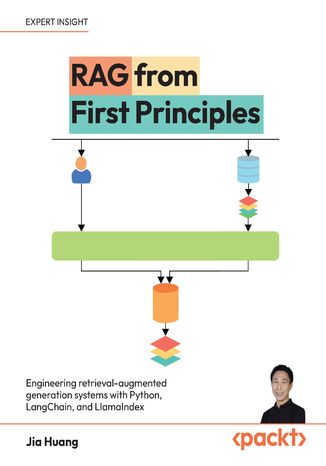
Most developers can spin up a RAG pipeline in an afternoon using LangChain or LlamaIndex. Far fewer understand why retrieval fails or how to fix it. This book is for those who want to go deeper.'RAG From First Principles' dismantles the retrieval-augmented generation stack layer by layer, how documents are ingested and parsed, why chunking strategy directly impacts answer quality, how embedding models encode meaning, what happens inside a vector database, and how sparse and dense retrieval interact in a hybrid system. Written by Jia Huang, a research engineer and bestselling AI author, it brings research depth and production experience to one of AI's most critical engineering disciplines.Structured as a progressive dialogue between a seasoned engineer and two students, the book surfaces the questions practitioners actually ask. Each chapter builds on the last, from data import and chunking through embedding selection, index design, hybrid search, and post-retrieval processing, into response generation, evaluation, and advanced paradigms including GraphRAG, Agentic RAG, and Modular RAG.By the end, you'll have the architectural understanding to optimize, debug, and extend your RAG systems with confidence.
Denis Rothman
RAG-Driven Generative AI provides a roadmap for building effective LLM, computer vision, and generative AI systems that balance performance and costs.This book offers a detailed exploration of RAG and how to design, manage, and control multimodal AI pipelines. By connecting outputs to traceable source documents, RAG improves output accuracy and contextual relevance, offering a dynamic approach to managing large volumes of information. This AI book shows you how to build a RAG framework, providing practical knowledge on vector stores, chunking, indexing, and ranking. You’ll discover techniques to optimize your project’s performance and better understand your data, including using adaptive RAG and human feedback to refine retrieval accuracy, balancing RAG with fine-tuning, implementing dynamic RAG to enhance real-time decision-making, and visualizing complex data with knowledge graphs.You’ll be exposed to a hands-on blend of frameworks like LlamaIndex and Deep Lake, vector databases such as Pinecone and Chroma, and models from Hugging Face and OpenAI. By the end of this book, you will have acquired the skills to implement intelligent solutions, keeping you competitive in fields from production to customer service across any project.*Email sign-up and proof of purchase required
Denis Rothman
Stop moving your data to the AI. This second edition defines a revolutionary architectural shift: bringing the AI to the data. By using Oracle Database 23ai as a converged engine in this book, you will architect Sovereign AI systems that eliminate the fragmentation, latency, and massive security risks inherent in traditional data extraction.You’ll work with DualRAG, synchronizing unstructured vector semantics with the deterministic truth of structured SQL, Graph, and Spatial retrieval. This allows your systems to reason over verified corporate data rather than probabilistic guesses, reducing hallucinations at the source. Moving beyond simple pipelines, you’ll also build MAS-RAG (multi-agent systems for RAG), where autonomous agents coordinate across hybrid retrieval workflows, multimodal video pipelines, and graph-based knowledge structures.Designed for developers and architects, these blueprints transform disconnected data silos into a unified engine to architect autonomous enterprise intelligence that scales with RLHF and model fine-tuning. By the end of the book, you’ll be able to design and deploy enterprise AI systems that combine retrieval, reasoning, and structured data to build reliable generative AI applications.*Email sign-up and proof of purchase required
Andrey Koleshko
A step-by-step and interactive approach explaining the Rake essentials along with code examples and advanced features. If you are a developer who is acquainted with the Ruby language and want to speed up writing the code concerned with files, then this book is for you. To start reading this book, basic Ruby knowledge is required; however, a huge amount of experience with the language is not necessary.
Rancher Deep Dive. Manage enterprise Kubernetes seamlessly with Rancher
Matthew Mattox
Knowing how to use Rancher enables you to manage multiple clusters and applications without being locked into a vendor’s platform. This book will guide you through Rancher’s capabilities while deepening your understanding of Kubernetes and helping you to take your applications to a new level.The book begins by introducing you to Rancher and Kubernetes, helping you to learn and implement best practices. As you progress through the chapters, you’ll understand the strengths and limitations of Rancher and Kubernetes and discover all the different ways to deploy Rancher. You’ll also find out how to design and deploy Kubernetes clusters to match your requirements. The concluding chapters will show you how to set up a continuous integration and continuous deployment (CI/CD) pipeline for deploying applications into a Rancher cluster, along with covering supporting services such as image registries and Helm charts.By the end of this Kubernetes book, you’ll be able to confidently deploy your mission-critical production workloads on Rancher-managed Kubernetes clusters.
Rapid - Apache Mahout Clustering designs. Explore clustering algorithms used with Apache Mahout
Ashish Gupta
As more and more organizations are discovering the use of big data analytics, interest in platforms that provide storage, computation, and analytic capabilities has increased. Apache Mahout caters to this need and paves the way for the implementation of complex algorithms in the field of machine learning to better analyse your data and get useful insights into it.Starting with the introduction of clustering algorithms, this book provides an insight into Apache Mahout and different algorithms it uses for clustering data. It provides a general introduction of the algorithms, such as K-Means, Fuzzy K-Means, StreamingKMeans, and how to use Mahout to cluster your data using a particular algorithm. You will study the different types of clustering and learn how to use Apache Mahout with real world data sets to implement and evaluate your clusters.This book will discuss about cluster improvement and visualization using Mahout APIs and also explore model-based clustering and topic modelling using Dirichlet process. Finally, you will learn how to build and deploy a model for production use.
Rapid Application Development with AWS Amplify. Full stack web development on Amazon Web Servics
Adrian Leung
AWS Amplify is a modern toolkit that includes a command line interface (CLI); libraries for JS, iOS, and Android programming; UI component libraries for frameworks like React, Angular, and Vue.js for web development, and React Native and Flutter for mobile development.You'll begin by learning how to build AWS Amplify solutions with React and React Native with TypeScript from scratch, along with integrating it with existing solutions. This book will show you the fastest way to build a production-ready minimum viable product (MVP) within days instead of years. You'll also discover how to increase development speed without compromising on quality by adopting behavior-driven development (BDD) and Cypress for end-to-end test automation, as well as the Amplify build pipeline (DevOps or CI/CD pipeline) to ensure optimal quality throughout continuous test automation and continuous delivery. As you advance, you'll work with React to determine how to build progressive web apps (PWAs) with Amplify and React Native for cross-platform mobile apps. In addition to this, you'll find out how to set up a custom domain name for your new website and set up the AWS Amplify Admin UI for managing the content of your app effectively.By the end of this AWS book, you'll be able to build a full-stack AWS Amplify solution all by yourself.
Ricardo Pereira, Paulo Moreira, Taiji Hagino
OutSystems is a software development platform that speeds up the build phase by abstracting code and making almost everything visual. This means replacing textual language with visual artifacts that avoid lexical errors and speed up code composition using accelerators and predefined templates.The book begins by walking you through the fundamentals of the technology, along with a general overview of end-to-end web and mobile software development. You'll learn how to configure your personal area in the cloud and use the OutSystems IDE to connect with it. The book then shows you how to build a web application based on the best architectural and developmental practices in the market, and takes the same approach for the mobile paradigm. As you advance, you'll find out how to develop the same application, and the great potential of reusing code from one paradigm in another and the symbiosis between them is showcased.The only application that'll differ from the application in the exercise is the one used in business process technology (BPT), with a focus on a common market use case.By the end of this OutSystems book, you'll be able to develop enterprise-level applications on the web and mobile, integrating them with third parties and other systems on the market. You'll also understand the concepts of performance, security, and software construction and be able to apply them effectively.