
Wydawca: Packt Publishing
Node.js Blueprints. Develop stunning web and desktop applications with the definitive Node.js
Krasimir Stefanov Tsonev
A straightforward, practical guide containing step-by-step tutorials that will push your Node.js programming skills to the next level. If you are a web developer with experience in writing client-side JavaScript and want to discover the fascinating world of Node.js to develop fast and efficient web and desktop applications, then this book is for you.
Node.js By Example. Learn to use Node.js by creating a fully functional social network
Krasimir Tsonev
If you are a JavaScript developer with no experience with Node.js or server-side web development, this book is for you. It will lead you through creating a fairly complex social network. You will learn how to work with a database and create real-time communication channels.
Bethany Griggs, Manuel Spigolon
Node.js is a game-changing technology for building modern web applications and tooling, bringing the power of JavaScript to the server and enabling full-stack development in a unified language. This updated edition of this Node.js cookbook, featuring Node.js 22, equips you with the latest advancements and enhancements in the Node.js framework ecosystem.From Bethany Griggs, who has served on the Node.js Technical Steering Committee and participated in the Node.js Release Working Group, and Manuel Spigolon, a core maintainer of Fastify, comes this fifth edition of the Node.js Cookbook to help you master Node.js 22. This book guides you step by step through crafting reusable code with Node.js modules, streamlining development using the Fastify web framework, and implementing data persistence in databases and rigorous testing practices for robust applications. You’ll address security concerns, optimize performance with worker threads, deploy Node.js microservices using containerization and orchestration, and tackle troubleshooting with effective debugging strategies. Packed with real-world examples, this guide empowers you to harness Node.js 22's full potential for creating secure, performant, and dynamic applications.
Mario Casciaro, Luciano Mammino
In this book, we will show you how to implement a series of best practices and design patterns to help you create efficient and robust Node.js applications with ease.We kick off by exploring the basics of Node.js, analyzing its asynchronous event driven architecture and its fundamental design patterns. We then show you how to build asynchronous control flow patterns with callbacks, promises and async/await. Next, we dive into Node.js streams, unveiling their power and showing you how to use them at their full capacity. Following streams is an analysis of different creational, structural, and behavioral design patterns that take full advantage of JavaScript and Node.js. Lastly, the book dives into more advanced concepts such as Universal JavaScript, scalability and messaging patterns to help you build enterprise-grade distributed applications.Throughout the book, you’ll see Node.js in action with the help of several real-life examples leveraging technologies such as LevelDB, Redis, RabbitMQ, ZeroMQ, and many others. They will be used to demonstrate a pattern or technique, but they will also give you a great introduction to the Node.js ecosystem and its set of solutions.
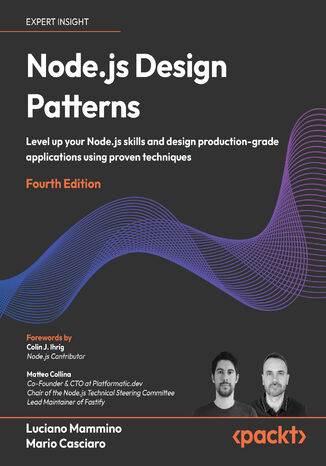
Luciano Mammino, Mario Casciaro, Colin J. Ihrig,...
Node.js underpins much of modern web development, reliably powering APIs and full-stack apps across all industries. Authors Luciano Mammino and Mario Casciaro offer a practical guide that unpacks the JavaScript runtime so you can write reliable, high-performance Node.js apps.Building on the highly rated third edition, this new edition adds fresh case studies and the latest Node.js developments: newer APIs and libraries, ESM improvements, practical security and production tips, and guidance on using Node.js with TypeScript. It also introduces a new chapter on testing that gives you a full introduction to testing philosophy and practical guidance on writing unit, integration, and end-to-end tests, giving you the confidence to write functional, stable, and reliable code.Real-world, end-to-end examples throughout the book show how to build microservices and distributed systems with Node.js, integrating production-proven technologies such as Redis, RabbitMQ, LevelDB, and ZeroMQ, the same components you’ll find in scalable deployments at companies of all sizes. End-of-chapter exercises consolidate your understanding.By the end of this Node.js book, you’ll have the design patterns, mindset, and hands-on skills every serious Node.js professional needs to confidently architect robust, efficient, and maintainable applications.
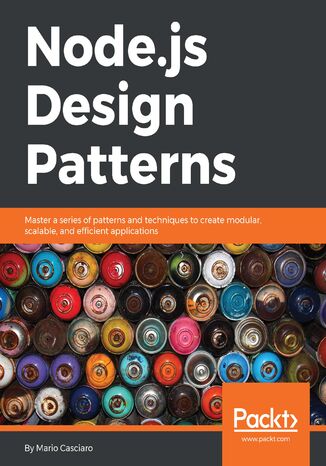
Mario Casciaro
Node.js is a massively popular software platform that lets you use JavaScript to easily create scalable server-side applications. It allows you to create efficient code, enabling a more sustainable way of writing software made of only one language across the full stack, along with extreme levels of reusability, pragmatism, simplicity, and collaboration. Node.js is revolutionizing the web and the way people and companies create their software.In this book, we will take you on a journey across various ideas and components, and the challenges you would commonly encounter while designing and developing software using the Node.js platform. You will also discover the Node.js way of dealing with design and coding decisions.The book kicks off by exploring the fundamental principles and components that define the platform. It then shows you how to master asynchronous programming and how to design elegant and reusable components using well-known patterns and techniques. The book rounds off by teaching you the various approaches to scale, distribute, and integrate your Node.js application.
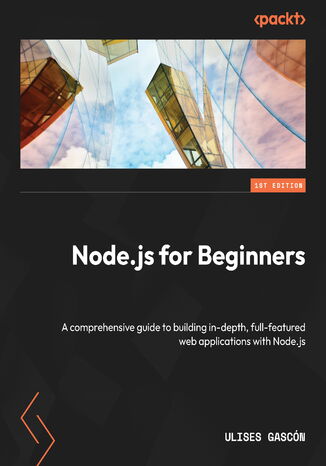
Ulises Gascón
Node.js revolutionizes server-side JavaScript development and empowers developers to build efficient, scalable, and versatile applications across a range of use cases. This book is written by a Node.js core collaborator and releaser and is the only book for beginners on Node.js. It takes you on a progressive learning path that will give you the skills needed to leverage Node.js.You’ll learn Node.js fundamentals and refresh your knowledge of JavaScript before transitioning to the development of modern web applications using Node.js, Express.js, and MongoDB. You’ll get hands-on with complex topics such as asynchronous programming, npm libraries, event-driven patterns for HTTP servers, RESTful API, and JSON Web Tokens. The final chapters will walk you through the deployment process, offering insights into various strategies, including bare metal setups, virtual machines, and containerization with Docker. You’ll also be guided through the use of Process Manager 2 (PM2) for efficient process management.By the end of this Node.js book, you'll have the skills to craft, test, and deploy Node.js web applications confidently and use this powerful stack in your day-to-day projects.
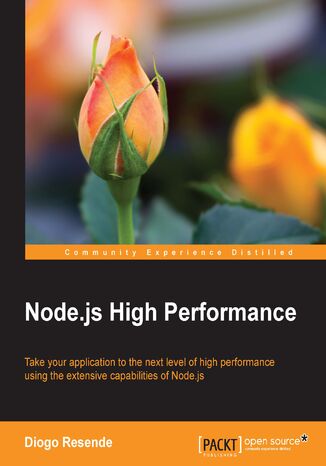
Diogo Resende
Take your application to the next level of high performance using the extensive capabilities of Node.jsAbout This BookAnalyze, benchmark, and profile your Node.js application to find slow spots, and push it to the limit by eliminating performance bottlenecksLearn the basis of performance analysis using Node.jsExplore the high performance capabilities of Node.js, along with best practicesIn DetailNode.js is a tool written in C, which allows you to use JavaScript on the server-side. High performance on a platform like Node.js is knowing how to take advantage of every aspect of your hardware, helping memory management act at its best, and correctly deciding how to architect a complex application. Do not panic if your applications start consuming a lot of memory; instead spot the leak and solve it fast with Node.js by monitoring and stopping it before it becomes an issue.This book will provide you with the skills you need to analyze the performance of your application and monitor the aspects that can and should be. Starting with performance analysis concepts and their importance in helping Node.js developers eliminate performance bottlenecks, this book will take you through development patterns to avoid performance penalties. You will learn the importance of garbage collection and its behaviour,and discover how to profile your processor, allowing better performance and scalability.You will then learn about the different types of data storage methods. Moving on, you will get to grips with testing and benchmarking applications to avoid unknown application test zones. Lastly, you will explore the limits that external components can impose in your application in the form of bottlenecks.By following the examples in each chapter, you will discover tips to getting better performing applications by avoiding anti-patterns and stretching the limits of your environment as much as possible.What You Will LearnDevelop applications using well-defined and well-tested development patternsExplore memory management and garbage collection to improve performanceMonitor memory changes and analyze heap snapshotsProfile the CPU and improve your code to avoid patterns that force intensive processor usageUnderstand the importance of data and when you should cache informationLearn to always test your code and benchmark when neededExtend your application’s scope and know what other elements can influence performanceWho This Book Is ForThis book is for Node.js developers who want a more in-depth knowledge of the platform to improve the performance of their applications. Whether you have a base Node.js background or you are an expert who knows the garbage collector and wants to leverage it to make applications more robust, the examples in this book will benefit you.Style and approachThis is a practical guide to learning high performance, which even the least experienced developer will comprehend. Small and simple examples help you test concepts yourself and easily adapt them to any application, boosting its performance and preparing it for the real-world.
David Herron
Node.js is a server-side JavaScript platform using an event driven, non-blocking I/O model allowing users to build fast and scalable data-intensive applications running in real time. Node.js Web Development shows JavaScript is not just for browser-side applications. It can be used for server-side web application development, real-time applications, microservices, and much more.This book gives you an excellent starting point, bringing you straight to the heart of developing web applications with Node.js. You will progress from a rudimentary knowledge of JavaScript and server-side development to being able to create and maintain your own Node.js application. With this book you'll learn how to use the HTTP Server and Client objects, data storage with both SQL and MongoDB databases, real-time applications with Socket.IO, mobile-first theming with Bootstrap, microservice deployment with Docker, authenticating against third-party services using OAuth, and much more.
Node.js Web Development. Server-side development with Node 10 made easy - Fourth Edition
David Herron
Node.js is a server-side JavaScript platform using an event-driven, non-blocking I/O model allowing users to build fast and scalable data-intensive applications running in real time. This book gives you an excellent starting point, bringing you straight to the heart of developing web applications with Node.js. You will progress from a rudimentary knowledge of JavaScript and server-side development to being able to create, maintain, deploy and test your own Node.js application.You will understand the importance of transitioning to functions that return Promise objects, and the difference between fs, fs/promises and fs-extra. With this book you'll learn how to use the HTTP Server and Client objects, data storage with both SQL and MongoDB databases, real-time applications with Socket.IO, mobile-first theming with Bootstrap, microservice deployment with Docker, authenticating against third-party services using OAuth, and use some well known tools to beef up security of Express 4.16 applications.
David Herron
Node.js is the leading choice of server-side web development platform, enabling developers to use the same tools and paradigms for both server-side and client-side software. This updated fifth edition of Node.js Web Development focuses on the new features of Node.js 14, Express 4.x, and ECMAScript, taking you through modern concepts, techniques, and best practices for using Node.js.The book starts by helping you get to grips with the concepts of building server-side web apps with Node.js. You’ll learn how to develop a complete Node.js web app, with a backend database tier to help you explore several databases. You'll deploy the app to real web servers, including a cloud hosting platform built on AWS EC2 using Terraform and Docker Swarm, while integrating other tools such as Redis and NGINX. As you advance, you'll learn about unit and functional testing, along with deploying test infrastructure using Docker. Finally, you'll discover how to harden Node.js app security, use Let's Encrypt to provision the HTTPS service, and implement several forms of app security with the help of expert practices. With each chapter, the book will help you put your knowledge into practice throughout the entire life cycle of developing a web app.By the end of this Node.js book, you’ll have gained practical Node.js web development knowledge and be able to build and deploy your own apps on a public web hosting solution.
Pratap Dangeti, Allen Yu, Claire Chung, Aldrin...
Data mining, or parsing the data to extract useful insights, is a niche skill that can transform your career as a data scientist Python is a flexible programming language that is equipped with a strong suite of libraries and toolkits, and gives you the perfect platform to sift through your data and mine the insights you seek. This Learning Path is designed to familiarize you with the Python libraries and the underlying statistics that you need to get comfortable with data mining.You will learn how to use Pandas, Python's popular library to analyze different kinds of data, and leverage the power of Matplotlib to generate appealing and impressive visualizations for the insights you have derived. You will also explore different machine learning techniques and statistics that enable you to build powerful predictive models.By the end of this Learning Path, you will have the perfect foundation to take your data mining skills to the next level and set yourself on the path to become a sought-after data science professional.This Learning Path includes content from the following Packt products:• Statistics for Machine Learning by Pratap Dangeti• Matplotlib 2.x By Example by Allen Yu, Claire Chung, Aldrin Yim• Pandas Cookbook by Theodore Petrou
Ivan Idris
NumPy is an extension to, and the fundamental package for scientific computing with Python. In today's world of science and technology, it is all about speed and flexibility. When it comes to scientific computing, NumPy is on the top of the list.NumPy Beginner's Guide will teach you about NumPy, a leading scientific computing library. NumPy replaces a lot of the functionality of Matlab and Mathematica, but in contrast to those products, is free and open source.Write readable, efficient, and fast code, which is as close to the language of mathematics as is currently possible with the cutting edge open source NumPy software library. Learn all the ins and outs of NumPy that requires you to know basic Python only. Save thousands of dollars on expensive software, while keeping all the flexibility and power of your favourite programming language.You will learn about installing and using NumPy and related concepts. At the end of the book we will explore some related scientific computing projects. This book will give you a solid foundation in NumPy arrays and universal functions. Through examples, you will also learn about plotting with Matplotlib and the related SciPy project. NumPy Beginner's Guide will help you be productive with NumPy and have you writing clean and fast code in no time at all.
Ivan Idris
This book is for the scientists, engineers, programmers, or analysts looking for a high-quality, open source mathematical library. Knowledge of Python is assumed. Also, some affinity, or at least interest, in mathematics and statistics is required. However, I have provided brief explanations and pointers to learning resources.
Ivan Idris
Today's world of science and technology is all about speed and flexibility. When it comes to scientific computing, NumPy is on the top of the list. NumPy will give you both speed and high productivity.NumPy Cookbook will teach you all about NumPy, a leading scientific computing library. NumPy replaces a lot of the functionality of Matlab and Mathematica, but in contrast to those products, it is free and open source.Numpy Cookbook will teach you to write readable, efficient, and fast code that is as close to the language of Mathematics as much as possible with the cutting edge open source NumPy software library.You will learn about installing and using NumPy and related concepts. At the end of the book, we will explore related scientific computing projects.This book will give you a solid foundation in NumPy arrays and universal functions. You will also learn about plotting with Matplotlib and the related SciPy project through examples.NumPy Cookbook will help you to be productive with NumPy and write clean and fast code.
Jaidev Deshpande, Leo (Liang-Huan) Chin, Tanmay Dutta,...
In today’s world of science and technology, it’s all about speed and flexibility. When it comes to scientific computing, NumPy tops the list. NumPy gives you both the speed and high productivity you need.This book will walk you through NumPy using clear, step-by-step examples and just the right amount of theory. We will guide you through wider applications of NumPy in scientific computing and will then focus on the fundamentals of NumPy, including array objects, functions, and matrices, each of them explained with practical examples. You will then learn about different NumPy modules while performing mathematical operations such as calculating the Fourier Transform; solving linear systems of equations, interpolation, extrapolation, regression, and curve fitting; and evaluating integrals and derivatives. We will also introduce you to using Cython with NumPy arrays and writing extension modules for NumPy code using the C API. This book will give you exposure to the vast NumPy library and help you build efficient, high-speed programs using a wide range of mathematical features.