
Wydawca: Packt Publishing
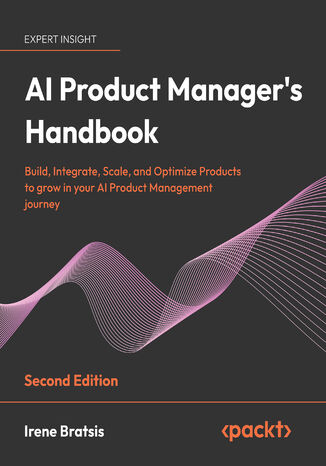
Irene Bratsis
AI is rapidly transforming product management, presenting new challenges and business opportunities. As AI-driven solutions become more complex, product managers must bridge the gap between technological capabilities and business needs. This book provides a detailed roadmap for successfully building and maintaining AI-driven products, serving as an indispensable companion on your journey to becoming an effective AI product manager. In this second edition, you'll find fresh insights into generative AI, and responsible AI practices with the most relevant tools for building AI-powered products.Authored by a leading AI product expert with years of hands-on experience in developing and managing AI solutions, this guide translates complex AI concepts into actionable strategies. Whether you're an aspiring AI PM or an experienced professional, this book offers a structured approach to defining AI product vision, leveraging data effectively, and aligning AI with business objectives. With new case studies and refined frameworks, this edition provides deeper insights into ethical AI, cross-functional collaboration, and deployment challenges.By the end of this book, you’ll be equipped with the knowledge to drive AI product success with key techniques for identifying AI opportunities and managing risks in a rapidly evolving landscape.*Email sign-up and proof of purchase required
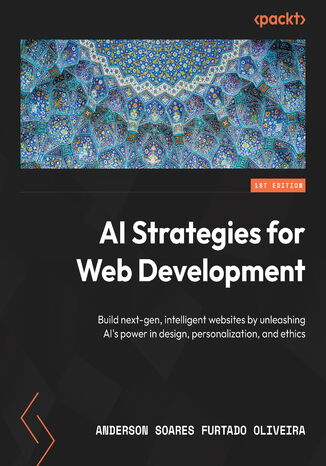
Anderson Soares Furtado Oliveira, Elijah Low, Marcelo...
If you’re a web developer looking to leverage the power of AI in your projects, then this book is for you. Written by an AI and ML expert with more than 15 years of experience, AI Strategies for Web Development takes you on a transformative journey through the dynamic intersection of AI and web development, offering a hands-on learning experience.The first part of the book focuses on uncovering the profound impact of AI on web projects, exploring fundamental concepts, and navigating popular frameworks and tools. As you progress, you’ll learn how to build smart AI applications with design intelligence, personalized user journeys, and coding assistants. Later, you’ll explore how to future-proof your web development projects using advanced AI strategies and understand AI’s impact on jobs. Toward the end, you’ll immerse yourself in AI-augmented development, crafting intelligent web applications and navigating the ethical landscape.Packed with insights into next-gen development environments, AI-augmented practices, emerging realities, interfaces, and security governance, this web development book acts as your roadmap to staying ahead in the AI and web development domain.
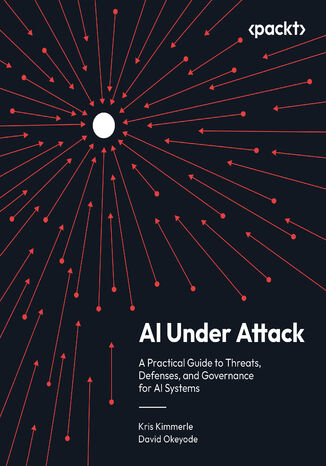
AI Under Attack. A Practical Guide to Threats, Defenses, and Governance for AI Systems
Kris Kimmerle, David Okeyode
Contrary to general AI texts or cybersecurity books with limited AI coverage, this guide offers a comprehensive dive into securing the generative AI ecosystem.It moves through five parts: Foundations explains why AI security is unique, covering threat modeling, attack surfaces, and defense principles. Attacks examines vectors against system anatomy, data/models, prompt injection, memory, RAG, and agents, concluding with red teaming and evaluation. Designing, Deploying, and Architecting Secure AI Systems covers secure infrastructure/MLOps, APIs, defensive prompting, agent security, supply chain integrity, and Zero Trust patterns. Operationalizing AI Security and Responsibility addresses governance, risk, compliance (GRC), security operations, safety/alignment, and AI-driven misinformation. Building Sustainable AI Security Programs focuses on organizational capability, threat intelligence, collaboration, and the future of AI security. Throughout, you will gain access to practical insights and structured approaches applicable to real-world scenarios.By the end, you will be able to design, implement, and maintain security programs for generative AI, defend against advanced threats, communicate risks to stakeholders, and establish governance ensuring secure, compliant operations across the lifecycle.
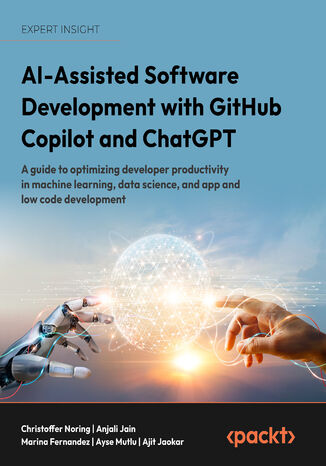
Christoffer Noring, Anjali Jain, Marina Fernandez, Ayşe...
AI-Assisted Programming for Web and Machine Learning shows you how to build applications and machine learning models and automate repetitive tasks.Part 1 focuses on coding, from building a user interface to the backend. You’ll use prompts to create the appearance of an app using HTML, styling with CSS, adding behavior with JavaScript, and working with multiple viewports. Next, you’ll build a web API with Python and Flask and refactor the code to improve code readability. Part 1 ends with using GitHub Copilot to improve the maintainability and performance of existing code. Part 2 provides a prompting toolkit for data science from data checking (inspecting data and creating distribution graphs and correlation matrices) to building and optimizing a neural network. You’ll use different prompt strategies for data preprocessing, feature engineering, model selection, training, hyperparameter optimization, and model evaluation for various machine learning models and use cases. The book closes with chapters on advanced techniques on GitHub Copilot and software agents. There are tips on code generation, debugging, and troubleshooting code. You’ll see how simpler and AI-powered agents work and discover tool calling.
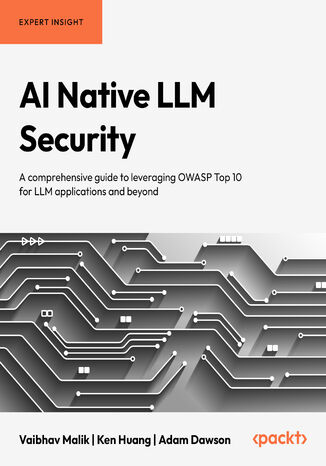
AI-Native LLM Security. Threats, defenses, and best practices for building safe and trustworthy AI
Vaibhav Malik, Ken Huang, Ads Dawson
Adversarial AI attacks present a unique set of security challenges, exploiting the very foundation of how AI learns. This book explores these threats in depth, equipping cybersecurity professionals with the tools needed to secure generative AI and LLM applications. Rather than skimming the surface of emerging risks, it focuses on practical strategies, industry standards, and recent research to build a robust defense framework.Structured around actionable insights, the chapters introduce a secure-by-design methodology, integrating threat modeling and MLSecOps practices to fortify AI systems. You’ll discover how to leverage established taxonomies from OWASP, NIST, and MITRE to identify and mitigate vulnerabilities. Through real-world examples, the book highlights best practices for incorporating security controls into AI development life cycles, covering key areas such as CI/CD, MLOps, and open-access LLMs.Built on the expertise of its co-authors—pioneers in the OWASP Top 10 for LLM applications—this guide also addresses the ethical implications of AI security, contributing to the broader conversation on trustworthy AI. By the end of this book, you’ll be able to develop, deploy, and secure AI technologies with confidence and clarity.*Email sign-up and proof of purchase required
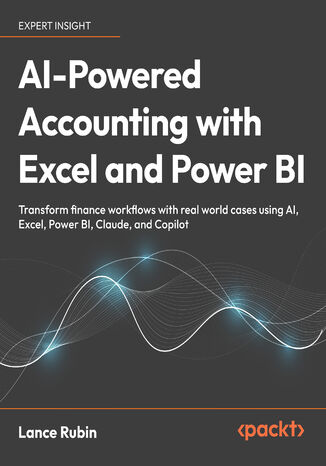
Lance Rubin
Accounting and finance teams are under increasing pressure to process more data, deliver faster insights, and modernize workflows using AI. However, many AI resources focus on theory rather than the operational realities of finance teams working heavily in Excel and reporting environments.AI-Powered Accounting Workflows with Excel and Power BI bridges this gap by showing you how to apply AI tools directly to practical finance tasks such as reconciliation, financial control, management reporting, workbook structuring, PDF extraction, and validation workflows. Using real-world finance scenarios, you’ll learn how tools such as TabAI, Anthropic Claude, Microsoft Copilot, Excel, Power BI, EXL Cloud, and Xero can help automate repetitive processes while maintaining accuracy, auditability, and professional judgment.Throughout the book, you’ll explore workflow optimization strategies, AI governance principles, prompt engineering techniques for finance, and methods for building scalable reporting and analytics solutions. By the end of this book, you’ll be able to confidently integrate AI into accounting and finance operations to improve efficiency, reporting quality, and decision-making.
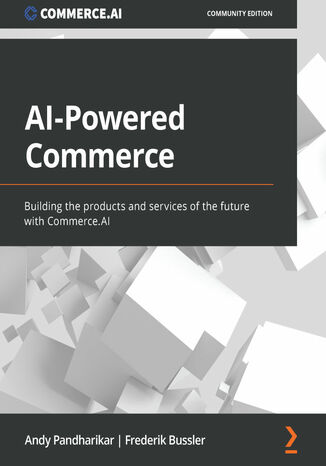
AI-Powered Commerce. Building the products and services of the future with Commerce.AI
Andy Pandharikar, Frederik Bussler
Commerce.AI is a suite of artificial intelligence (AI) tools, trained on over a trillion data points, to help businesses build next-gen products and services. If you want to be the best business on the block, using AI is a must.Developers and analysts working with AI will be able to put their knowledge to work with this practical guide. You'll begin by learning the core themes of new product and service innovation, including how to identify market opportunities, come up with ideas, and predict trends. With plenty of use cases as reference, you'll learn how to apply AI for innovation, both programmatically and with Commerce.AI. You'll also find out how to analyze product and service data with tools such as GPT-J, Python pandas, Prophet, and TextBlob. As you progress, you'll explore the evolution of commerce in AI, including how top businesses today are using AI. You'll learn how Commerce.AI merges machine learning, product expertise, and big data to help businesses make more accurate decisions. Finally, you'll use the Commerce.AI suite for product ideation and analyzing market trends.By the end of this artificial intelligence book, you'll be able to strategize new product opportunities by using AI, and also have an understanding of how to use Commerce.AI for product ideation, trend analysis, and predictions.
AI-Powered Commerce. Building the products and services of the future with Commerce.AI
Andy Pandharikar, Frederik Bussler
Commerce.AI is a suite of artificial intelligence (AI) tools, trained on over a trillion data points, to help businesses build next-gen products and services. If you want to be the best business on the block, using AI is a must.Developers and analysts working with AI will be able to put their knowledge to work with this practical guide. You'll begin by learning the core themes of new product and service innovation, including how to identify market opportunities, come up with ideas, and predict trends. With plenty of use cases as reference, you'll learn how to apply AI for innovation, both programmatically and with Commerce.AI. You'll also find out how to analyze product and service data with tools such as GPT-J, Python pandas, Prophet, and TextBlob. As you progress, you'll explore the evolution of commerce in AI, including how top businesses today are using AI. You'll learn how Commerce.AI merges machine learning, product expertise, and big data to help businesses make more accurate decisions. Finally, you'll use the Commerce.AI suite for product ideation and analyzing market trends.By the end of this artificial intelligence audiobook, you'll be able to strategize new product opportunities by using AI, and also have an understanding of how to use Commerce.AI for product ideation, trend analysis, and predictions.