
Видавець: Packt Publishing
Sudipta Mukherjee
The F# functional programming language enables developers to write simple code to solve complex problems. With F#, developers create consistent and predictable programs that are easier to test and reuse, simpler to parallelize, and are less prone to bugs.If you want to learn how to use F# to build machine learning systems, then this is the book you want. Starting with an introduction to the several categories on machine learning, you will quickly learn to implement time-tested, supervised learning algorithms. You will gradually move on to solving problems on predicting housing pricing using Regression Analysis. You will then learn to use Accord.NET to implement SVM techniques and clustering. You will also learn to build a recommender system for your e-commerce site from scratch. Finally, you will dive into advanced topics such as implementing neural network algorithms while performing sentiment analysis on your data.
Johan Astborg
F# is a functional programming language that allows you to write simple code for complex problems. Currently, it is most commonly used in the financial sector. Quantitative finance makes heavy use of mathematics to model various parts of finance in the real world. If you are interested in using F# for your day-to-day work or research in quantitative finance, this book is a must-have.This book will cover everything you need to know about using functional programming for quantitative finance. Using a functional programming language will enable you to concentrate more on the problem itself rather than implementation details. Tutorials and snippets are summarized into an automated trading system throughout the book.This book will introduce you to F#, using Visual Studio, and provide examples with functional programming and finance combined. The book also covers topics such as downloading, visualizing and calculating statistics from data.F# is a first class programming language for the financial domain.
Eriawan Kusumawardhono
F# is a functional programming language and is used in enterprise applications that demand high performance. It has its own unique trait: it is a functional programming language and has OOP support at the same time.This book will help you make F# applications run faster with examples you can easily break down and take into your own work. You will be able to assess the performance of the program and identify bottlenecks. Beginning with a gentle overview of concurrency features in F#, you will get to know the advanced topics of concurrency optimizations in F#, such as F# message passing agent of MailboxProcessor and further interoperation with .NET TPL. Based on this knowledge, you will be able to enhance the performance optimizations when implementing and using other F# language features.The book also covers optimization techniques by using F# best practices and F# libraries. You will learn how the concepts of concurrency and parallel programming will help in improving the performance. With this, you would be able to take advantage of multi-core processors and track memory leaks, root causes, and CPU issues. Finally, you will be able to test their applications to achieve scalability.
Michael James Williams
The Facebook platform provides you with an ideal solution for building rich, social experiences on the web to develop an effective user experience application. Combined with Flash which effectively enables social interactions, you can create a fully functional application on Facebook. If you've been waiting to get started with your own applications and games on Facebook, with this book you don't have to wait any longer.This book takes you through everything you need to know to integrate your AS3 apps and games with Facebook accompanied by illustrative screenshots and short quizzes.It presents you with in depth coverage of the key underlying concepts such as creating a basic application that runs inside Facebook and exploring the Graph API which greatly simplifies how developers can retrieve data. This book also covers topics on security, permissions and authentication features on Facebook.This beginner's guide starts off by teaching you about retrieving simple public data and then rapidly working your way up to authenticating users, building powerful searches across the entire database, and uploading photos and other content.Throughout the book, you'll learn by building two fundamental components: an RIA Facebook interface and an AS3 SDK that you can drop into any project to add Facebook integration. This easy-to-understand guide has everything written as AS3-only projects with publicly available components, so you can follow along whether you use Flash Pro, Flex, or MXMLC – as long as you know AS3!This hands-on tutorial will present you with a whole new perspective of the three core aspects of Facebook – searching, retrieving, and updating the data .This practical book focuses on how to set up an application on Facebook and how to deal with different contexts like AIR.By the end of this book, you will be confident enough to set up your own application and create social interactions for users to share on Facebook.
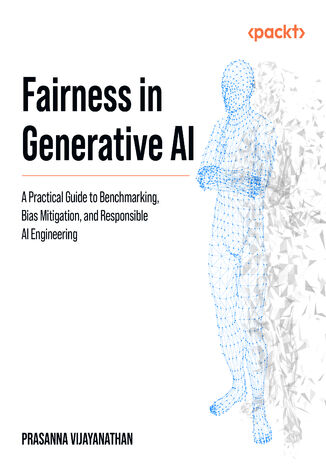
Prasanna Vijayanathan
As generative AI moves into critical applications like hiring, credit decisions, education, and healthcare, the potential for real-world harm escalates. When systems perpetuate stereotypes or skew outcomes based on identity, the impact goes far beyond poor user experience. It results in lost opportunities, violated dignity, and erosion of trust. This book offers practical methods for evaluating and ensuring fairness across text, image, and multimodal GenAI systems. You'll begin with fairness principles that matter for GenAI and learn how to translate philosophical constructs into engineering artifacts. Abstract goals become measurable requirements: what constitutes harm, which groups are in scope, how fairness is defined, and which trade-offs are acceptable. Next, design a benchmarking framework that integrates with existing pipelines. Thereafter, create scenario and prompt libraries, model sensitive attributes and intersections, and run evaluations through an orchestrated pipeline. Implement quantitative metrics and qualitative rubrics, add human review with rater training and agreement checks, and publish results as scorecards and dashboards. Finally, integrate fairness checks into CI and model release gates, monitor drift, and run incident response playbooks so benchmarks stay credible as models and norms evolve.
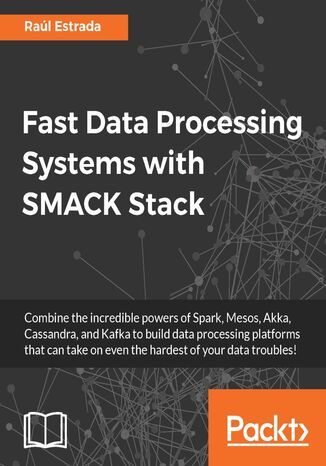
Raúl Estrada
SMACK is an open source full stack for big data architecture. It is a combination of Spark, Mesos, Akka, Cassandra, and Kafka. This stack is the newest technique developers have begun to use to tackle critical real-time analytics for big data. This highly practical guide will teach you how to integrate these technologies to create a highly efficient data analysis system for fast data processing.We’ll start off with an introduction to SMACK and show you when to use it. First you’ll get to grips with functional thinking and problem solving using Scala. Next you’ll come to understand the Akka architecture. Then you’ll get to know how to improve the data structure architecture and optimize resources using Apache Spark. Moving forward, you’ll learn how to perform linear scalability in databases with Apache Cassandra. You’ll grasp the high throughput distributed messaging systems using Apache Kafka. We’ll show you how to build a cheap but effective cluster infrastructure with Apache Mesos. Finally, you will deep dive into the different aspect of SMACK using a few case studies. By the end of the book, you will be able to integrate all the components of the SMACK stack and use them together to achieve highly effective and fast data processing.
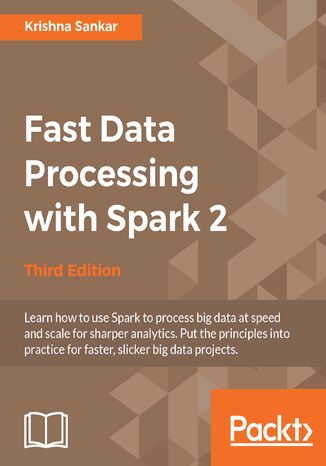
Fast Data Processing with Spark 2. Accelerate your data for rapid insight - Third Edition
Krishna Sankar , Holden Karau
When people want a way to process big data at speed, Spark is invariably the solution. With its ease of development (in comparison to the relative complexity of Hadoop), it’s unsurprising that it’s becoming popular with data analysts and engineers everywhere. Beginning with the fundamentals, we’ll show you how to get set up with Spark with minimum fuss. You’ll then get to grips with some simple APIs before investigating machine learning and graph processing – throughout we’ll make sure you know exactly how to apply your knowledge. You will also learn how to use the Spark shell, how to load data before finding out how to build and run your own Spark applications. Discover how to manipulate your RDD and get stuck into a range of DataFrame APIs. As if that’s not enough, you’ll also learn some useful Machine Learning algorithms with the help of Spark MLlib and integrating Spark with R. We’ll also make sure you’re confident and prepared for graph processing, as you learn more about the GraphX API.
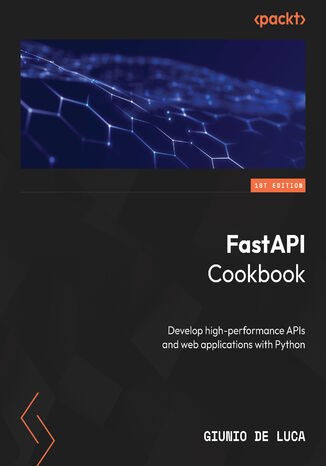
FastAPI Cookbook. Develop high-performance APIs and web applications with Python
Giunio De Luca, Antonio Ferraro
FastAPI is a cutting-edge Python framework that is revolutionizing the way web apps and APIs are built. Known for its speed, simplicity, and scalability, FastAPI empowers developers to create high-performing applications with ease. This book will help you leverage FastAPI’s immense potential to handle high-traffic scenarios and integrate seamlessly with modern Python tools.The book begins by familiarizing you with the basics of setting up and configuring your FastAPI environment before moving to the intricacies of building RESTful APIs, managing data with SQL and NoSQL databases, and handling authentication and authorization. Next, you'll focus on advanced topics such as custom middleware, WebSocket communication, and integration with various Python libraries. Each chapter is meticulously crafted with practical recipes, progressing from foundational concepts to advanced features and best practices. The concluding chapters show you how to optimize performance, implement rate limiting, and execute background tasks, empowering you to become a proficient FastAPI developer.By the end of this book, you'll have gained the skills you need to migrate existing apps to FastAPI, and be equipped to tackle any challenge in the modern web development landscape, ensuring your apps are not only functional, but also efficient, secure, and scalable.