
Publisher: Packt Publishing
Jacobo Rodriguez
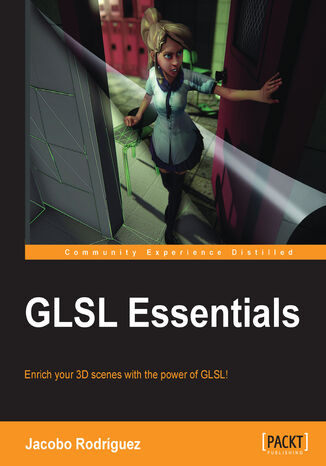
Shader programming has been the largest revolution in graphics programming. OpenGL Shading Language (abbreviated: GLSL or GLslang), is a high-level shading language based on the syntax of the C programming language.With GLSL you can execute code on your GPU (aka graphics card). More sophisticated effects can be achieved with this technique.Therefore, knowing how OpenGL works and how each shader type interacts with each other, as well as how they are integrated into the system, is imperative for graphic programmers. This knowledge is crucial in order to be familiar with the mechanisms for rendering 3D objects.GLSL Essentials is the only book on the market that teaches you about shaders from the very beginning. It shows you how graphics programming has evolved, in order to understand why you need each stage in the Graphics Rendering Pipeline, and how to manage it in a simple but concise way. This book explains how shaders work in a step-by-step manner, with an explanation of how they interact with the application assets at each stage.This book will take you through the graphics pipeline and will describe each section in an interactive and clear way. You will learn how the OpenGL state machine works and all its relevant stages. Vertex shaders, fragment shaders, and geometry shaders will be covered, as well some use cases and an introduction to the math needed for lighting algorithms or transforms. Generic GPU programming (GPGPU) will also be covered.After reading GLSL Essentials you will be ready to generate any rendering effect you need.
Christopher J Welsh (USD)
GNS3 is an open-source Graphical Network Simulator used extensively by networking professionals to simulate networking devices such as Cisco, Juniper and Vyatta routers, along with Virtual PCs.GNS3 Network Simulation Guide gives you all the information you need to run a successful GNS3 simulation. You will be guided through the tricky installation pre-requisites and procedures involved in developing a simulated topology suitable for studying for Cisco CCIE Certification. We will also cover many useful tips and tricks which will help you make the most of your GNS3 simulator application.You will begin the GNS3 journey by ensuring that you have prepared your computer with any additional files required by GNS3, to set up the simulated environment needed for a successful installation process.Once GNS3 is installed, you will get to work creating a successful simulation including routers, Ethernet switches, Virtual PCs, and capture packets using Wireshark. Next, you will learn how to master GNS3's Graphical User Interface as well as the Command Console. The inner workings of GNS3 are described in depth so that you gain an appreciation of how UDP tunnels are used to tie the many components of GNS3 together.By following the clear examples and exercises in this guide, you will learn everything that you need to know about how to use GNS3 to prepare for certifications, as well as simulate real-world network scenarios.
Jesper Schmidt Hansen
Today, scientific computing and data analysis play an integral part in most scientific disciplines ranging from mathematics and biology to imaging processing and finance. With GNU Octave you have a highly flexible tool that can solve a vast number of such different problems as complex statistical analysis and dynamical system studies.The GNU Octave Beginner's Guide gives you an introduction that enables you to solve and analyze complicated numerical problems. The book is based on numerous concrete examples and at the end of each chapter you will find exercises to test your knowledge. It's easy to learn GNU Octave, with the GNU Octave Beginner's Guide to hand.Using real-world examples the GNU Octave Beginner's Guide will take you through the most important aspects of GNU Octave. This practical guide takes you from the basics where you are introduced to the interpreter to a more advanced level where you will learn how to build your own specialized and highly optimized GNU Octave toolbox package. The book starts by introducing you to work variables like vectors and matrices, demonstrating how to perform simple arithmetic operations on these objects before explaining how to use some of the simple functionality that comes with GNU Octave, including plotting. It then goes on to show you how to write new functionality into GNU Octave and how to make a toolbox package to solve your specific problem. Finally, it demonstrates how to optimize your code and link GNU Octave with C and C++ code enabling you to solve even the most computationally demanding tasks. After reading GNU Octave Beginner's Guide you will be able to use and tailor GNU Octave to solve most numerical problems and perform complicated data analysis with ease.
Ashok Ramachandran
Attention, small business owners! Stop tax-day stress. Stop procrastinating with a shoebox full of receipts. Stop reinventing the wheel with a spreadsheet. Stop making decisions simply on a hunch. Stop wasting money on software that is overkill. Start by downloading GnuCash and getting your accounts in order. Designed to be easy to use, yet powerful and flexible, GnuCash allows you to track bank accounts, income, and expenses. As quick and intuitive to use as a checkbook register, it is based on professional accounting principles to ensure balanced books and accurate reports. You can do it and Gnucash 2.4 Small Business Accounting Beginner's Guide will help you get up and running with maintaining your accounts.Gnucash 2.4 Small Business Accounting Beginner's Guide speaks business language, not accountant-speak, because it is written by a former small business owner. It guides you to use GnuCash from scratch with step-by-step tutorials without jargon, pointing out the gotchas to avoid with lots of tips. It will teach you to work on routine business transactions while migrating transaction data from other applications gradually. You will be able to keep on top of transactions and run reports after reading just three chapters!Beyond Chapter 3, it is up to you how far you want to go. Reconcile with your bank and credit card statements. Charge and pay sales tax. Do invoicing. Track payments due. Set up reminders for bills. Avoid stress at tax time. Print checks. Capture expenses using your mobile phone.Gnucash 2.4 Small Business Accounting Beginner's Guide gives you the power. Know your numbers. Make decisions with confidence. Drive your business to its full potential.
GNU/Linux Rapid Embedded Programming. Your one-stop solution to embedded programming on GNU/Linux
Rodolfo Giometti
Embedded computers have become very complex in the last few years and developers need to easily manage them by focusing on how to solve a problem without wasting time in finding supported peripherals or learning how to manage them. The main challenge with experienced embedded programmers and engineers is really how long it takes to turn an idea into reality, and we show you exactly how to do it. This book shows how to interact with external environments through specific peripherals used in the industry. We will use the latest Linux kernel release 4.4.x and Debian/Ubuntu distributions (with embedded distributions like OpenWrt and Yocto).The book will present popular boards in the industry that are user-friendly to base the rest of the projects on - BeagleBone Black, SAMA5D3 Xplained, Wandboard and system-on-chip manufacturers.Readers will be able to take their first steps in programming the embedded platforms, using C, Bash, and Python/PHP languages in order to get access to the external peripherals. More about using and programming device driver and accessing the peripherals will be covered to lay a strong foundation. The readers will learn how to read/write data from/to the external environment by using both C programs or a scripting language (Bash/PHP/Python) and how to configure a device driver for a specific hardware.After finishing this book, the readers will be able to gain a good knowledge level and understanding of writing, configuring, and managing drivers, controlling and monitoring applications with the help of efficient/quick programming and will be able to apply these skills into real-world projects.
Lee Phillips
gnuplot is the world's finest technical plotting software, used by scientists, engineers, and others for many years. It is in constant development and runs on practically every operating system, and can produce output in almost any format. The quality of its 3d plots is unmatched and its ability to be incorporated into computer programs and document preparation systems is excellent.gnuplot Cookbook ñ it will help you master gnuplot. Start using gnuplot immediately to solve your problems in data analysis and presentation. Quickly find a visual example of the graph you want to make and see a complete, working script for producing it. Learn how to use the new features in gnuplot 4.4. Find clearly explained, working examples of using gnuplot with LaTeX and with your own computer programming language.You will master all the ins and outs of gnuplot through gnuplot Cookbook.You will learn to plot basic 2d to complex 3d plots, annotate from simple labels to equations, integrate from simple scripts to full documents and computer progams. You will be taught to annotate graphs with equations and symbols that match the style of the rest of your text, thus creating a seamless, professional document. You will be guided to create a web page with an interactive graph, and add graphical output to your simulation or numerical analysis program.Start using all of gnuplot's simple to complex features to suit your needs, without studying its 200 page manual through this Cookbook.
Go: Building Web Applications. Building Web Applications
Nathan Kozyra, Mat Ryer
Go is an open source programming language that makes it easy to build simple, reliable, and efficient software. It is a statically typed language with syntax loosely derived from that of C, adding garbage collection, type safety, some dynamic-typing capabilities, additional built-in types such as variable-length arrays and key-value maps, and a large standard library.This course starts with a walkthrough of the topics most critical to anyone building a new web application. Whether it’s keeping your application secure, connecting to your database, enabling token-based authentication, or utilizing logic-less templates, this course has you covered. Scale, performance, and high availability lie at the heart of the projects, and the lessons learned throughout this course will arm you with everything you need to build world-class solutions. It will also take you through the history of concurrency, how Go utilizes it, how Go differs from other languages, and the features and structures of Go's concurrency core. It will make you feel comfortable designing a safe, data-consistent, and high-performance concurrent application in Go.This course is an invaluable resource to help you understand Go's powerful features to build simple, reliable, secure, and efficient web applications.
Go Cookbook. Build modular, readable, and testable applications in Go
Aaron Torres
Go (a.k.a. Golang) is a statically-typed programming language first developed at Google. It is derived from C with additional features such as garbage collection, type safety, dynamic-typing capabilities, additional built-in types, and a large standard library.This book takes off where basic tutorials on the language leave off. You can immediately put into practice some of the more advanced concepts and libraries offered by the language while avoiding some of the common mistakes for new Go developers. The book covers basic type and error handling. It explores applications that interact with users, such as websites, command-line tools, or via the file system. It demonstrates how to handle advanced topics such as parallelism, distributed systems, and performance tuning. Lastly, it finishes with reactive and serverless programming in Go.