
Wydawca: Packt Publishing
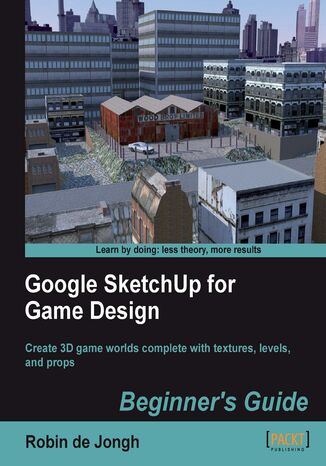
Robin de Jongh
Creating video game environments similar to the best 3D games on the market is now within the capability of hobbyists for the first time, with the free availability of game development software such as Unity 3D, and the ease with which groups of enthusiasts can get together to pool their skills for a game project. The sheer number of these independent game projects springing up means there is a constant need for game art, the physical 3D environment and objects that inhabit these game worlds. Now thanks to Google there is an easy, fun way to create professional game art, levels and props.Google SketchUp is the natural choice for beginners to game design. This book provides you with the workflow to quickly build realistic 3D environments, levels, and props to fill your game world. In simple steps you will model terrain, buildings, vehicles, and much more.Google SketchUp is the ideal entry level modeling tool for game design, allowing you to take digital photographs and turn them into 3D objects for quick, fun, game creation. SketchUp for Game Design takes you through the modeling of a game level with SketchUp and Unity 3D, complete with all game art, textures and props. You will learn how to create cars, buildings, terrain, tools and standard level props such as barrels, fencing and wooden pallets. You will set up your game level in Unity 3D to create a fully functional first person walk-around level to email to your friends or future employers.When you have completed the projects in this book, you will be comfortable creating 3D worlds, whether for games, visualization, or films.
Traci Lynn Ruthkoski
There's a lot of data in our world, and visual representations are often the best method of making sense of it all. Yet, it should not take an army of programmers and analysts to create visualizations in order to make data useful. The Google Visualization API is accessible to novice and advanced programmers alike, making data useful to more people.Google Visualization API Essentials will show you how to create interactive data displays with very little code. The API, combined with Google Spreadsheets and Fusion Tables, is a complete system, from data management to analytical displays. Not only is it simple to learn, but the Google Visualization API can also be viewed as a first step to learning additional Google APIs.Google Visualization API Essentials uses both methodology overviews and hands-on examples with real data to introduce chart and graph creation on the Google platform. Topics are presented from various aspects, including Google Spreadsheets and Fusion Tables, and Graphic User Interfaces. An overview of the various API development environments available to developers is also covered. Basic and advanced charts, data source connectivity, style formatting, and publishing options are also explored in depth.Google Visualization API Essentials brings the arsenal of Google Visualizations into the web developer toolkit.
Shamsuddin Ahammad
GWT 2 radically improves web experience for users by using existing Java tools to build no-compromise AJAX for any modern browser. It provides a solid platform so that other great libraries can be built on top of GWT. Creating web applications efficiently and making them impressive, however, is not as easy as it sounds. Writing web applications for multiple browsers can be quite tasking. In addition, building, reusing, and maintaining large JavaScript code bases and AJAX components can be difficult. GWT 2 Application Development Cookbook eases these burdens by allowing developers to quickly build and maintain complex yet highly efficient JavaScript front-end applications in the Java programming language . It tells you how to make web experience all the more thrilling and hassle free, using various tools along with GWT SDK.This book starts with developing an application from scratch. Right from creating the layout of the home page to home page elements including left and right sidebars, to placing tree like navigational menu, menu bars, tool bars, banners, footers are discussed with examples.You will see how to create forms using the Ext GWT library widgets and handle different types of events. Then you will move on to see how to design a database for sales processing systems and learn to create the database in MySQL with the help of easy–to-follow recipes.One of the interesting topics of this book is using JPA in GWT. Using the JPA object in GWT is a challenge. To use them perfectly, a mechanism to convert the JPA object into plain object and vice versa is required. You will see recipes to use entity classes, entity managers, and controller classes in GWT application. You will efficiently create reports with parameters, variables and subreports, and get the report output in both HTML and PDF format using real-world recipes.You will then learn to configure the GlassFish server to deploy a GWT application with database. Finally, learn how to trace speed and improve perfomance in web applications using tracing techniques.
Balaji Iyer
Google Workspace has evolved from individual Google services to a suite of apps that improve productivity and promote efficient collaboration in an enterprise organization.This book takes you through the evolution of Google Workspace, features included in each Workspace edition, and various core services, such as Cloud Identity, Gmail, and Calendar. You’ll explore the functionality of each configuration, which will help you make informed decisions for your organization. Later chapters will show you how to implement security configurations that are available at different layers of Workspace and also how Workspace meets essential enterprise compliance needs. You’ll gain a high-level overview of the core services available in Google Workspace, including Google Apps Script, AppSheet, and Google Cloud Platform. Finally, you’ll explore the different tools Google offers when you’re adopting Google Cloud and migrating your data from legacy mail servers or on-premises applications over to cloud servers.By the end of this Google Workspace book, you’ll be able to successfully deploy Google Workspace, configure users, and migrate data, thereby helping with cloud adoption.
Nigel King, Adil Khan
It seems that every year since the Enron collapse there has been a fresh debacle that refuses to lower the spotlight from corporate Governance, Risk, and Compliance management.Before Sarbanes Oxely forced company managers to become risk conscious, if you asked a chief executive whether he thought he had adequate internal controls, the most likely answer would have been What is an internal control? This is clearly no longer the case. Every week some story breaks detailing a lack of good governance, a failure to plan for a foreseeable catastrophe or a failure to comply with an important law or regulation. These stories bring GRC themes into public view, and public scrutiny, and make management and directors keen to show they have put their best efforts forward to govern their companies well, manage risks to the enterprise, and to comply with all applicable laws.Perhaps only Oracle and SAP are in a position to really address all three aspects. The mission of GRC applications is to ensure that the managers and directors of Enterprises that run such applications have a strong defensible position. Written by industry experts with more than 30 years combined experience, this book covers the Governance, Risk Management and Compliance Management of a large modern enterprise and how the IT Infrastructure, in particular the Oracle IT Infrastructure, can assist in that governance. This book is not an implementation guide for GRC products rather it shows you how those products participate in the governance process, how they introduce or mitigate risk, and how they can be brought into compliance with best practice, as well as applicable laws and regulations.The book is divided into three major sections:Governance ñ where we discuss the strategic management of the enterprise, setting plans for managers, making disclosures to investors, and ensuring that the board knows that the enterprise is meeting its goals and staying within its policies.Risk Management ñ where we discuss audit disciplines. This is where we work out what can go wrong, document what we have to do to prevent it from going wrong and check that what we think prevents it going wrong - actually works! We move through the various sub-disciplines within the audit profession and show what tools are best suited from within the Oracle family to assist.Compliance Management ñ where we map the tools and facilities that we have discovered in the first two sections to frameworks and legislations. We give this from an industry and geography agnostic viewpoint, and then drill into some specific industries and countries.We neither stay in the narrow definition of GRC applications, nor limit ourselves to the Business Applications but take you to the most appropriate places in the full Oracle footprint. The book is written from the perspective of big GRC. It is not an implementation manual for the GRC products, although we hope you can get the best out of the GRC products after reading this book. We discuss many applications and technology products that are not in the GRC product family.
GPT-3. The Ultimate Guide To Building NLP Products With OpenAI API
Sandra Kublik, Shubham Saboo
GPT-3 has made creating AI apps simpler than ever. This book provides a comprehensive guide on how to utilize the OpenAI API with ease. It explores imaginative methods of utilizing this tool for your specific needs and showcases successful businesses that have been established through its use.The book is divided into two sections, with the first focusing on the fundamentals of the OpenAI API. The second part examines the dynamic and thriving environment that has arisen around GPT-3.Chapter 1 sets the stage with background information and defining key terms. Chapter 2 goes in-depth into the API, breaking it down into its essential components, explaining their functions and offering best practices. Chapter 3, you will build your first app with GPT-3.Chapter 4 features interviews with the founders of successful GPT-3-based products, who share challenges and insights gained. Chapter 5 examines the perspective of enterprises on GPT-3 and its potential for adoption. The problematic consequences of widespread GPT-3 adoption, such as misapplication and bias, are addressed along with efforts to resolve these issues in Chapter 6. Finally, Chapter 7 delves into the future by exploring the most exciting trends and possibilities as GPT-3 becomes increasingly integrated into the commercial ecosystem.
Paulo Motta
Written by Paulo Motta, a senior researcher with decades of experience, this comprehensive GPU programming book is an essential guide for leveraging the power of parallelism to accelerate your computations. The first section introduces the concept of parallelism and provides practical advice on how to think about and utilize it effectively. Starting with a basic GPU program, you then gain hands-on experience in managing the device. This foundational knowledge is then expanded by parallelizing the program to illustrate how GPUs enhance performance.The second section explores GPU architecture and implementation strategies for parallel algorithms, and offers practical insights into optimizing resource usage for efficient execution.In the final section, you will explore advanced topics such as utilizing CUDA streams. You will also learn how to package and distribute GPU-accelerated libraries for the Python ecosystem, extending the reach and impact of your work.Combining expert insight with real-world problem solving, this book is a valuable resource for developers and researchers aiming to harness the full potential of GPU computing. The blend of theoretical foundations, practical programming techniques, and advanced optimization strategies it offers is sure to help you succeed in the fast-evolving field of GPU programming.

Hubert Klein Ikkink
If you work on Java projects, use Gradle as a build automation tool, and you use dependencies in your project, this is the book for you. Additionally, if you want to deploy your project artifacts as dependencies for other developers using Gradle, you've found the right book.