
Verleger: Packt Publishing
Cuantum Technologies LLC
Embark on a transformative journey with this course designed to equip you with robust Python and SQL skills. Starting with an introduction to Python, you'll delve into fundamental building blocks, control flow, functions, and object-oriented programming. As you progress, you'll master data structures, file I/O, exception handling, and the Python Standard Library, ensuring a solid foundation in Python.The course then transitions to SQL, beginning with an introduction and covering basics, and proceeding to advanced querying techniques. You'll learn about database administration and how Python integrates seamlessly with SQL, enhancing your data manipulation capabilities. By combining Python with SQLAlchemy, you'll perform advanced database operations and execute complex data analysis tasks, preparing you for real-world challenges.By the end of this course, you will have developed the expertise to utilize Python and SQL for scientific computing, data analysis, and database management. This comprehensive learning path ensures you can tackle diverse projects, from basic scripting to sophisticated data operations, making you a valuable asset in the tech industry. You'll also gain hands-on experience with real-world datasets, enhancing your problem-solving skills and boosting your confidence.
Python API Development Fundamentals. Develop a full-stack web application with Python and Flask
Jack Chan, Ray Chung , Jack Huang
Python is a flexible language that can be used for much more than just script development. By knowing the Python RESTful APIs work, you can build a powerful backend for web applications and mobile applications using Python.You'll take your first steps by building a simple API and learning how the frontend web interface can communicate with the backend. You'll also learn how to serialize and deserialize objects using the marshmallow library. Then, you'll learn how to authenticate and authorize users using Flask-JWT. You'll also learn how to enhance your APIs by adding useful features, such as email, image upload, searching, and pagination. You'll wrap up the whole book by deploying your APIs to the cloud.By the end of this book, you'll have the confidence and skill to leverage the power of RESTful APIs and Python to build efficient web applications.
Jaime Buelta
Developing large-scale systems that continuously grow in scale and complexity requires a thorough understanding of how software projects should be implemented. Software developers, architects, and technical management teams rely on high-level software design patterns such as microservices architecture, event-driven architecture, and the strategic patterns prescribed by domain-driven design (DDD) to make their work easier.This book covers these proven architecture design patterns with a forward-looking approach to help Python developers manage application complexity—and get the most value out of their test suites.Starting with the initial stages of design, you will learn about the main blocks and mental flow to use at the start of a project. The book covers various architectural patterns like microservices, web services, and event-driven structures and how to choose the one best suited to your project. Establishing a foundation of required concepts, you will progress into development, debugging, and testing to produce high-quality code that is ready for deployment. You will learn about ongoing operations on how to continue the task after the system is deployed to end users, as the software development lifecycle is never finished.By the end of this Python book, you will have developed architectural thinking: a different way of approaching software design, including making changes to ongoing systems.
Dr. Joshua Eckroth
Artificial Intelligence (AI) is the newest technology that’s being employed among varied businesses, industries, and sectors. Python Artificial Intelligence Projects for Beginners demonstrates AI projects in Python, covering modern techniques that make up the world of Artificial Intelligence.This book begins with helping you to build your first prediction model using the popular Python library, scikit-learn. You will understand how to build a classifier using an effective machine learning technique, random forest, and decision trees. With exciting projects on predicting bird species, analyzing student performance data, song genre identification, and spam detection, you will learn the fundamentals and various algorithms and techniques that foster the development of these smart applications. In the concluding chapters, you will also understand deep learning and neural network mechanisms through these projects with the help of the Keras library.By the end of this book, you will be confident in building your own AI projects with Python and be ready to take on more advanced projects as you progress
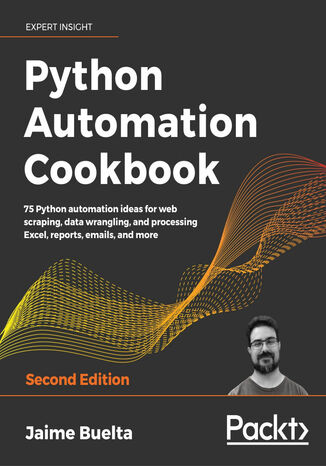
Jaime Buelta
In this updated and extended version of Python Automation Cookbook, each chapter now comprises the newest recipes and is revised to align with Python 3.8 and higher. The book includes three new chapters that focus on using Python for test automation, machine learning projects, and for working with messy data.This edition will enable you to develop a sharp understanding of the fundamentals required to automate business processes through real-world tasks, such as developing your first web scraping application, analyzing information to generate spreadsheet reports with graphs, and communicating with automatically generated emails.Once you grasp the basics, you will acquire the practical knowledge to create stunning graphs and charts using Matplotlib, generate rich graphics with relevant information, automate marketing campaigns, build machine learning projects, and execute debugging techniques.By the end of this book, you will be proficient in identifying monotonous tasks and resolving process inefficiencies to produce superior and reliable systems.
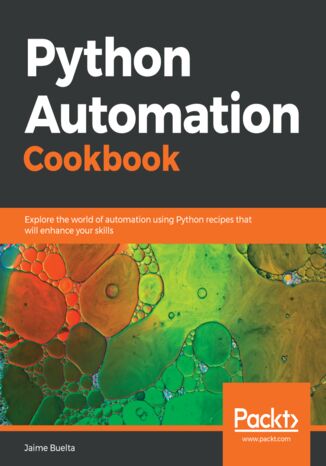
Jaime Buelta
Have you been doing the same old monotonous office work over and over again? Or have you been trying to find an easy way to make your life better by automating some of your repetitive tasks? Through a tried and tested approach, understand how to automate all the boring stuff using Python. The Python Automation Cookbook helps you develop a clear understanding of how to automate your business processes using Python, including detecting opportunities by scraping the web, analyzing information to generate automatic spreadsheets reports with graphs, and communicating with automatically generated emails. You’ll learn how to get notifications via text messages and run tasks while your mind is focused on other important activities, followed by understanding how to scan documents such as résumés. Once you’ve gotten familiar with the fundamentals, you’ll be introduced to the world of graphs, along with studying how to produce organized charts using Matplotlib. In addition to this, you’ll gain in-depth knowledge of how to generate rich graphics showing relevant information. By the end of this book, you’ll have refined your skills by attaining a sound understanding of how to identify and correct problems to produce superior and reliable systems.
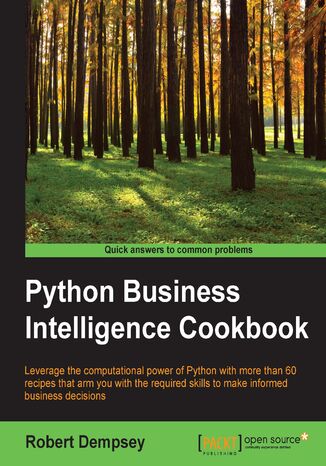
Robert Dempsey
The amount of data produced by businesses and devices is going nowhere but up. In this scenario, the major advantage of Python is that it's a general-purpose language and gives you a lot of flexibility in data structures. Python is an excellent tool for more specialized analysis tasks, and is powered with related libraries to process data streams, to visualize datasets, and to carry out scientific calculations. Using Python for business intelligence (BI) can help you solve tricky problems in one go.Rather than spending day after day scouring Internet forums for “how-to” information, here you’ll find more than 60 recipes that take you through the entire process of creating actionable intelligence from your raw data, no matter what shape or form it’s in. Within the first 30 minutes of opening this book, you’ll learn how to use the latest in Python and NoSQL databases to glean insights from data just waiting to be exploited.We’ll begin with a quick-fire introduction to Python for BI and show you what problems Python solves. From there, we move on to working with a predefined data set to extract data as per business requirements, using the Pandas library and MongoDB as our storage engine.Next, we will analyze data and perform transformations for BI with Python. Through this, you will gather insightful data that will help you make informed decisions for your business. The final part of the book will show you the most important task of BI—visualizing data by building stunning dashboards using Matplotlib, PyTables, and iPython Notebook.
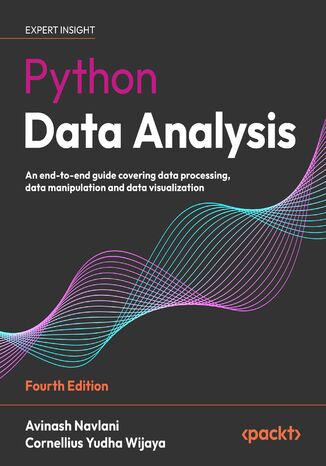
Avinash Navlani, Cornellius Yudha Wijaya
Data analysis enables you to generate value from small and big data by discovering new patterns, and Python is one of the most popular tools for analyzing a wide variety of data. With this book, you'll get up and running using Python for data analysis by exploring the different phases used in data analysis and learning how to use modern libraries from the Python ecosystem to create efficient data pipelines.Starting with the essential statistical and data analysis fundamentals using Python, you'll perform complex data analysis and modeling, data manipulation, data cleaning, and data visualization using easy-to-follow examples. You'll then understand how to conduct time series analysis and signal processing using ARMA models. As you advance, you'll get to grips with smart processing and data analytics using machine learning algorithms such as regression, classification, Principal Component Analysis (PCA), and clustering. You'll also work on real-world examples to analyze textual and image data using natural language processing (NLP) and image analytics techniques, respectively. Finally, the book will demonstrate parallel computing using Dask.By the end of this data analysis book, you'll be equipped with the skills you need to prepare data for analysis and create meaningful data visualizations for forecasting values from data.