
Wydawca: Packt Publishing
Michael Dame
From incomplete collections of knowledge and varying design approaches to technical knowledge barriers, Kubernetes users face various challenges when developing their own operators. Knowing how to write, deploy, and pack operators makes cluster management automation much easier – and that's what this book is here to teach you.Beginning with operators and Operator Framework fundamentals, the book delves into how the different components of Operator Framework (such as the Operator SDK, Operator Lifecycle Manager, and OperatorHub.io) are used to build operators. You’ll learn how to write a basic operator, interact with a Kubernetes cluster in code, and distribute that operator to users. As you advance, you’ll be able to develop a sample operator in the Go programming language using Operator SDK tools before running it locally with Operator Lifecycle Manager, and also learn how to package an operator bundle for distribution. The book covers best practices as well as sample applications and case studies based on real-world operators to help you implement the concepts you’ve learned.By the end of this Kubernetes book, you’ll be able to build and add application-specific operational logic to a Kubernetes cluster, making it easier to automate complex applications and augment the platform.
The Kubernetes Workshop. Learn how to build and run highly scalable workloads on Kubernetes
Zachary Arnold , Sahil Dua , Wei...
Thanks to its extensive support for managing hundreds of containers that run cloud-native applications, Kubernetes is the most popular open source container orchestration platform that makes cluster management easy. This workshop adopts a practical approach to get you acquainted with the Kubernetes environment and its applications.Starting with an introduction to the fundamentals of Kubernetes, you’ll install and set up your Kubernetes environment. You’ll understand how to write YAML files and deploy your first simple web application container using Pod. You’ll then assign human-friendly names to Pods, explore various Kubernetes entities and functions, and discover when to use them. As you work through the chapters, this Kubernetes book will show you how you can make full-scale use of Kubernetes by applying a variety of techniques for designing components and deploying clusters. You’ll also get to grips with security policies for limiting access to certain functions inside the cluster. Toward the end of the book, you’ll get a rundown of Kubernetes advanced features for building your own controller and upgrading to a Kubernetes cluster without downtime.By the end of this workshop, you’ll be able to manage containers and run cloud-based applications efficiently using Kubernetes.
The Lean-Agile Way. Unleash business results in the digital era with value stream management
Cecil 'Gary' Rupp, Richard Knaster, Steve Pereira,...
In today’s fast-paced business landscape, efficiency is essential. Authored by industry experts Cecil ‘Gary’ Rupp, a Lean-Agile consultant with over three decades of executive experience; Richard Knaster, a SAFe® Fellow and transformation leader; Steve Pereira, a value stream consultant and board advisor; and Al Shalloway, creator of FLEX and PMI’s Disciplined Agile Value Stream Consultant workshop, the book offers proven strategies to streamline processes, enhance products, and improve service delivery. You’ll start with an introduction to foundational Lean and Agile practices, recognizing the significance of digital enhancements in modernizing business processes. As you progress, you'll learn VSM techniques to identify and prioritize work and investments to provide maximum value to customers. Moreover, you'll grasp Lean-Agile practices aimed at promoting collaboration among teams and ensuring the continuous flow of product-oriented deliveries tailored to address customer needs. Finally, you'll gain executive-level insights on how organizations must access timely information for decision-making and foster a culture of continuous business transformation. Armed with this knowledge and a robust toolkit, you'll be empowered to drive meaningful change, optimize resources, and stay ahead in the rapidly evolving marketplace.

Damian Wojsław, Grzegorz Adamowicz
The Linux DevOps Handbook is a comprehensive resource that caters to both novice and experienced professionals, ensuring a strong foundation in Linux. This book will help you understand how Linux serves as a cornerstone of DevOps, offering the flexibility, stability, and scalability essential for modern software development and operations.You’ll begin by covering Linux distributions, intermediate Linux concepts, and shell scripting to get to grips with automating tasks and streamlining workflows. You’ll then progress to mastering essential day-to-day tools for DevOps tasks. As you learn networking in Linux, you’ll be equipped with connection establishment and troubleshooting skills. You’ll also learn how to use Git for collaboration and efficient code management.The book guides you through Docker concepts for optimizing your DevOps workflows and moves on to advanced DevOps practices, such as monitoring, tracing, and distributed logging. You’ll work with Terraform and GitHub to implement continuous integration (CI)/continuous deployment (CD) pipelines and employ Atlantis for automated software delivery. Additionally, you’ll identify common DevOps pitfalls and strategies to avoid them.By the end of this book, you’ll have built a solid foundation in Linux fundamentals, practical tools, and advanced practices, all contributing to your enhanced Linux skills and successful DevOps implementation.
David Ping
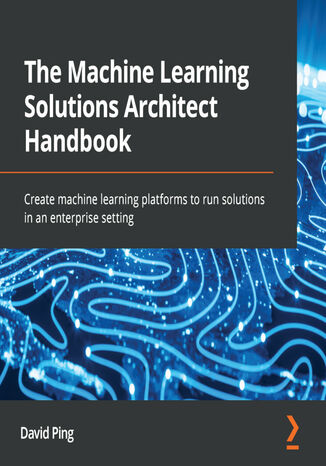
When equipped with a highly scalable machine learning (ML) platform, organizations can quickly scale the delivery of ML products for faster business value realization. There is a huge demand for skilled ML solutions architects in different industries, and this handbook will help you master the design patterns, architectural considerations, and the latest technology insights you’ll need to become one. You’ll start by understanding ML fundamentals and how ML can be applied to solve real-world business problems. Once you've explored a few leading problem-solving ML algorithms, this book will help you tackle data management and get the most out of ML libraries such as TensorFlow and PyTorch. Using open source technology such as Kubernetes/Kubeflow to build a data science environment and ML pipelines will be covered next, before moving on to building an enterprise ML architecture using Amazon Web Services (AWS). You’ll also learn about security and governance considerations, advanced ML engineering techniques, and how to apply bias detection, explainability, and privacy in ML model development.By the end of this book, you’ll be able to design and build an ML platform to support common use cases and architecture patterns like a true professional.
David Ping
When equipped with a highly scalable machine learning (ML) platform, organizations can quickly scale the delivery of ML products for faster business value realization. There is a huge demand for skilled ML solutions architects in different industries, and this handbook will help you master the design patterns, architectural considerations, and the latest technology insights you’ll need to become one.You’ll start by understanding ML fundamentals and how ML can be applied to solve real-world business problems. Once you've explored a few leading problem-solving ML algorithms, this book will help you tackle data management and get the most out of ML libraries such as TensorFlow and PyTorch.Using open source technology such as Kubernetes/Kubeflow to build a data science environment and ML pipelines will be covered next, before moving on to building an enterprise ML architecture using Amazon Web Services (AWS). You’ll also learn about security and governance considerations, advanced ML engineering techniques, and how to apply bias detection, explainability, and privacy in ML model development. And finally, you'll get acquainted with AWS AI services and their applications in real-world use cases.By the end of this audiobook, you’ll be able to design and build an ML platform to support common use cases and architecture patterns like a true professional.
David Ping
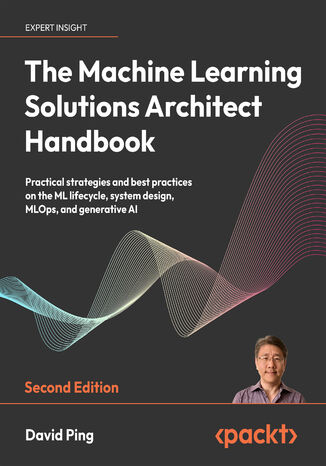
David Ping, Head of GenAI and ML Solution Architecture for global industries at AWS, provides expert insights and practical examples to help you become a proficient ML solutions architect, linking technical architecture to business-related skills.You'll learn about ML algorithms, cloud infrastructure, system design, MLOps , and how to apply ML to solve real-world business problems. David explains the generative AI project lifecycle and examines Retrieval Augmented Generation (RAG), an effective architecture pattern for generative AI applications. You’ll also learn about open-source technologies, such as Kubernetes/Kubeflow, for building a data science environment and ML pipelines before building an enterprise ML architecture using AWS. As well as ML risk management and the different stages of AI/ML adoption, the biggest new addition to the handbook is the deep exploration of generative AI.By the end of this book , you’ll have gained a comprehensive understanding of AI/ML across all key aspects, including business use cases, data science, real-world solution architecture, risk management, and governance. You’ll possess the skills to design and construct ML solutions that effectively cater to common use cases and follow established ML architecture patterns, enabling you to excel as a true professional in the field.
Hyatt Saleh , John Wesley Doyle ,...
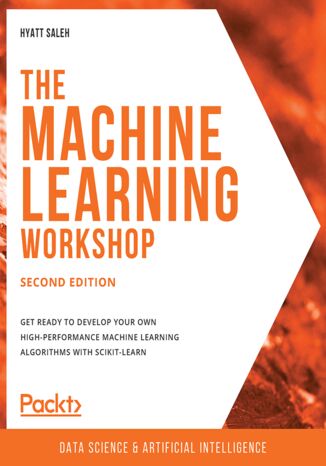
Machine learning algorithms are an integral part of almost all modern applications. To make the learning process faster and more accurate, you need a tool flexible and powerful enough to help you build machine learning algorithms quickly and easily. With The Machine Learning Workshop, you'll master the scikit-learn library and become proficient in developing clever machine learning algorithms.The Machine Learning Workshop begins by demonstrating how unsupervised and supervised learning algorithms work by analyzing a real-world dataset of wholesale customers. Once you've got to grips with the basics, you'll develop an artificial neural network using scikit-learn and then improve its performance by fine-tuning hyperparameters. Towards the end of the workshop, you'll study the dataset of a bank's marketing activities and build machine learning models that can list clients who are likely to subscribe to a term deposit. You'll also learn how to compare these models and select the optimal one.By the end of The Machine Learning Workshop, you'll not only have learned the difference between supervised and unsupervised models and their applications in the real world, but you'll also have developed the skills required to get started with programming your very own machine learning algorithms.