
Programowanie
Niezależnie czy dopiero rozpoczynacie swoją przygodę z programowaniem, czy jesteście już uznanymi na rynku profesjonalistami, to w kategorii Programowanie na pewno znajdziecie podręczniki, które pomogą Wam w przebiegu pracy, czy też w nauce podstaw programowania.
W książkach z tego działu zawarta jest wiedza zarówno związana z czysto technicznymi sprawami typu składnia języków, ale także z umiejętnościami bardziej "miękkimi" jak obsługa i wykorzystanie pełnych możliwości środowisk programistycznych, czy też projektowanie oprogramowania lub metody numeryczne czy oraz struktury danych.
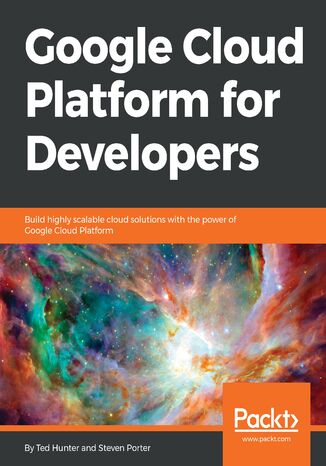
Ted Hunter, Steven Porter
Google Cloud Platform (GCP) provides autoscaling compute power and distributed in-memory cache, task queues, and datastores to write, build, and deploy Cloud-hosted applications.With Google Cloud Platform for Developers, you will be able to develop and deploy scalable applications from scratch and make them globally available in almost any language. This book will guide you in designing, deploying, and managing applications running on Google Cloud. You’ll start with App Engine and move on to work with Container Engine, compute engine, and cloud functions. You’ll learn how to integrate your new applications with the various data solutions on GCP, including Cloud SQL, Bigtable, and Cloud Storage. This book will teach you how to streamline your workflow with tools such as Source Repositories, Container Builder, and StackDriver. Along the way, you’ll see how to deploy and debug services with IntelliJ, implement continuous delivery pipelines, and configure robust monitoring and alerting for your production systems.By the end of this book, you’ll be well-versed with all the development tools of Google Cloud Platform, and you’ll develop, deploy, and manage highly scalable and reliable applications.
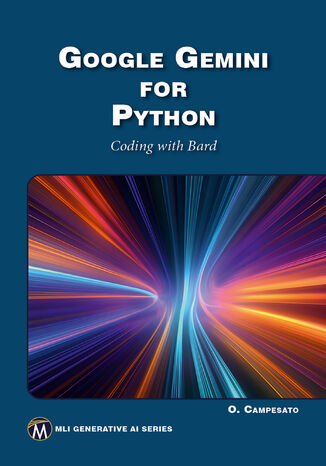
Google Gemini for Python. Coding with Bard: Mastering Python with Google's AI Tools
Mercury Learning and Information, Oswald Campesato
This book bridges Python 3 programming and Generative AI, equipping readers with the skills to navigate both domains confidently. It starts with Python basics, covering data types, number formatting, text manipulation, loops, functions, data structures, NumPy, Pandas, conditional logic, and reserved words. You'll also learn about handling user input, managing exceptions, and working with command-line arguments.The journey continues into Generative AI, distinguishing it from Conversational AI. It introduces popular platforms and models, including Bard (now called Gemini) and its competitors, providing insights into their capabilities, strengths, weaknesses, and applications. The final chapters show how to generate various Python 3 code samples using Gemini.Understanding these concepts is crucial for modern programming and AI applications. This book transitions readers from basic Python programming to advanced AI techniques, blending theoretical knowledge with practical skills. Companion files with source code and figures enhance the learning experience, making this an essential resource for mastering Python 3 and Generative AI.
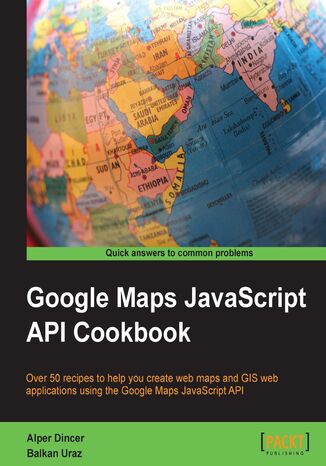
Alper Dincer, Balkan Uraz
Day by day, the use of location data is becoming more and more popular, and Google is one of the main game changers in this area. The Google Maps JavaScript API is one of the most functional and robust mapping APIs used among Geo developers. With Google Maps, you can build location-based apps, maps for mobile apps, visualize geospatial data, and customize your own maps.Google Maps JavaScript API Cookbook is a practical, hands-on guide that provides you with a number of clear, step-by-step recipes that will help you to unleash the capabilities of the Google Maps JavaScript API in conjunction with open source or commercial GIS servers and services through a number of practical examples of real world scenarios.This book begins by covering the essentials of including simple maps for Web and mobile, adding vector and raster layers, styling your own base maps, creating your own controls and responding to events, and including your own events.You will learn how to integrate open source or commercial GIS servers and services including ArcGIS Server, GeoServer, CartoDB, Fusion Tables, and Google Maps Engine with the Google Maps JavaScript API. You will also extend the Google Maps JavaScript API to push its capabilities to the limit with additional libraries and services including geometry, AdSense, geocoding, directions, and StreetView.This book covers everything you need to know about creating a web map or GIS applications using the Google Maps JavaScript API on multiple platforms.
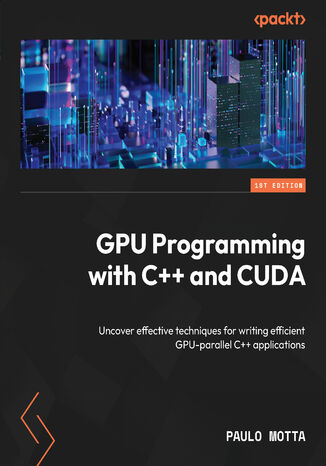
Paulo Motta
Written by Paulo Motta, a senior researcher with decades of experience, this comprehensive GPU programming book is an essential guide for leveraging the power of parallelism to accelerate your computations. The first section introduces the concept of parallelism and provides practical advice on how to think about and utilize it effectively. Starting with a basic GPU program, you then gain hands-on experience in managing the device. This foundational knowledge is then expanded by parallelizing the program to illustrate how GPUs enhance performance.The second section explores GPU architecture and implementation strategies for parallel algorithms, and offers practical insights into optimizing resource usage for efficient execution.In the final section, you will explore advanced topics such as utilizing CUDA streams. You will also learn how to package and distribute GPU-accelerated libraries for the Python ecosystem, extending the reach and impact of your work.Combining expert insight with real-world problem solving, this book is a valuable resource for developers and researchers aiming to harness the full potential of GPU computing. The blend of theoretical foundations, practical programming techniques, and advanced optimization strategies it offers is sure to help you succeed in the fast-evolving field of GPU programming.

Hubert Klein Ikkink
If you work on Java projects, use Gradle as a build automation tool, and you use dependencies in your project, this is the book for you. Additionally, if you want to deploy your project artifacts as dependencies for other developers using Gradle, you've found the right book.
Hubert Klein Ikkink
Gradle is the next generation in build automation. It uses convention-over-configuration to provide good defaults, but is also flexible enough to be usable in every situation you encounter in daily development. Build logic is described with a powerful DSL and empowers developers to create reusable and maintainable build logic.Gradle Effective Implementation Guide is a great introduction and reference for using Gradle. The Gradle build language is explained with hands on code and practical applications. You learn how to apply Gradle in your Java, Scala or Groovy projects, integrate with your favorite IDE and how to integrate with well-known continuous integration servers.Start with the foundations and work your way through hands on examples to build your knowledge of Gradle to skyscraper heights. You will quickly learn the basics of Gradle, how to write tasks, work with files and how to use write build scripts using the Groovy DSL. Then as you develop you will be shown how to use Gradle for Java projects. Compile, package, test and deploy your applications with ease. When you've mastered the simple, move on to the sublime and integrate your code with continuous integration servers and IDEs. By the end of the Gradle Effective Implementation Guide you will be able to use Gradle in your daily development. Writing tasks, applying plugins and creating build logic will be second nature.
Hubert Klein Ikkink
Gradle is a project automation tool that has a wide range of applications. The basic aim of Gradle is to automate a wide variety of tasks performed by software developers, including compiling computer source code to binary code, packaging binary codes, running tests, deploying applications to production systems, and creating documentation.The book will start with the fundamentals of Gradle and introduce you to the tools that will be used in further chapters. You will learn to create and work with Gradle scripts and then see how to use Gradle to build your Java Projects. While building Java application, you will find out about other important topics such as dependency management, publishing artifacts, and integrating the application with other JVM languages such as Scala and Groovy. By the end of this book, you will be able to use Gradle in your daily development. Writing tasks, applying plugins, and creating build logic will be your second nature.
Kunal Dabir, Abhinandan Maheshwari
Gradle is an advanced and modern build automation tool. It inherits the best elements of the past generation of build tools, but it also differs and innovates to bring terseness, elegance, simplicity, and the flexibility to build.Right from installing Gradle and writing your first build file to creating a fully-fledged multi-module project build, this book will guide you through its topics in a step-by-step fashion.You will get your hands dirty with a simple Java project built with Gradle and go on to build web applications that are run with Jetty or Tomcat. We take a unique approach towards explaining the DSL using the Gradle API, which makes the DSL more accessible and intuitive. All in all, this book is a concise guide to help you decipher the Gradle build files, covering the essential topics that are most useful in real-world projects. With every chapter, you will learn a new topic and be able to readily implement your build files.