
Programowanie
Niezależnie czy dopiero rozpoczynacie swoją przygodę z programowaniem, czy jesteście już uznanymi na rynku profesjonalistami, to w kategorii Programowanie na pewno znajdziecie podręczniki, które pomogą Wam w przebiegu pracy, czy też w nauce podstaw programowania.
W książkach z tego działu zawarta jest wiedza zarówno związana z czysto technicznymi sprawami typu składnia języków, ale także z umiejętnościami bardziej "miękkimi" jak obsługa i wykorzystanie pełnych możliwości środowisk programistycznych, czy też projektowanie oprogramowania lub metody numeryczne czy oraz struktury danych.
Saurabh Badhwar
Dynamically typed languages like Python are continuously improving. With the addition of exciting new features and a wide selection of modern libraries and frameworks, Python has emerged as an ideal language for developing enterprise applications. Hands-On Enterprise Application Development with Python will show you how to build effective applications that are stable, secure, and easily scalable.The book is a detailed guide to building an end-to-end enterprise-grade application in Python. You will learn how to effectively implement Python features and design patterns that will positively impact your application lifecycle. The book also covers advanced concurrency techniques that will help you build a RESTful application with an optimized frontend. Given that security and stability are the foundation for an enterprise application, you’ll be trained on effective testing, performance analysis, and security practices, and understand how to embed them in your codebase during the initial phase. You’ll also be guided in how to move on from a monolithic architecture to one that is service oriented, leveraging microservices and serverless deployment techniques.By the end of the book, you will have become proficient at building efficient enterprise applications in Python.
Bassem Aly
Hands-On Enterprise Automation with Python starts by covering the set up of a Python environment to perform automation tasks, as well as the modules, libraries, and tools you will be using. We’ll explore examples of network automation tasks using simple Python programs and Ansible. Next, we will walk you through automating administration tasks with Python Fabric, where you will learn to perform server configuration and administration, along with system administration tasks such as user management, database management, and process management. As you progress through this book, you’ll automate several testing services with Python scripts and perform automation tasks on virtual machines and cloud infrastructure with Python. In the concluding chapters, you will cover Python-based offensive security tools and learn how to automate your security tasks.By the end of this book, you will have mastered the skills of automating several system administration tasks with Python.
Cesar Saavedra, Heiko W. Rupp , Jeff...
Eclipse MicroProfile has gained momentum in the industry as a multi-vendor, interoperable, community-driven specification. It is a major disruptor that allows organizations with large investments in enterprise Java to move to microservices without spending a lot on retraining their workforce.This book is based on MicroProfile 2.2, however, it will guide you in running your applications in MicroProfile 3.0. You'll start by understanding why microservices are important in the digital economy and how MicroProfile addresses the need for enterprise Java microservices. You'll learn about the subprojects that make up a MicroProfile, its value proposition to organizations and developers, and its processes and governance. As you advance, the book takes you through the capabilities and code examples of MicroProfile’s subprojects - Config, Fault Tolerance, Health Check, JWT Propagation, Metrics, and OpenTracing. Finally, you’ll be guided in developing a conference application using Eclipse MicroProfile, and explore possible scenarios of what’s next in MicroProfile with Jakarta EE.By the end of this book, you'll have gained a clear understanding of Eclipse MicroProfile and its role in enterprise Java microservices.
Denis Rothman
Effectively translating AI insights to business stakeholders requires careful planning, design, and visualization choices. Describing the problem, the model, and the relationships among variables and their findings are often subtle, surprising, and technically complex.Hands-On Explainable AI (XAI) with Python will see you work with specific hands-on machine learning Python projects that are strategically arranged to enhance your grasp on AI results analysis. You will be building models, interpreting results with visualizations, and integrating XAI reporting tools and different applications.You will build XAI solutions in Python, TensorFlow 2, Google Cloud’s XAI platform, Google Colaboratory, and other frameworks to open up the black box of machine learning models. The book will introduce you to several open-source XAI tools for Python that can be used throughout the machine learning project life cycle.You will learn how to explore machine learning model results, review key influencing variables and variable relationships, detect and handle bias and ethics issues, and integrate predictions using Python along with supporting the visualization of machine learning models into user explainable interfaces.By the end of this AI book, you will possess an in-depth understanding of the core concepts of XAI.
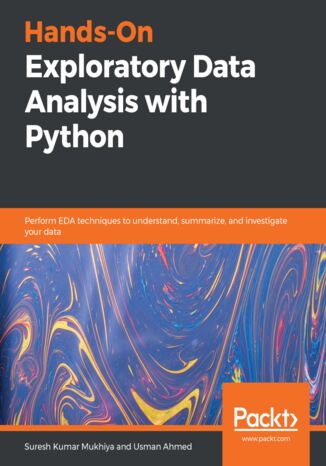
Suresh Kumar Mukhiya, Usman Ahmed
Exploratory Data Analysis (EDA) is an approach to data analysis that involves the application of diverse techniques to gain insights into a dataset. This book will help you gain practical knowledge of the main pillars of EDA - data cleaning, data preparation, data exploration, and data visualization.You’ll start by performing EDA using open source datasets and perform simple to advanced analyses to turn data into meaningful insights. You’ll then learn various descriptive statistical techniques to describe the basic characteristics of data and progress to performing EDA on time-series data. As you advance, you’ll learn how to implement EDA techniques for model development and evaluation and build predictive models to visualize results. Using Python for data analysis, you’ll work with real-world datasets, understand data, summarize its characteristics, and visualize it for business intelligence.By the end of this EDA book, you’ll have developed the skills required to carry out a preliminary investigation on any dataset, yield insights into data, present your results with visual aids, and build a model that correctly predicts future outcomes.
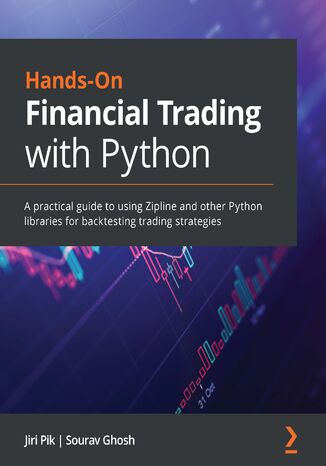
Jiri Pik, Sourav Ghosh
Creating an effective system to automate your trading can help you achieve two of every trader’s key goals; saving time and making money. But to devise a system that will work for you, you need guidance to show you the ropes around building a system and monitoring its performance. This is where Hands-on Financial Trading with Python can give you the advantage.This practical Python book will introduce you to Python and tell you exactly why it’s the best platform for developing trading strategies. You’ll then cover quantitative analysis using Python, and learn how to build algorithmic trading strategies with Zipline using various market data sources.Using Zipline as the backtesting library allows access to complimentary US historical daily market data until 2018. As you advance, you will gain an in-depth understanding of Python libraries such as NumPy and pandas for analyzing financial datasets, and explore Matplotlib, statsmodels, and scikit-learn libraries for advanced analytics.As you progress, you’ll pick up lots of skills like time series forecasting, covering pmdarima and Facebook Prophet.By the end of this trading book, you will be able to build predictive trading signals, adopt basic and advanced algorithmic trading strategies, and perform portfolio optimization to help you get —and stay—ahead of the markets.
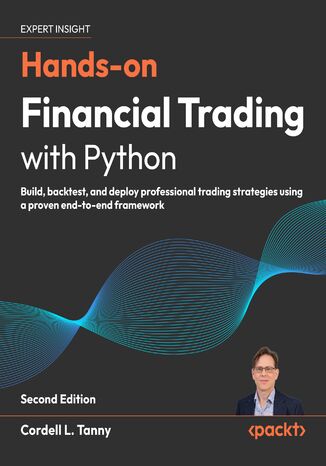
Cordell L. Tanny
Most Python trading books teach libraries in isolation. This book teaches you the complete workflow professionals use to build systematic strategies. The book walks you through the complete journey. You start by acquiring and cleaning market data, handling the messy realities of missing values and misaligned time series. With clean data in hand, you move into exploration: visualizing market relationships, forming trading hypotheses, and identifying patterns worth pursuing. Signal generation follows naturally from that analysis. You build indicators, define entry and exit rules, then validate everything through rigorous backtesting using walk-forward analysis and out-of-sample testing. The final stage: evaluating performance with institutional-grade metrics and deploying your strategy for automated execution.This entire process is demonstrated through one volatility tail-hedge strategy, built progressively across every chapter. Same data, same strategy, layer by layer. You see how each step connects to the next. You'll learn professional standards developed over 25 years of institutional trading: spotting lookahead bias, structuring production code, validating backtests, and distinguishing real edges from noise. All code included.By the end, you have a working strategy and a repeatable framework for building your own.
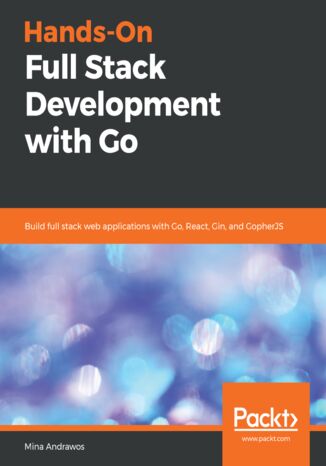
Mina Andrawos
The Go programming language has been rapidly adopted by developers for building web applications. With its impressive performance and ease of development, Go enjoys the support of a wide variety of open source frameworks, for building scalable and high-performant web services and apps. Hands-On Full Stack Development with Go is a comprehensive guide that covers all aspects of full stack development with Go.This clearly written, example-rich book begins with a practical exposure to Go development and moves on to build a frontend with the popular React framework. From there, you will build RESTful web APIs utilizing the Gin framework. After that, we will dive deeper into important software backend concepts, such as connecting to the database via an ORM, designing routes for your services, securing your services, and even charging credit cards via the popular Stripe API. We will also cover how to test, and benchmark your applications efficiently in a production environment. In the concluding chapters, we will cover isomorphic developments in pure Go by learning about GopherJS. As you progress through the book, you'll gradually build a musical instrument online store application from scratch.By the end of the book, you will be confident in taking on full stack web applications in Go.