
Programowanie
Niezależnie czy dopiero rozpoczynacie swoją przygodę z programowaniem, czy jesteście już uznanymi na rynku profesjonalistami, to w kategorii Programowanie na pewno znajdziecie podręczniki, które pomogą Wam w przebiegu pracy, czy też w nauce podstaw programowania.
W książkach z tego działu zawarta jest wiedza zarówno związana z czysto technicznymi sprawami typu składnia języków, ale także z umiejętnościami bardziej "miękkimi" jak obsługa i wykorzystanie pełnych możliwości środowisk programistycznych, czy też projektowanie oprogramowania lub metody numeryczne czy oraz struktury danych.
Scala Test-Driven Development. Write clean scala code that works
Gaurav Sood
Test-driven development (TDD) produces high-quality applications in less time than is possible with traditional methods. Due to the systematic nature of TDD, the application is tested in individual units as well as cumulatively, right from the design stage, to ensure optimum performance and reduced debugging costs. This step-by-step guide shows you how to use the principles of TDD and built-in Scala testing modules to write clean and fully tested Scala code and give your workflow the change it needs to let you create better applications than ever before. After an introduction to TDD, you will learn the basics of ScalaTest, one of the most flexible and most popular testing tools around for Scala, by building your first fully test-driven application. Building on from that you will learn about the ScalaTest API and how to refactor code to produce high-quality applications. We’ll teach you the concepts of BDD (Behavior-driven development) and you’ll see how to add functional tests to the existing suite of tests. You’ll be introduced to the concepts of Mocks and Stubs and will learn to increase test coverage using properties. With a concluding chapter on miscellaneous tools, this book will enable you to write better quality code that is easily maintainable and watch your apps change for the better.
Jason Myerscough
Azure Data Explorer (ADX) enables developers and data scientists to make data-driven business decisions. This book will help you rapidly explore and query your data at scale and secure your ADX clusters.The book begins by introducing you to ADX, its architecture, core features, and benefits. You'll learn how to securely deploy ADX instances and navigate through the ADX Web UI, cover data ingestion, and discover how to query and visualize your data using the powerful Kusto Query Language (KQL). Next, you'll get to grips with KQL operators and functions to efficiently query and explore your data, as well as perform time series analysis and search for anomalies and trends in your data. As you progress through the chapters, you'll explore advanced ADX topics, including deploying your ADX instances using Infrastructure as Code (IaC). The book also shows you how to manage your cluster performance and monthly ADX costs by handling cluster scaling and data retention periods. Finally, you'll understand how to secure your ADX environment by restricting access with best practices for improving your KQL query performance.By the end of this Azure book, you'll be able to securely deploy your own ADX instance, ingest data from multiple sources, rapidly query your data, and produce reports with KQL and Power BI.
Tarik Makota, Brian Maguire, Danny Gagne, Rajeev...
Amazon Kinesis is a collection of secure, serverless, durable, and highly available purpose-built data streaming services. This data streaming service provides APIs and client SDKs that enable you to produce and consume data at scale.Scalable Data Streaming with Amazon Kinesis begins with a quick overview of the core concepts of data streams, along with the essentials of the AWS Kinesis landscape. You'll then explore the requirements of the use case shown through the book to help you get started and cover the key pain points encountered in the data stream life cycle. As you advance, you'll get to grips with the architectural components of Kinesis, understand how they are configured to build data pipelines, and delve into the applications that connect to them for consumption and processing. You'll also build a Kinesis data pipeline from scratch and learn how to implement and apply practical solutions. Moving on, you'll learn how to configure Kinesis on a cloud platform. Finally, you’ll learn how other AWS services can be integrated into Kinesis. These services include Redshift, Dynamo Database, AWS S3, Elastic Search, and third-party applications such as Splunk.By the end of this AWS book, you’ll be able to build and deploy your own Kinesis data pipelines with Kinesis Data Streams (KDS), Kinesis Data Firehose (KFH), Kinesis Video Streams (KVS), and Kinesis Data Analytics (KDA).
Dean MacNeil, Aslam Cader
Jira Align is a platform purpose-built for enterprises to connect strategy with execution and drive transparency, consistency, and predictability at all levels of scale. The platform supports business value delivery in agile frameworks such as LeSS, DAD, and SAFe. It also caters to organizations that mix agile with waterfall to support scaled bimodal delivery.Starting with an introduction to the platform and its features, this book takes you through the foundational building blocks of Jira Align. You’ll learn how an organization can benefit from implementing Jira Align and understand how to connect dimensions such as people, work, time, and outcomes. The book takes you through the typical steps for implementing Jira Align for maximizing outcomes and helps you solve common team, program, and portfolio-level challenges by enhancing visibility, tracking dependencies and risks, and using reports for real-time, distributed decision making. Throughout the book, you’ll explore features such as remote agile ceremonies, live roadmaps, and objectives and key results (OKRs). You’ll also get to grips with lean portfolio management, financial reporting, and using the program board for planning and execution.By the end of this book, you’ll be well versed in the key features of Jira Align and be able to leverage them to support all levels of agile at scale.
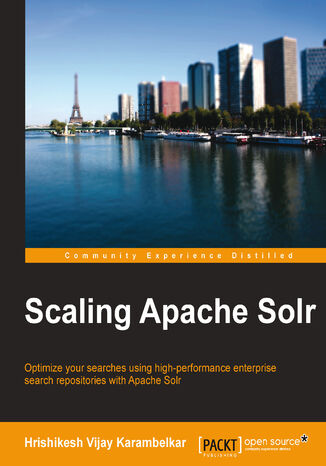
Hrishikesh Vijay Karambelkar
This book is a step-by-step guide for readers who would like to learn how to build complete enterprise search solutions, with ample real-world examples and case studies. If you are a developer, designer, or architect who would like to build enterprise search solutions for your customers or organization, but have no prior knowledge of Apache Solr/Lucene technologies, this is the book for you.
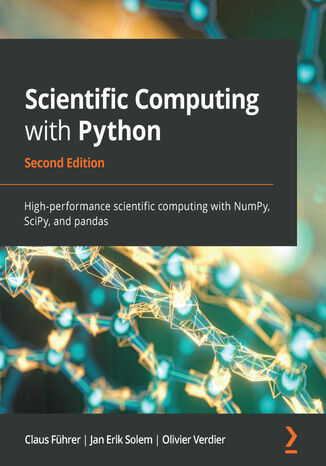
Claus Führer, Claus Fuhrer, Jan Erik Solem,...
Python has tremendous potential within the scientific computing domain. This updated edition of Scientific Computing with Python features new chapters on graphical user interfaces, efficient data processing, and parallel computing to help you perform mathematical and scientific computing efficiently using Python.This book will help you to explore new Python syntax features and create different models using scientific computing principles. The book presents Python alongside mathematical applications and demonstrates how to apply Python concepts in computing with the help of examples involving Python 3.8. You'll use pandas for basic data analysis to understand the modern needs of scientific computing, and cover data module improvements and built-in features. You'll also explore numerical computation modules such as NumPy and SciPy, which enable fast access to highly efficient numerical algorithms. By learning to use the plotting module Matplotlib, you will be able to represent your computational results in talks and publications. A special chapter is devoted to SymPy, a tool for bridging symbolic and numerical computations.By the end of this Python book, you'll have gained a solid understanding of task automation and how to implement and test mathematical algorithms within the realm of scientific computing.
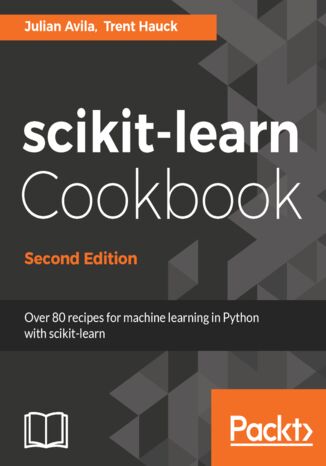
Julian Avila, Trent Hauck
Python is quickly becoming the go-to language for analysts and data scientists due to its simplicity and flexibility, and within the Python data space, scikit-learn is the unequivocal choice for machine learning. This book includes walk throughs and solutions to the common as well as the not-so-common problems in machine learning, and how scikit-learn can be leveraged to perform various machine learning tasks effectively.The second edition begins with taking you through recipes on evaluating the statistical properties of data and generates synthetic data for machine learning modelling. As you progress through the chapters, you will comes across recipes that will teach you to implement techniques like data pre-processing, linear regression, logistic regression, K-NN, Naïve Bayes, classification, decision trees, Ensembles and much more. Furthermore, you’ll learn to optimize your models with multi-class classification, cross validation, model evaluation and dive deeper in to implementing deep learning with scikit-learn. Along with covering the enhanced features on model section, API and new features like classifiers, regressors and estimators the book also contains recipes on evaluating and fine-tuning the performance of your model. By the end of this book, you will have explored plethora of features offered by scikit-learn for Python to solve any machine learning problem you come across.
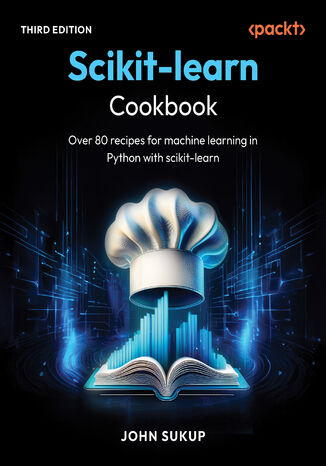
John Sukup
Trusted by data scientists, ML engineers, and software developers alike, scikit-learn offers a versatile, user-friendly framework for implementing a wide range of ML algorithms, enabling the efficient development and deployment of predictive models in real-world applications. This third edition of scikit-learn Cookbook will help you master ML with real-world examples and scikit-learn 1.5 features.This updated edition takes you on a journey from understanding the fundamentals of ML and data preprocessing, through implementing advanced algorithms and techniques, to deploying and optimizing ML models in production. Along the way, you’ll explore practical, step-by-step recipes that cover everything from feature engineering and model selection to hyperparameter tuning and model evaluation, all using scikit-learn.By the end of this book, you’ll have gained the knowledge and skills needed to confidently build, evaluate, and deploy sophisticated ML models using scikit-learn, ready to tackle a wide range of data-driven challenges.*Email sign-up and proof of purchase required