
Techniki programowania
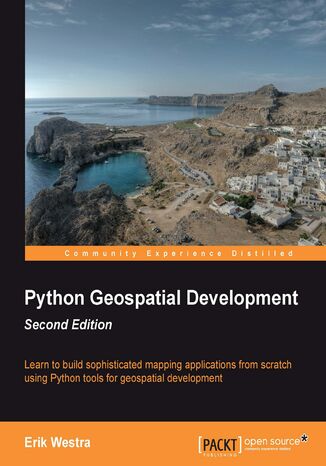
Erik Westra
Geospatial development links your data to places on the Earth's surface. Writing geospatial programs involves tasks such as grouping data by location, storing and analyzing large amounts of spatial information, performing complex geospatial calculations, and drawing colorful interactive maps. In order to do this well, you'll need appropriate tools and techniques, as well as a thorough understanding of geospatial concepts such as map projections, datums and coordinate systems.Python Geospatial Development - Second Edition teaches you everything you need to know about writing geospatial applications using Python. No prior knowledge of geospatial concepts, tools or techniques is required. The book guides you through the process of installing and using various toolkits, obtaining geospatial data for use in your programs, and building complete and sophisticated geospatial applications in Python.Python Geospatial Development teaches you everything you need to know about writing geospatial applications using Python. No prior knowledge of geospatial concepts, tools or techniques is required. The book guides you through the process of installing and using various toolkits, obtaining geospatial data for use in your programs, and building complete and sophisticated geospatial applications in Python.This book provides an overview of the major geospatial concepts, data sources and toolkits. It teaches you how to store and access spatial data using Python, how to perform a range of spatial calculations, and how to store spatial data in a database. Because maps are such an important aspect of geospatial programming, the book teaches you how to build your own “slippy map” interface within a web application, and finishes with the detailed construction of a geospatial data editor using Geodjango.Whether you want to write quick utilities to solve spatial problems, or develop sophisticated web applications based around maps and geospatial data, this book includes everything you need to know.
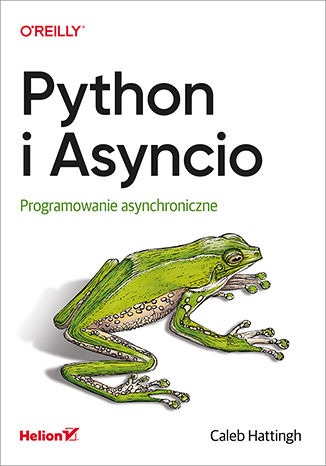
Python i Asyncio. Programowanie asynchroniczne
Caleb Hattingh
Programowanie współbieżne jest ważną techniką w tworzeniu nowoczesnych rozwiązań sieciowych. Programiści Pythona często w tym celu korzystają z wątków i mechanizmu wywłaszczania. Z tym że nie jest to optymalne rozwiązanie - z uwagi na ryzyko naruszenia bezpieczeństwa. Istnieje też możliwość programowania asynchronicznego z wykorzystaniem biblioteki asyncio, która została dodana w Pythonie 3.4. Złożoność API Asyncio budzi jednak obawy programistów Pythona, również biegle posługujących się tym językiem. Mimo to wysiłek włożony w zrozumienie działania Asyncio jest opłacalny, gdyż biblioteka ta pozwala na skuteczne rozwiązywanie problemów ze współbieżnym programowaniem sieciowym. Lektura tej książki ułatwi Ci pozbycie się obaw przed biblioteką asyncio. Zrozumiesz jej podstawowe elementy, co pozwoli Ci na rozpoczęcie programowania sterowanego zdarzeniami i prostą obsługę tysięcy jednoczesnych połączeń sieciowych. Dowiesz się, dlaczego Asyncio stanowi bezpieczniejszą alternatywę dla wielozadaniowości z wywłaszczaniem wątków, i dogłębnie zrozumiesz koncepcję programowania asynchronicznego. Następnie przeanalizujesz wprowadzone w Pythonie zmiany, dzięki którym możliwe jest programowanie asynchroniczne. Dowiesz się także, w jakich konkretnie sytuacjach biblioteka asyncio jest wyjątkowo użyteczna i których narzędzi należy wtedy używać. W książce pokazano najlepsze sposoby wykorzystania nowych możliwości Asyncio. W tej książce: porównanie programowania współbieżnego z wykorzystaniem Asyncio i wątków podstawy programowania bazującego na zdarzeniach możliwości Asyncio ważne dla programistów końcowych oraz twórców frameworków składnia async/await, w tym API koprocedur i klasy Future szczegółowe przypadki użycia kilku bibliotek zgodnych z Asyncio Programowanie asynchroniczne: nowa wizja bezpieczeństwa kodu Pythona!
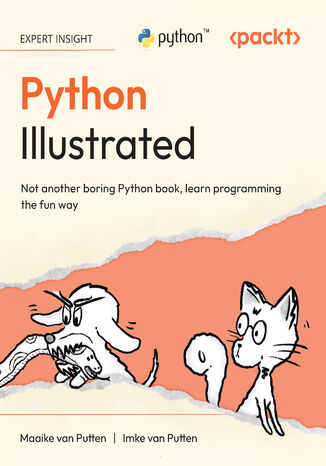
Python Illustrated. Not another boring Python book, learn programming the fun way
Maaike van Putten, Imke van Putten
This is not your average Python programming book, because the world doesn’t need another one of those. Instead, it’s an illustrated, fun, and hands-on guide that treats learning Python like the adventure it should be. It’s designed especially for beginners who want to understand how code works without getting overwhelmed. You’ll be guided by a cheeky, know-it-all cat who’s surprisingly good at teaching Python from scratch. Don’t worry about going through it alone; a slightly moody dachshund dog is your study buddy, learning right alongside you. Each chapter introduces a core programming concept, explains it with a playful twist, and reinforces it through human-friendly examples, analogies, and exercises. Whether you’re a software professional or someone who’s never written a single line of code, this book will help you build real Python coding skills… and even enjoy the process (shocking, right?). Forget dry tutorials and walls of text. Python Illustrated speaks to visual learners, creative thinkers, cat lovers, dog lovers, and anyone who prefers their learning with a dash of humor. From writing your first function to understanding object-oriented programming, you’ll build a solid foundation in Python (without the usual headaches).
Python: Journey from Novice to Expert. Journey from Novice to Expert
Fabrizio Romano, Dusty Phillips, Rick van Hattem
Python is a dynamic and powerful programming language, having its application in a wide range of domains. It has an easy-to-use, simple syntax, and a powerful library, which includes hundreds of modules to provide routines for a wide range of applications, thus making it a popular language among programing enthusiasts.This course will take you on a journey from basic programming practices to high-end tools and techniques giving you an edge over your peers. It follows an interesting learning path, divided into three modules. As you complete each one, you’ll have gained key skills and get ready for the material in the next module.The first module will begin with exploring all the essentials of Python programming in an easy-to-understand way. This will lay a good foundation for those who are interested in digging deeper. It has a practical and example-oriented approach through which both the introductory and the advanced topics are explained. Starting with the fundamentals of programming and Python, it ends by exploring topics, like GUIs, web apps, and data science.In the second module you will learn about object oriented programming techniques in Python. Starting with a detailed analysis of object-oriented technique and design, you will use the Python programming language to clearly grasp key concepts from the object-oriented paradigm. This module fully explains classes, data encapsulation, inheritance, polymorphism, abstraction, and exceptions with an emphasis on when you can use each principle to develop well-designed software.With a good foundation of Python you will move onto the third module which is a comprehensive tutorial covering advanced features of the Python language. Start by creating a project-specific environment using venv. This will introduce you to various Pythonic syntax and common pitfalls before moving onto functional features and advanced concepts, thereby gaining an expert level knowledge in programming and teaching how to script highest quality Python programs.
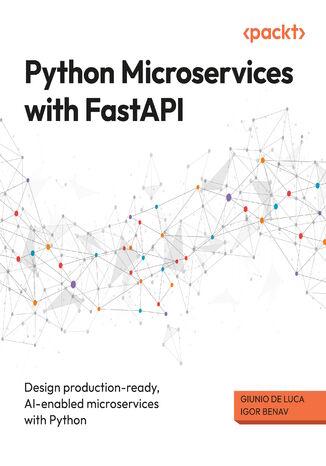
Python Microservices with FastAPI. Design production-ready, AI-enabled microservices with Python
Giunio De Luca, Igor Benav
This book shows you how to turn an idea into a reliable product.This is a playbook for practical progress. Choose what to ship now, what to delay, and how to avoid risky changes. Keep services tidy, naming clear, and tests small but useful. You will build a realistic end-to-end system step by step, following the evolution of a babysitting marketplace platform with sign-up, search, booking, messaging, and payments delivered in steady increments.When it is time to add intelligence, you learn practical ways to use AI for customer support, recommendations, and operational insights. The focus stays on measurable value, not hype, while keeping performance, costs, and reliability predictable in production.Your guides are Giunio De Luca, PhD, author of Packt’s FastAPI Cookbook and an architect who has shipped systems across research, sports, and energy, and Igor “Benav” Magalhães, founder of Benav Labs and maintainer of widely used open-source tools. They share patterns they rely on when deadlines are real and reliability matters.By the end, you will not just know FastAPI. You will think like a senior engineer, plan delivery with confidence, avoid common traps, measure what matters, and run a backend platform that users trust and teams enjoy maintaining.
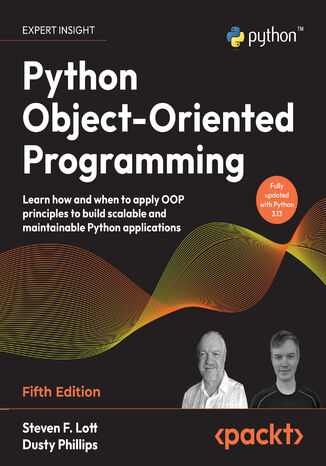
Steven F. Lott, Dusty Phillips
Learn to write effective, maintainable, and scalable Python applications by mastering object-oriented programming with this updated fifth edition. Whether you’re transitioning from scripting to structured development or refining your OOP skills, this book offers a clear, practical path forward.You’ll explore Python’s approach to OOP, from class creation and inheritance to polymorphism and abstraction, while discovering how to make smarter decisions about when and how to use these tools. You’ll apply what you learn through hands-on examples and exercises.Updated for Python 3.13, this edition simplifies complex topics such as abstract base classes, testing with unittest and pytest, and async programming with asyncio. It introduces a new chapter on Python’s type hinting ecosystem—crucial for modern Python development.Written by long-time Python experts Steven Lott and Dusty Phillips, this edition emphasizes clarity, testability, and professional software engineering practices. It helps you move beyond scripting to building well-structured, production-ready Python systems.By the end of this book, you’ll be confident in applying OOP principles, design patterns, type hints, and concurrency tools to create robust and maintainable Python applications.
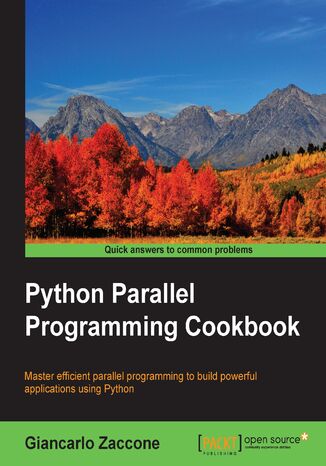
Giancarlo Zaccone
This book will teach you parallel programming techniques using examples in Python and will help you explore the many ways in which you can write code that allows more than one process to happen at once. Starting with introducing you to the world of parallel computing, it moves on to cover the fundamentals in Python. This is followed by exploring the thread-based parallelism model using the Python threading module by synchronizing threads and using locks, mutex, semaphores queues, GIL, and the thread pool. Next you will be taught about process-based parallelism where you will synchronize processes using message passing along with learning about the performance of MPI Python Modules. You will then go on to learn the asynchronous parallel programming model using the Python asyncio module along with handling exceptions. Moving on, you will discover distributed computing with Python, and learn how to install a broker, use Celery Python Module, and create a worker. You will understand anche Pycsp, the Scoop framework, and disk modules in Python. Further on, you will learnGPU programming withPython using the PyCUDA module along with evaluating performance limitations.
Python. Programowanie funkcyjne
Steven F. Lott
Zgodnie z paradygmatem programowania funkcyjnego największy nacisk należy kłaść na stałe i funkcje. Polega to na konstruowaniu funkcji oraz na obliczaniu wartości wyrażeń. W ten sposób otrzymuje się kod odporny na błędy. Python nie jest w pełni funkcyjnym językiem programowania, jednak pozwala na taki sposób pisania programów. Dzięki temu umożliwia tworzenie zwięzłego i eleganckiego kodu. Na przykład stosowanie wyrażeń generatorowych w Pythonie sprawia, że tworzone programy działają szybciej, ponieważ zużywają mniej zasobów. Niezależnie więc od stosowanego paradygmatu warto zapożyczyć pewne elementy programowania funkcyjnego i wykorzystać je do tworzenia ekspresyjnych i zwięzłych aplikacji w Pythonie. To znakomity podręcznik dla programistów, którzy chcą wykorzystać techniki i wzorce projektowe z funkcyjnych języków programowania, aby tworzyć w Pythonie zwięzłe, eleganckie i ekspresyjne programy - z czytelnym i łatwym w utrzymaniu kodem. Zawiera ogólny przegląd koncepcji funkcyjnych oraz wyjaśnia tak istotne pojęcia jak funkcje pierwszej klasy, funkcje wyższego rzędu, funkcje czyste, leniwe wartościowanie i wiele innych. Wnikliwie omawia sposób korzystania z tych funkcji w Pythonie 3.6, a także techniki przygotowywania i eksploracji danych. Ponadto pokazuje, w jaki sposób standardowa biblioteka Pythona pasuje do funkcyjnego modelu programowania. Co ważne, w książce znalazło się kilka przykładów prezentujących w praktyce opisane koncepcje. W książce między innymi: podstawy modelu programowania funkcyjnego działania na kolekcjach danych i przetwarzanie krotek projektowanie dekoratorów biblioteka PyMonad usługi sieciowe a programowanie funkcyjne Python: kod funkcyjny i funkcjonalny!