
Analiza danych
Nagaraj Venkatesan
Business Intelligence (BI) tools like Power BI are used by a wide range of professionals, creating diverse and complex scenarios, and finding the right solution can be daunting, especially when multiple approaches exist for a single use case. The author distills his 17 years of experience on various data platform technologies in this book to walk you through various Power BI usage scenarios.The book is structured around Power BI usage scenarios, such as developing solutions for corporate BI reporting, self-service BI reporting, and Power BI for data scientists and independent software vendors (ISVs). Each part highlights common data issues encountered in the usage scenario, the correct approach to solve the problems, and supporting technical guidance. The chapters also introduce you to some of the latest enhancements in Power BI, such as Microsoft Fabric integration with Power BI, AI features like Copilot, Power BI Git integration, and Power BI Governance features.By the end of this book, you’ll have learned how to design optimal solutions using Power BI components and pick the right tool for the job, while adhering to security and performance best practices.*Email sign-up and proof of purchase required
Anand Deshpande, Manish Kumar, Albenzo Coletta, Giancarlo...
In this age of big data, companies have larger amount of consumer data than ever before, far more than what the current technologies can ever hope to keep up with. However, Artificial Intelligence closes the gap by moving past human limitations in order to analyze data.With the help of Artificial Intelligence for big data, you will learn to use Machine Learning algorithms such as k-means, SVM, RBF, and regression to perform advanced data analysis. You will understand the current status of Machine and Deep Learning techniques to work on Genetic and Neuro-Fuzzy algorithms. In addition, you will explore how to develop Artificial Intelligence algorithms to learn from data, why they are necessary, and how they can help solve real-world problems.By the end of this book, you'll have learned how to implement various Artificial Intelligence algorithms for your big data systems and integrate them into your product offerings such as reinforcement learning, natural language processing, image recognition, genetic algorithms, and fuzzy logic systems.
Luis Sobrecueva
AutoKeras is an AutoML open-source software library that provides easy access to deep learning models. If you are looking to build deep learning model architectures and perform parameter tuning automatically using AutoKeras, then this book is for you.This book teaches you how to develop and use state-of-the-art AI algorithms in your projects. It begins with a high-level introduction to automated machine learning, explaining all the concepts required to get started with this machine learning approach. You will then learn how to use AutoKeras for image and text classification and regression. As you make progress, you'll discover how to use AutoKeras to perform sentiment analysis on documents. This book will also show you how to implement a custom model for topic classification with AutoKeras. Toward the end, you will explore advanced concepts of AutoKeras such as working with multi-modal data and multi-task, customizing the model with AutoModel, and visualizing experiment results using AutoKeras Extensions.By the end of this machine learning book, you will be able to confidently use AutoKeras to design your own custom machine learning models in your company.
Dmitry Foshin, Tonya Chernyshova, Dmitry Anoshin, Xenia...
This new edition of the Azure Data Factory book, fully updated to reflect ADS V2, will help you get up and running by showing you how to create and execute your first job in ADF. There are updated and new recipes throughout the book based on developments happening in Azure Synapse, Deployment with Azure DevOps, and Azure Purview. The current edition also runs you through Fabric Data Factory, Data Explorer, and some industry-grade best practices with specific chapters on each.You’ll learn how to branch and chain activities, create custom activities, and schedule pipelines, as well as discover the benefits of cloud data warehousing, Azure Synapse Analytics, and Azure Data Lake Gen2 Storage. With practical recipes, you’ll learn how to actively engage with analytical tools from Azure Data Services and leverage your on-premises infrastructure with cloud-native tools to get relevant business insights. You'll familiarize yourself with the common errors that you may encounter while working with ADF and find out the solutions to them. You’ll also understand error messages and resolve problems in connectors and data flows with the debugging capabilities of ADF.By the end of this book, you’ll be able to use ADF with its latest advancements as the main ETL and orchestration tool for your data warehouse projects.
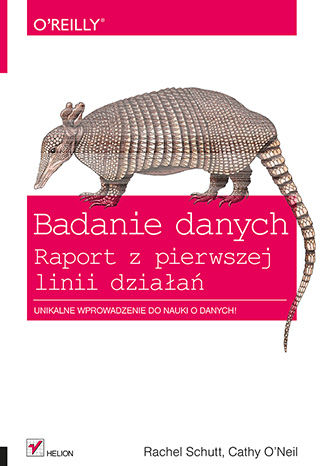
Badanie danych. Raport z pierwszej linii działań
Rachel Schutt, Cathy O'Neil
Unikalne wprowadzenie do nauki o danych! W dzisiejszych czasach najcenniejszym dobrem jest informacja. Ogromne ilości danych są przechowywane w przepastnych bazach danych, a kluczem do sukcesu jest ich umiejętna analiza i wyciąganie wniosków. To dynamicznie rozwijająca się dziedzina wiedzy, w której do tej pory brakowało solidnych podręczników, pozwalających na dogłębne poznanie tego obszaru. Na szczęście to się zmieniło! To unikalna książka, w której badacze z największych firm branży IT dzielą się skutecznymi technikami analizy danych. Z kolejnych rozdziałów dowiesz się, czym jest nauka o danych, model danych oraz test A/B. Ponadto zdobędziesz wiedzę na temat wnioskowania statystycznego, algorytmów, języka R oraz wizualizacji danych. Sięgnij po tę książkę, jeżeli chcesz się dowiedzieć, jak wykrywać oszustwa, korzystać z MapReduce oraz badać przyczynowość. To obowiązkowa pozycja na półce czytelników zainteresowanych badaniem danych. Wśród tematów poruszonych w książce odnajdziesz: Wnioskowanie statystyczne, eksploracyjną analizę danych i proces (metodologię) nauki o danych Algorytmy Filtry spamu, naiwny algorytm Bayesa i wstępną obróbkę danych Regresję logistyczną Modelowanie finansowe Mechanizmy rekomendacji i przyczynowość Wizualizowanie danych Sieci społecznościowe i dziennikarstwo danych Inżynierię danych, systemy MapReduce, Pregel i Hadoop Wyciągnij wartościowe wnioski z posiadanych informacji!
Osvaldo Martin, Eric Ma, Austin Rochford
The second edition of Bayesian Analysis with Python is an introduction to the main concepts of applied Bayesian inference and its practical implementation in Python using PyMC3, a state-of-the-art probabilistic programming library, and ArviZ, a new library for exploratory analysis of Bayesian models.The main concepts of Bayesian statistics are covered using a practical and computational approach. Synthetic and real data sets are used to introduce several types of models, such as generalized linear models for regression and classification, mixture models, hierarchical models, and Gaussian processes, among others. By the end of the book, you will have a working knowledge of probabilistic modeling and you will be able to design and implement Bayesian models for your own data science problems. After reading the book you will be better prepared to delve into more advanced material or specialized statistical modeling if you need to.
Bayesian Analysis with Python. Unleash the power and flexibility of the Bayesian framework
Osvaldo Martin
The purpose of this book is to teach the main concepts of Bayesian data analysis. We will learn how to effectively use PyMC3, a Python library for probabilistic programming, to perform Bayesian parameter estimation, to check models and validate them. This book begins presenting the key concepts of the Bayesian framework and the main advantages of this approach from a practical point of view. Moving on, we will explore the power and flexibility of generalized linear models and how to adapt them to a wide array of problems, including regression and classification. We will also look into mixture models and clustering data, and we will finish with advanced topics like non-parametrics models and Gaussian processes. With the help of Python and PyMC3 you will learn to implement, check and expand Bayesian models to solve data analysis problems.
Alvaro Fuentes
Python is one of the most common and popular languages preferred by leading data analysts and statisticians for working with massive datasets and complex data visualizations.Become a Python Data Analyst introduces Python’s most essential tools and libraries necessary to work with the data analysis process, right from preparing data to performing simple statistical analyses and creating meaningful data visualizations.In this book, we will cover Python libraries such as NumPy, pandas, matplotlib, seaborn, SciPy, and scikit-learn, and apply them in practical data analysis and statistics examples. As you make your way through the chapters, you will learn to efficiently use the Jupyter Notebook to operate and manipulate data using NumPy and the pandas library. In the concluding chapters, you will gain experience in building simple predictive models and carrying out statistical computation and analysis using rich Python tools and proven data analysis techniques.By the end of this book, you will have hands-on experience performing data analysis with Python.