
Analiza danych
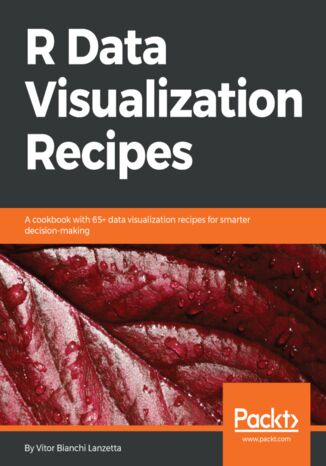
Vitor Bianchi Lanzetta
R is an open source language for data analysis and graphics that allows users to load various packages for effective and better data interpretation. Its popularity has soared in recent years because of its powerful capabilities when it comes to turning different kinds of data into intuitive visualization solutions.This book is an update to our earlier R data visualization cookbook with 100 percent fresh content and covering all the cutting edge R data visualization tools. This book is packed with practical recipes, designed to provide you with all the guidance needed to get to grips with data visualization using R. It starts off with the basics of ggplot2, ggvis, and plotly visualization packages, along with an introduction to creating maps and customizing them, before progressively taking you through various ggplot2 extensions, such as ggforce, ggrepel, and gganimate. Using real-world datasets, you will analyze and visualize your data as histograms, bar graphs, and scatterplots, and customize your plots with various themes and coloring options. The book also covers advanced visualization aspects such as creating interactive dashboards using ShinyBy the end of the book, you will be equipped with key techniques to create impressive data visualizations with professional efficiency and precision.
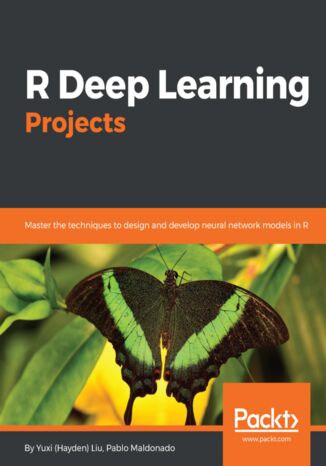
R Deep Learning Projects. Master the techniques to design and develop neural network models in R
Yuxi (Hayden) Liu, Pablo Maldonado
R is a popular programming language used by statisticians and mathematicians for statistical analysis, and is popularly used for deep learning. Deep Learning, as we all know, is one of the trending topics today, and is finding practical applications in a lot of domains.This book demonstrates end-to-end implementations of five real-world projects on popular topics in deep learning such as handwritten digit recognition, traffic light detection, fraud detection, text generation, and sentiment analysis. You'll learn how to train effective neural networks in R—including convolutional neural networks, recurrent neural networks, and LSTMs—and apply them in practical scenarios. The book also highlights how neural networks can be trained using GPU capabilities. You will use popular R libraries and packages—such as MXNetR, H2O, deepnet, and more—to implement the projects. By the end of this book, you will have a better understanding of deep learning concepts and techniques and how to use them in a practical setting.
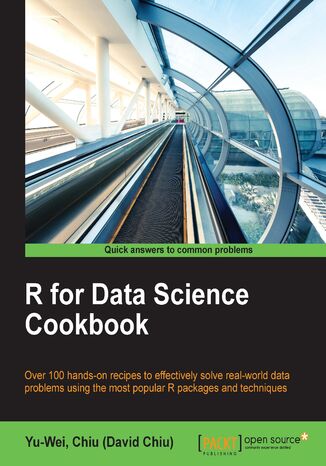
Prabhanjan Narayanachar Tattar, Yu-Wei, Chiu (David Chiu)
This cookbook offers a range of data analysis samples in simple and straightforward R code, providing step-by-step resources and time-saving methods to help you solve data problems efficiently.The first section deals with how to create R functions to avoid the unnecessary duplication of code. You will learn how to prepare, process, and perform sophisticated ETL for heterogeneous data sources with R packages. An example of data manipulation is provided, illustrating how to use the “dplyr” and “data.table” packages to efficiently process larger data structures. We also focus on “ggplot2” and show you how to create advanced figures for data exploration.In addition, you will learn how to build an interactive report using the “ggvis” package. Later chapters offer insight into time series analysis on financial data, while there is detailed information on the hot topic of machine learning, including data classification, regression, clustering, association rule mining, and dimension reduction.By the end of this book, you will understand how to resolve issues and will be able to comfortably offer solutions to problems encountered while performing data analysis.
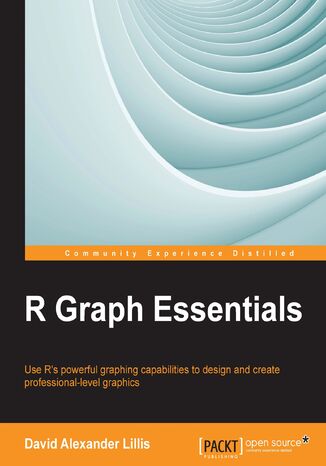
This book is targeted at R programmers who want to learn the graphing capabilities of R. This book will presume that you have working knowledge of R.
Jaynal Abedin, Hrishi V. Mittal
Targeted at those with an existing familiarity with R programming, this practical guide will appeal directly to programmers interested in learning effective data visualization techniques with R and a wide-range of its associated libraries.
Raghav Bali
Data science and machine learning are some of the top buzzwords in the technical world today. From retail stores to Fortune 500 companies, everyone is working hard to making machine learning give them data-driven insights to grow their business. With powerful data manipulation features, machine learning packages, and an active developer community, R empowers users to build sophisticated machine learning systems to solve real-world data problems.This book takes you on a data-driven journey that starts with the very basics of R and machine learning and gradually builds upon the concepts to work on projects that tackle real-world problems.You’ll begin by getting an understanding of the core concepts and definitions required to appreciate machine learning algorithms and concepts. Building upon the basics, you will then work on three different projects to apply the concepts of machine learning, following current trends and cover major algorithms as well as popular R packages in detail. These projects have been neatly divided into six different chapters covering the worlds of e-commerce, finance, and social-media, which are at the very core of this data-driven revolution. Each of the projects will help you to understand, explore, visualize, and derive insights depending upon the domain and algorithms.Through this book, you will learn to apply the concepts of machine learning to deal with data-related problems and solve them using the powerful yet simple language, R.
R: Mining spatial, text, web, and social media data. Create and customize data mining algorithms
Richard Heimann, Nathan H. Danneman, Pradeepta Mishra,...
Data mining is the first step to understanding data and making sense of heaps of data. Properly mined data forms the basis of all data analysis and computing performed on it. This learning path will take you from the very basics of data mining to advanced data mining techniques, and will end up with a specialized branch of data mining—social media mining.You will learn how to manipulate data with R using code snippets and how to mine frequent patterns, association, and correlation while working with R programs. You will discover how to write code for various predication models, stream data, and time-series data. You will also be introduced to solutions written in R based on R Hadoop projects. Now that you are comfortable with data mining with R, you will move on to implementing your knowledge with the help of end-to-end data mining projects. You will learn how to apply different mining concepts to various statistical and data applications in a wide range of fields. At this stage, you will be able to complete complex data mining cases and handle any issues you might encounter during projects.After this, you will gain hands-on experience of generating insights from social media data. You will get detailed instructions on how to obtain, process, and analyze a variety of socially-generated data while providing a theoretical background to accurately interpret your findings. You will be shown R code and examples of data that can be used as a springboard as you get the chance to undertake your own analyses of business, social, or political data.This Learning Path combines some of the best that Packt has to offer in one complete, curated package. It includes content from the following Packt products:? Learning Data Mining with R by Bater Makhabel ? R Data Mining Blueprints by Pradeepta Mishra? Social Media Mining with R by Nathan Danneman and Richard Heimann
R Programming Fundamentals. Deal with data using various modeling techniques
Kaelen Medeiros
R Programming Fundamentals, focused on R and the R ecosystem, introduces you to the tools for working with data. You’ll start by understanding how to set up R and RStudio, followed by exploring R packages, functions, data structures, control flow, and loops.Once you have grasped the basics, you’ll move on to studying data visualization and graphics. You’ll learn how to build statistical and advanced plots using the powerful ggplot2 library. In addition to this, you’ll discover data management concepts such as factoring, pivoting, aggregating, merging, and dealing with missing values.By the end of this book, you’ll have completed an entire data science project of your own for your portfolio or blog.