
Analiza danych
Yu-Wei, Chiu (David Chiu), Atmajitsinh Gohil, Shanthi...
The R language is a powerful, open source, functional programming language. At its core, R is a statistical programming language that provides impressive tools to analyze data and create high-level graphics. This Learning Path is chock-full of recipes. Literally! It aims to excite you with awesome projects focused on analysis, visualization, and machine learning. We’ll start off with data analysis – this will show you ways to use R to generate professional analysis reports. We’ll then move on to visualizing our data – this provides you with all the guidance needed to get comfortable with data visualization with R. Finally, we’ll move into the world of machine learning – this introduces you to data classification, regression, clustering, association rule mining, and dimension reduction.This Learning Path combines some of the best that Packt has to offer in one complete, curated package. It includes content from the following Packt products:• R Data Analysis Cookbook by Viswa Viswanathan and Shanthi Viswanathan• R Data Visualization Cookbook by Atmajitsinh Gohil• Machine Learning with R Cookbook by Yu-Wei, Chiu (David Chiu)
R Statistics Cookbook. Over 100 recipes for performing complex statistical operations with R 3.5
Francisco Juretig
R is a popular programming language for developing statistical software. This book will be a useful guide to solving common and not-so-common challenges in statistics. With this book, you'll be equipped to confidently perform essential statistical procedures across your organization with the help of cutting-edge statistical tools.You'll start by implementing data modeling, data analysis, and machine learning to solve real-world problems. You'll then understand how to work with nonparametric methods, mixed effects models, and hidden Markov models. This book contains recipes that will guide you in performing univariate and multivariate hypothesis tests, several regression techniques, and using robust techniques to minimize the impact of outliers in data.You'll also learn how to use the caret package for performing machine learning in R. Furthermore, this book will help you understand how to interpret charts and plots to get insights for better decision making.By the end of this book, you will be able to apply your skills to statistical computations using R 3.5. You will also become well-versed with a wide array of statistical techniques in R that are extensively used in the data science industry.
R: Unleash Machine Learning Techniques. Smarter data analytics
Dipanjan Sarkar, Brett Lantz, Raghav Bali, Cory...
R is the established language of data analysts and statisticians around the world. And you shouldn’t be afraid to use it…This Learning Path will take you through the fundamentals of R and demonstrate how to use the language to solve a diverse range of challenges through machine learning. Accessible yet comprehensive, it provides you with everything you need to become more a more fluent data professional, and more confident with R. In the first module you’ll get to grips with the fundamentals of R. This means you’ll be taking a look at some of the details of how the language works, before seeing how to put your knowledge into practice to build some simple machine learning projects that could prove useful for a range of real world problems.For the following two modules we’ll begin to investigate machine learning algorithms in more detail. To build upon the basics, you’ll get to work on three different projects that will test your skills. Covering some of the most important algorithms and featuring some of the most popular R packages, they’re all focused on solving real problems in different areas, ranging from finance to social media.This Learning Path has been curated from three Packt products:• R Machine Learning By Example By Raghav Bali, Dipanjan Sarkar• Machine Learning with R - Second Edition By Brett Lantz• Mastering Machine Learning with R By Cory Lesmeister
R Web Scraping Quick Start Guide. Techniques and tools to crawl and scrape data from websites
Olgun Aydin
Web scraping is a technique to extract data from websites. It simulates the behavior of a website user to turn the website itself into a web service to retrieve or introduce new data. This book gives you all you need to get started with scraping web pages using R programming.You will learn about the rules of RegEx and Xpath, key components for scraping website data. We will show you web scraping techniques, methodologies, and frameworks. With this book's guidance, you will become comfortable with the tools to write and test RegEx and XPath rules. We will focus on examples of dynamic websites for scraping data and how to implement the techniques learned. You will learn how to collect URLs and then create XPath rules for your first web scraping script using rvest library. From the data you collect, you will be able to calculate the statistics and create R plots to visualize them. Finally, you will discover how to use Selenium drivers with R for more sophisticated scraping. You will create AWS instances and use R to connect a PostgreSQL database hosted on AWS. By the end of the book, you will be sufficiently confident to create end-to-end web scraping systems using R.
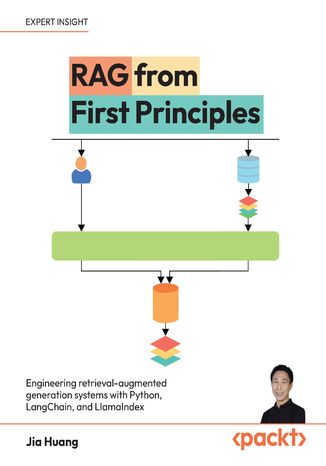
Jia Huang
Most developers can spin up a RAG pipeline in an afternoon using LangChain or LlamaIndex. Far fewer understand why retrieval fails or how to fix it. This book is for those who want to go deeper.'RAG From First Principles' dismantles the retrieval-augmented generation stack layer by layer, how documents are ingested and parsed, why chunking strategy directly impacts answer quality, how embedding models encode meaning, what happens inside a vector database, and how sparse and dense retrieval interact in a hybrid system. Written by Jia Huang, a research engineer and bestselling AI author, it brings research depth and production experience to one of AI's most critical engineering disciplines.Structured as a progressive dialogue between a seasoned engineer and two students, the book surfaces the questions practitioners actually ask. Each chapter builds on the last, from data import and chunking through embedding selection, index design, hybrid search, and post-retrieval processing, into response generation, evaluation, and advanced paradigms including GraphRAG, Agentic RAG, and Modular RAG.By the end, you'll have the architectural understanding to optimize, debug, and extend your RAG systems with confidence.
Rapid - Apache Mahout Clustering designs. Explore clustering algorithms used with Apache Mahout
Ashish Gupta
As more and more organizations are discovering the use of big data analytics, interest in platforms that provide storage, computation, and analytic capabilities has increased. Apache Mahout caters to this need and paves the way for the implementation of complex algorithms in the field of machine learning to better analyse your data and get useful insights into it.Starting with the introduction of clustering algorithms, this book provides an insight into Apache Mahout and different algorithms it uses for clustering data. It provides a general introduction of the algorithms, such as K-Means, Fuzzy K-Means, StreamingKMeans, and how to use Mahout to cluster your data using a particular algorithm. You will study the different types of clustering and learn how to use Apache Mahout with real world data sets to implement and evaluate your clusters.This book will discuss about cluster improvement and visualization using Mahout APIs and also explore model-based clustering and topic modelling using Dirichlet process. Finally, you will learn how to build and deploy a model for production use.
Raportowanie w System Center Configuration Manager Bez tajemnic
Garth Jones, Dan Toll, Kerrie Meyler
Baza danych SQL Server programu Microsoft System Center Configuration Manager (ConfigMgr) zawiera wiele cennych informacji na temat Twoich użytkowników, komputerów, sprzętu, systemów operacyjnych, aplikacji czy stanu zgodności. Aby umożliwić Ci efektywne wyodrębnianie tych danych, Microsoft dostarczył kilku doskonałych narzędzi, wliczając w to usługi raportowania SQL Server Reporting Services (SSRS) i dodatek SQL Server Data Tools Business Intelligence (SSDT-BI). Podręcznik Raportowanie w System Center Configuration Manager bez tajemnic pokaże Ci, w jaki sposób możesz wykorzystać maksymalny potencjał tych narzędzi. Światowej sławy guru raportowania, Garth Jones, wraz z będącymi ekspertami współautorami tego przewodnika poprowadzi Cię przez wszystkie aspekty niestandardowego raportowania w System Center. Poczynając od instalacji i konfiguracji usług SSRS, krok po kroku nauczysz się wykorzystywać widoki języka SQL do wyszukiwania potrzebnych Ci danych, budować zapytania SQL, tworzyć proste i zaawansowane raporty, a także wykorzystywać administrację opartą na rolach do bezpiecznego dostarczania tych raportów właściwym osobom. W książce tej Jones zebrał aktualne, niezawodne i wszechstronne techniki raportowania w System Center, których na próżno szukać w innych podręcznikach i witrynach internetowych. Korzystając z tego przewodnika będziesz w stanie konsekwentnie pozyskiwać właściwe informacje, które pozwolą Ci rozwiązywać palące problemy i szybko reagować na ewentualne obawy zarządu. Garth Jones, główny architekt w Enhansoft i Microsoft MVP, specjalizuje się w poszerzaniu wartości i znaczenia programu System Center Configuration Manager. Z rodziną produktów System Center pracuje od roku 1996, kiedy to występowała jeszcze pod nazwą SMS. Dan Toll jest administratorem programu Configuration Manager, z którym pracuje od wersji SMS 2003. Specjalizuje się we wdrożeniach systemów operacyjnych dla stacji roboczych i serwerów przy użyciu narzędzi Microsoft Deployment Toolkit (MDT) oraz w raportowaniu w programie ConfigMgr. Kerrie Meyler, Microsoft MVP, jest wiodącą autorką wielu książek z serii System Center Unleashed. Obecnie pracuje jako niezależny konsultant. W czasie trwającej ponad 17 lat kariery zawodowej ewangelizowała produkt SMS na stanowisku starszego specjalisty technologii w Microsoft i prezentowała technologie System Center na konferencjach TechEd i MMS. Szczegółowe informacje na temat Instalowania i konfigurowania usług SSRS pod kątem optymalnego raportowania w System Center i łatwiej-szego rozwiązywania problemów Danych przechowywanych w bazie lokacji programu ConfigMgr Wydajnego pozyskiwania danych programu ConfigMgr poprzez tworzenie zapytań SQL z poziomu SQL Server Management Studio Najlepszych praktyk w zakresie tworzenia i projektowania raportów w System Center Tworzenia szablonów raportów, dostosowywania treści z użyciem parametrów raportów oraz zagnieżdżania wykresów Dostosowywania logo, palet kolorów i pozostałych elementów raportów na potrzeby konkretnej organizacji Konstruowania zaawansowanych metod przeglądania szczegółowego w celu dostarczenia dodatkowych informacji Wzmacniania zabezpieczeń raportów poprzez integrowanie administracji programu ConfigMgr opartej na rolach w zapytaniach SQL Wykorzystywania raportowania do pomiaru kluczowych wskaźników wydajności i pogłębiania wiedzy na temat własnego środowiska Dostosowywania raportów do potrzeb użytkowników końcowych lub zarządu W SIECI: Wszystkie zaprezentowane w tej książce przykłady i skrypty dostępne są do pobrania na stronie informit.com/title/9780672337789
Rivu Chakraborty
In today's app-driven era, when programs are asynchronous, and responsiveness is so vital, reactive programming can help you write code that's more reliable, easier to scale, and better-performing. Reactive programming is revolutionary.With this practical book, Kotlin developers will first learn how to view problems in the reactive way, and then build programs that leverage the best features of this exciting new programming paradigm. You will begin with the general concepts of Reactive programming and then gradually move on to working with asynchronous data streams. You will dive into advanced techniques such as manipulating time in data-flow, customizing operators and provider and how to use the concurrency model to control asynchronicity of code and process event handlers effectively.You will then be introduced to functional reactive programming and will learn to apply FRP in practical use cases in Kotlin. This book will also take you one step forward by introducing you to Spring 5 and Spring Boot 2 using Kotlin. By the end of the book, you will be able to build real-world applications with reactive user interfaces as well as you'll learn to implement reactive programming paradigms in Android.