
Analiza danych
Zafar
As Salesforce orgs mature over time, data management and integrations are becoming more challenging than ever. Salesforce Data Architecture and Management follows a hands-on approach to managing data and tracking the performance of your Salesforce org.You’ll start by understanding the role and skills required to become a successful data architect. The book focuses on data modeling concepts, how to apply them in Salesforce, and how they relate to objects and fields in Salesforce. You’ll learn the intricacies of managing data in Salesforce, starting from understanding why Salesforce has chosen to optimize for read rather than write operations. After developing a solid foundation, you’ll explore examples and best practices for managing your data. You’ll understand how to manage your master data and discover what the Golden Record is and why it is important for organizations. Next, you'll learn how to align your MDM and CRM strategy with a discussion on Salesforce’s Customer 360 and its key components. You’ll also cover data governance, its multiple facets, and how GDPR compliance can be achieved with Salesforce. Finally, you'll discover Large Data Volumes (LDVs) and best practices for migrating data using APIs.By the end of this book, you’ll be well-versed with data management, data backup, storage, and archiving in Salesforce.
Vinay Singh
The SAP BusinessObjects Business Intelligence platform is a powerful reporting and analysis tool. This book is the ideal introduction to the SAP BusinessObjects Business Intelligence platform, introducing you to its data visualization, visual analytics, reporting, and dashboarding capabilities.The book starts with an overview of the BI platform and various data sources for reporting. Then, we move on to looking at data visualization, analysis, reporting, and analytics using BusinessObjects Business Intelligence tools. You will learn about the features associated with reporting, scheduling, and distribution and learn how to deploy the platform. Toward the end, you will learn about the strategies and factors that should be considered during deployment.By the end, you will be confident working with the SAP BusinessObjects Business Intelligence platform to deliver better insights for more effective decision making.
Harish Gulati
SAS is a groundbreaking tool for advanced predictive and statistical analytics used by top banks and financial corporations to establish insights from their financial data.SAS for Finance offers you the opportunity to leverage the power of SAS analytics in redefining your data. Packed with real-world examples from leading financial institutions, the author discusses statistical models using time series data to resolve business issues.This book shows you how to exploit the capabilities of this high-powered package to create clean, accurate financial models. You can easily assess the pros and cons of models to suit your unique business needs.By the end of this book, you will be able to leverage the true power of SAS to design and develop accurate analytical models to gain deeper insights into your financial data.
Sridhar Alla, Md. Rezaul Karim
Scala has been observing wide adoption over the past few years, especially in the field of data science and analytics. Spark, built on Scala, has gained a lot of recognition and is being used widely in productions. Thus, if you want to leverage the power of Scala and Spark to make sense of big data, this book is for you.The first part introduces you to Scala, helping you understand the object-oriented and functional programming concepts needed for Spark application development. It then moves on to Spark to cover the basic abstractions using RDD and DataFrame. This will help you develop scalable and fault-tolerant streaming applications by analyzing structured and unstructured data using SparkSQL, GraphX, and Spark structured streaming. Finally, the book moves on to some advanced topics, such as monitoring, configuration, debugging, testing, and deployment.You will also learn how to develop Spark applications using SparkR and PySpark APIs, interactive data analytics using Zeppelin, and in-memory data processing with Alluxio.By the end of this book, you will have a thorough understanding of Spark, and you will be able to perform full-stack data analytics with a feel that no amount of data is too big.
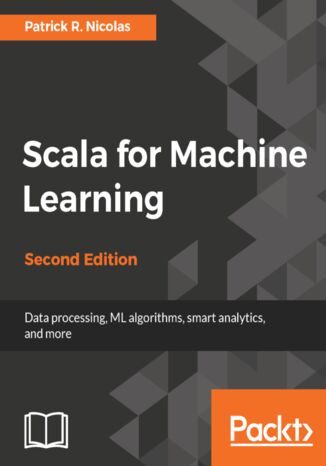
Mohammed Rafi, Patrick R. Nicolas
The discovery of information through data clustering and classification is becoming a key differentiator for competitive organizations. Machine learning applications are everywhere, from self-driving cars, engineering design, logistics, manufacturing, and trading strategies, to detection of genetic anomalies. The book is your one stop guide that introduces you to the functional capabilities of the Scala programming language that are critical to the creation of machine learning algorithms such as dependency injection and implicits. You start by learning data preprocessing and filtering techniques. Following this, you'll move on to unsupervised learning techniques such as clustering and dimension reduction, followed by probabilistic graphical models such as Naïve Bayes, hidden Markov models and Monte Carlo inference. Further, it covers the discriminative algorithms such as linear, logistic regression with regularization, kernelization, support vector machines, neural networks, and deep learning. You’ll move on to evolutionary computing, multibandit algorithms, and reinforcement learning.Finally, the book includes a comprehensive overview of parallel computing in Scala and Akka followed by a description of Apache Spark and its ML library. With updated codes based on the latest version of Scala and comprehensive examples, this book will ensure that you have more than just a solid fundamental knowledge in machine learning with Scala.
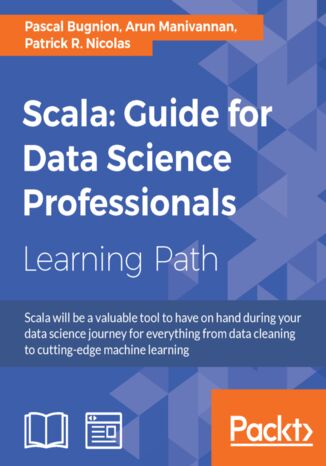
Scala: Guide for Data Science Professionals. Build robust data pipelines with Scala
Arun Manivannan, Pascal Bugnion, Patrick R. Nicolas
Scala is especially good for analyzing large sets of data as the scale of the task doesn’t have any significant impact on performance. Scala’s powerful functional libraries can interact with databases and build scalable frameworks — resulting in the creation of robust data pipelines. The first module introduces you to Scala libraries to ingest, store, manipulate, process, and visualize data. Using real world examples, you will learn how to design scalable architecture to process and model data — starting from simple concurrency constructs and progressing to actor systems and Apache Spark. After this, you will also learn how to build interactive visualizations with web frameworks.Once you have become familiar with all the tasks involved in data science, you will explore data analytics with Scala in the second module. You’ll see how Scala can be used to make sense of data through easy to follow recipes. You will learn about Bokeh bindings for exploratory data analysis and quintessential machine learning with algorithms with Spark ML library. You’ll get a sufficient understanding of Spark streaming, machine learning for streaming data, and Spark graphX. Armed with a firm understanding of data analysis, you will be ready to explore the most cutting-edge aspect of data science — machine learning. The final module teaches you the A to Z of machine learning with Scala. You’ll explore Scala for dependency injections and implicits, which are used to write machine learning algorithms. You’ll also explore machine learning topics such as clustering, dimentionality reduction, Naïve Bayes, Regression models, SVMs, neural networks, and more. This learning path combines some of the best that Packt has to offer into one complete, curated package. It includes content from the following Packt products:• Scala for Data Science, Pascal Bugnion• Scala Data Analysis Cookbook, Arun Manivannan • Scala for Machine Learning, Patrick R. Nicolas
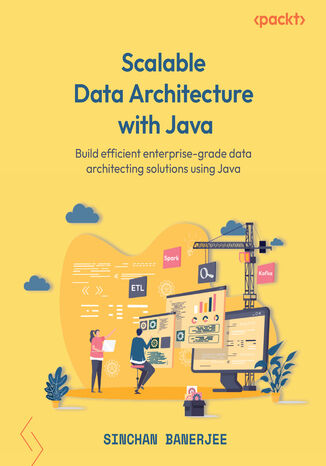
Sinchan Banerjee
Java architectural patterns and tools help architects to build reliable, scalable, and secure data engineering solutions that collect, manipulate, and publish data.This book will help you make the most of the architecting data solutions available with clear and actionable advice from an expert.You’ll start with an overview of data architecture, exploring responsibilities of a Java data architect, and learning about various data formats, data storage, databases, and data application platforms as well as how to choose them. Next, you’ll understand how to architect a batch and real-time data processing pipeline. You’ll also get to grips with the various Java data processing patterns, before progressing to data security and governance. The later chapters will show you how to publish Data as a Service and how you can architect it. Finally, you’ll focus on how to evaluate and recommend an architecture by developing performance benchmarks, estimations, and various decision metrics.By the end of this book, you’ll be able to successfully orchestrate data architecture solutions using Java and related technologies as well as to evaluate and present the most suitable solution to your clients.
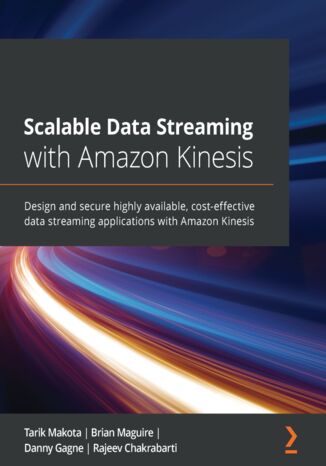
Tarik Makota, Brian Maguire, Danny Gagne, Rajeev...
Amazon Kinesis is a collection of secure, serverless, durable, and highly available purpose-built data streaming services. This data streaming service provides APIs and client SDKs that enable you to produce and consume data at scale.Scalable Data Streaming with Amazon Kinesis begins with a quick overview of the core concepts of data streams, along with the essentials of the AWS Kinesis landscape. You'll then explore the requirements of the use case shown through the book to help you get started and cover the key pain points encountered in the data stream life cycle. As you advance, you'll get to grips with the architectural components of Kinesis, understand how they are configured to build data pipelines, and delve into the applications that connect to them for consumption and processing. You'll also build a Kinesis data pipeline from scratch and learn how to implement and apply practical solutions. Moving on, you'll learn how to configure Kinesis on a cloud platform. Finally, you’ll learn how other AWS services can be integrated into Kinesis. These services include Redshift, Dynamo Database, AWS S3, Elastic Search, and third-party applications such as Splunk.By the end of this AWS book, you’ll be able to build and deploy your own Kinesis data pipelines with Kinesis Data Streams (KDS), Kinesis Data Firehose (KFH), Kinesis Video Streams (KVS), and Kinesis Data Analytics (KDA).