
Uczenie maszynowe
Giuseppe Bonaccorso
Machine learning is a subset of AI that aims to make modern-day computer systems smarter and more intelligent. The real power of machine learning resides in its algorithms, which make even the most difficult things capable of being handled by machines. However, with the advancement in the technology and requirements of data, machines will have to be smarter than they are today to meet the overwhelming data needs; mastering these algorithms and using them optimally is the need of the hour.Mastering Machine Learning Algorithms is your complete guide to quickly getting to grips with popular machine learning algorithms. You will be introduced to the most widely used algorithms in supervised, unsupervised, and semi-supervised machine learning, and will learn how to use them in the best possible manner. Ranging from Bayesian models to the MCMC algorithm to Hidden Markov models, this book will teach you how to extract features from your dataset and perform dimensionality reduction by making use of Python-based libraries such as scikit-learn v0.19.1. You will also learn how to use Keras and TensorFlow 1.x to train effective neural networks.If you are looking for a single resource to study, implement, and solve end-to-end machine learning problems and use-cases, this is the book you need.
Chiheb Chebbi
Cyber security is crucial for both businesses and individuals. As systems are getting smarter, we now see machine learning interrupting computer security. With the adoption of machine learning in upcoming security products, it’s important for pentesters and security researchers to understand how these systems work, and to breach them for testing purposes. This book begins with the basics of machine learning and the algorithms used to build robust systems. Once you’ve gained a fair understanding of how security products leverage machine learning, you'll dive into the core concepts of breaching such systems. Through practical use cases, you’ll see how to find loopholes and surpass a self-learning security system. As you make your way through the chapters, you’ll focus on topics such as network intrusion detection and AV and IDS evasion. We’ll also cover the best practices when identifying ambiguities, and extensive techniques to breach an intelligent system.By the end of this book, you will be well-versed with identifying loopholes in a self-learning security system and will be able to efficiently breach a machine learning system.
Dr. Saket S.R. Mengle , Maximo Gurmendez
Amazon Web Services (AWS) is constantly driving new innovations that empower data scientists to explore a variety of machine learning (ML) cloud services. This book is your comprehensive reference for learning and implementing advanced ML algorithms in AWS cloud.As you go through the chapters, you’ll gain insights into how these algorithms can be trained, tuned, and deployed in AWS using Apache Spark on Elastic Map Reduce (EMR), SageMaker, and TensorFlow. While you focus on algorithms such as XGBoost, linear models, factorization machines, and deep nets, the book will also provide you with an overview of AWS as well as detailed practical applications that will help you solve real-world problems. Every application includes a series of companion notebooks with all the necessary code to run on AWS. In the next few chapters, you will learn to use SageMaker and EMR Notebooks to perform a range of tasks, right from smart analytics and predictive modeling through to sentiment analysis. By the end of this book, you will be equipped with the skills you need to effectively handle machine learning projects and implement and evaluate algorithms on AWS.
Cory Lesmeister
Given the growing popularity of the R-zerocost statistical programming environment, there has never been a better time to start applying ML to your data. This book will teach you advanced techniques in ML ,using? the latest code in R 3.5. You will delve into various complex features of supervised learning, unsupervised learning, and reinforcement learning algorithms to design efficient and powerful ML models. This newly updated edition is packed with fresh examples covering a range of tasks from different domains. Mastering Machine Learning with R starts by showing you how to quickly manipulate data and prepare it for analysis. You will explore simple and complex models and understand how to compare them. You’ll also learn to use the latest library support, such as TensorFlow and Keras-R, for performing advanced computations. Additionally, you’ll explore complex topics, such as natural language processing (NLP), time series analysis, and clustering, which will further refine your skills in developing applications. Each chapter will help you implement advanced ML algorithms using real-world examples. You’ll even be introduced to reinforcement learning, along with its various use cases and models. In the concluding chapters, you’ll get a glimpse into how some of these blackbox models can be diagnosed and understood. By the end of this book, you’ll be equipped with the skills to deploy ML techniques in your own projects or at work.
Cory Lesmeister
Machine learning is a field of Artificial Intelligence to build systems that learn from data. Given the growing prominence of R—a cross-platform, zero-cost statistical programming environment—there has never been a better time to start applying machine learning to your data.The book starts with introduction to Cross-Industry Standard Process for Data Mining. It takes you through Multivariate Regression in detail. Moving on, you will also address Classification and Regression trees. You will learn a couple of “Unsupervised techniques”. Finally, the book will walk you through text analysis and time series.The book will deliver practical and real-world solutions to problems and variety of tasks such as complex recommendation systems. By the end of this book, you will gain expertise in performing R machine learning and will be able to build complex ML projects using R and its packages.
Mastering OpenCV 3. Get hands-on with practical Computer Vision using OpenCV 3 - Second Edition
Jason Saragih
As we become more capable of handling data in every kind, we are becoming more reliant on visual input and what we can do with those self-driving cars, face recognition, and even augmented reality applications and games. This is all powered by Computer Vision.This book will put you straight to work in creating powerful and unique computer vision applications. Each chapter is structured around a central project and deep dives into an important aspect of OpenCV such as facial recognition, image target tracking, making augmented reality applications, the 3D visualization framework, and machine learning. You’ll learn how to make AI that can remember and use neural networks to help your applications learn.By the end of the book, you will have created various working prototypes with the projects in the book and will be well versed with the new features of OpenCV3.
Alberto Fernández Villán
OpenCV is considered to be one of the best open source computer vision and machine learning software libraries. It helps developers build complete projects in relation to image processing, motion detection, or image segmentation, among many others. OpenCV for Python enables you to run computer vision algorithms smoothly in real time, combining the best of the OpenCV C++ API and the Python language.In this book, you'll get started by setting up OpenCV and delving into the key concepts of computer vision. You'll then proceed to study more advanced concepts and discover the full potential of OpenCV. The book will also introduce you to the creation of advanced applications using Python and OpenCV, enabling you to develop applications that include facial recognition, target tracking, or augmented reality. Next, you'll learn machine learning techniques and concepts, understand how to apply them in real-world examples, and also explore their benefits, including real-time data production and faster data processing. You'll also discover how to translate the functionality provided by OpenCV into optimized application code projects using Python bindings. Toward the concluding chapters, you'll explore the application of artificial intelligence and deep learning techniques using the popular Python libraries TensorFlow, and Keras.By the end of this book, you'll be able to develop advanced computer vision applications to meet your customers' demands.
Ankur Ankan
Probabilistic Graphical Models is a technique in machine learning that uses the concepts of graph theory to compactly represent and optimally predict values in our data problems. In real world problems, it's often difficult to select the appropriate graphical model as well as the appropriate inference algorithm, which can make a huge difference in computation time and accuracy. Thus, it is crucial to know the working details of these algorithms.This book starts with the basics of probability theory and graph theory, then goes on to discuss various models and inference algorithms. All the different types of models are discussed along with code examples to create and modify them, and also to run different inference algorithms on them. There is a complete chapter devoted to the most widely used networks Naive Bayes Model and Hidden Markov Models (HMMs). These models have been thoroughly discussed using real-world examples.
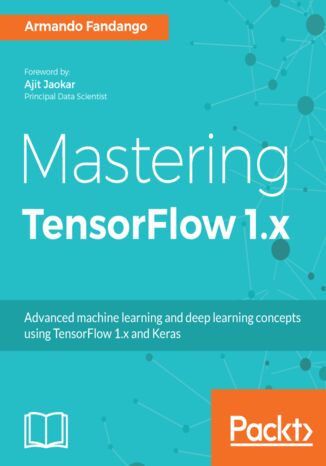
Armando Fandango, Ajit Jaokar
TensorFlow is the most popular numerical computation library built from the ground up for distributed, cloud, and mobile environments. TensorFlow represents the data as tensors and the computation as graphs.This book is a comprehensive guide that lets you explore the advanced features of TensorFlow 1.x. Gain insight into TensorFlow Core, Keras, TF Estimators, TFLearn, TF Slim, Pretty Tensor, and Sonnet. Leverage the power of TensorFlow and Keras to build deep learning models, using concepts such as transfer learning, generative adversarial networks, and deep reinforcement learning. Throughout the book, you will obtain hands-on experience with varied datasets, such as MNIST, CIFAR-10, PTB, text8, and COCO-Images.You will learn the advanced features of TensorFlow1.x, such as distributed TensorFlow with TF Clusters, deploy production models with TensorFlow Serving, and build and deploy TensorFlow models for mobile and embedded devices on Android and iOS platforms. You will see how to call TensorFlow and Keras API within the R statistical software, and learn the required techniques for debugging when the TensorFlow API-based code does not work as expected.The book helps you obtain in-depth knowledge of TensorFlow, making you the go-to person for solving artificial intelligence problems. By the end of this guide, you will have mastered the offerings of TensorFlow and Keras, and gained the skills you need to build smarter, faster, and efficient machine learning and deep learning systems.
Matematyka dyskretna dla praktyków. Algorytmy i uczenie maszynowe w Pythonie
Ryan T. White, Archana Tikayat Ray
Mimo że osiągnięcia matematyczne stały się podwalinami algorytmiki, wielu inżynierów nie w pełni rozumie reguły matematyki dyskretnej. Nawet jeśli nie stanowi to szczególnego problemu w codziennej pracy, w końcu okazuje się, że matematyka dyskretna jest niezbędna do osiągnięcia prawdziwej biegłości w operowaniu algorytmami i w pracy na danych. Co więcej, znajomość tej dziedziny bardzo ułatwia rozwiązywanie problemów z zakresu uczenia maszynowego. W ten sposób praktyczna biegłość w matematyce zauważalnie poprawia wyniki pracy inżynierów. Ta książka jest kompleksowym wprowadzeniem do matematyki dyskretnej, przydatnym dla każdego, kto chce pogłębić i ugruntować swoje umiejętności informatyczne. W zrozumiały sposób przedstawiono tu metody matematyki dyskretnej i ich zastosowanie w algorytmach i analizie danych, włączając w to techniki uczenia maszynowego. Zaprezentowano również zasady oceny złożoności obliczeniowej algorytmów i używania wyników tej oceny do zarządzania pracą procesora. Omówiono także sposoby przechowywania struktur grafowych, ich przeszukiwania i znajdywania ścieżek między wierzchołkami. Pokazano też, jak wykorzystać przedstawione informacje podczas posługiwania się bibliotekami Pythona, takimi jak scikit-learn i NumPy. W książce między innymi: terminologia i metody matematyki dyskretnej zastosowanie metod matematyki dyskretnej w algorytmach i analizie danych algebra Boole'a i kombinatoryka w podstawowych strukturach algorytmów rozwiązywanie problemów z dziedziny teorii grafów zadania związane z uczeniem maszynowym a matematyka dyskretna Matematyka dyskretna - poznaj, zrozum, zastosuj!
Hala Nelson
Sztuczna inteligencja i technologie oparte na danych są coraz częściej integrowane z istniejącymi systemami i operacjami. Ta tendencja dotyczy licznych branż. Dziś przy budowaniu systemów SI można korzystać z gotowych bibliotek, jeżeli jednak zależy Ci na w pełni świadomym tworzeniu doskonalszych aplikacji, musisz dobrze opanować matematykę leżącą u podstaw sztucznej inteligencji. Nawet jeśli nie darzysz królowej nauk płomiennym uczuciem, dzięki temu kompleksowemu opracowaniu z łatwością poradzisz sobie z jej lepszym poznaniem. Nie znajdziesz tu skomplikowanych teorii naukowych, tylko przystępnie podane koncepcje matematyczne niezbędne do rozwoju w dziedzinie sztucznej inteligencji, w szczególności do praktycznego stosowania najnowocześniejszych modeli. Poznasz takie zagadnienia jak regresja, sieci neuronowe, sieci konwolucyjne, optymalizacja, prawdopodobieństwo, procesy Markowa, równania różniczkowe i wiele innych w ekskluzywnym kontekście sztucznej inteligencji. Książkę docenią pasjonaci nowych technologii, twórcy aplikacji, inżynierowie i analitycy danych, a także matematycy i naukowcy. W książce: wyjaśnienie pojęć z zakresu uczenia maszynowego, inżynierii danych i matematyki ujednolicanie modeli w ramach jednej struktury matematycznej grafy i dane sieciowe eksploracja rzeczywistych danych, zmniejszanie liczby wymiarów i przetwarzanie obrazów korzystanie z modeli w różnych projektach opartych na danych implikacje i ograniczenia sztucznej inteligencji Ta książka w zachwycający sposób sprawia, że matematyka staje się zabawą dla licznych uczestników przyszłości opartej na sztucznej inteligencji! Adri Purkayastha, analityk oceny ryzyka, BNP Paribas O książce w mediach: Eksperyment Myślowy – recenzja książki
Mercury Learning and Information, C. P. Kothandaraman
This course serves as a comprehensive reference guide for engineers, mathematicians, scientists, and industry professionals, covering essential mathematical formulas and key scientific data. It is divided into two parts: mathematical formulas including algebra, trigonometry, analytic geometry, differential and integral calculus, and vectors; and scientific data covering units, properties of gases, elements, acoustics, materials, thermodynamics, radioactivity, and more.Understanding these concepts is crucial for professionals, providing a solid foundation for their work. The course explains technical terms, theorems, and applicable laws in detail, ensuring clarity and practical understanding. Each chapter provides valuable insights and data fundamental for scientific and engineering applications.Starting with algebra and geometry, the course advances through calculus and vectors, then explores scientific data in various fields. By the end, users will have a thorough reference of critical formulas and data, making it indispensable for students and professionals. This structured approach ensures learners gain both theoretical knowledge and practical applications essential for their careers.
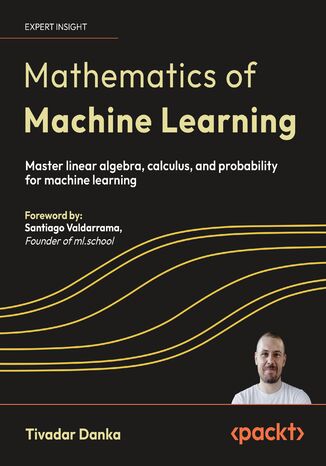
Tivadar Danka, Santiago Valdarrama
Mathematics of Machine Learning provides a rigorous yet accessible introduction to the mathematical underpinnings of machine learning, designed for engineers, developers, and data scientists ready to elevate their technical expertise. With this book, you’ll explore the core disciplines of linear algebra, calculus, and probability theory essential for mastering advanced machine learning concepts. PhD mathematician turned ML engineer Tivadar Danka—known for his intuitive teaching style that has attracted 100k+ followers—guides you through complex concepts with clarity, providing the structured guidance you need to deepen your theoretical knowledge and enhance your ability to solve complex machine learning problems. Balancing theory with application, this book offers clear explanations of mathematical constructs and their direct relevance to machine learning tasks. Through practical Python examples, you’ll learn to implement and use these ideas in real-world scenarios, such as training machine learning models with gradient descent or working with vectors, matrices, and tensors. By the end of this book, you’ll have gained the confidence to engage with advanced machine learning literature and tailor algorithms to meet specific project requirements.*Email sign-up and proof of purchase required
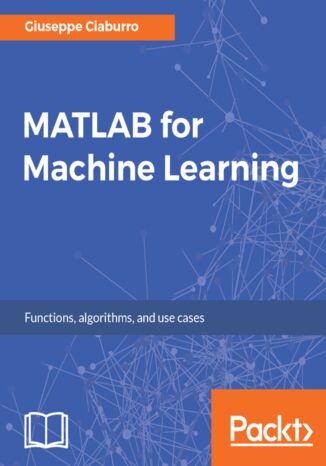
MATLAB for Machine Learning. Practical examples of regression, clustering and neural networks
Giuseppe Ciaburro
MATLAB is the language of choice for many researchers and mathematics experts for machine learning. This book will help you build a foundation in machine learning using MATLAB for beginners.You’ll start by getting your system ready with t he MATLAB environment for machine learning and you’ll see how to easily interact with the Matlab workspace. We’ll then move on to data cleansing, mining and analyzing various data types in machine learning and you’ll see how to display data values on a plot. Next, you’ll get to know about the different types of regression techniques and how to apply them to your data using the MATLAB functions. You’ll understand the basic concepts of neural networks and perform data fitting, pattern recognition, and clustering analysis. Finally, you’ll explore feature selection and extraction techniques for dimensionality reduction for performance improvement. At the end of the book, you will learn to put it all together into real-world cases covering major machine learning algorithms and be comfortable in performing machine learning with MATLAB.
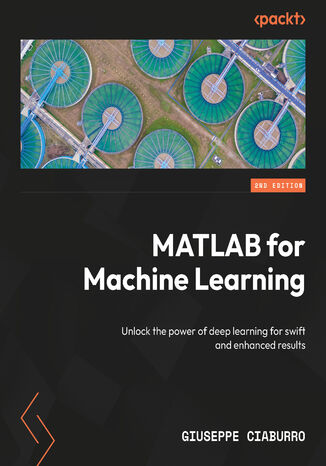
Giuseppe Ciaburro
Discover why the MATLAB programming environment is highly favored by researchers and math experts for machine learning with this guide which is designed to enhance your proficiency in both machine learning and deep learning using MATLAB, paving the way for advanced applications.By navigating the versatile machine learning tools in the MATLAB environment, you’ll learn how to seamlessly interact with the workspace. You’ll then move on to data cleansing, data mining, and analyzing various types of data in machine learning, and visualize data values on a graph. As you progress, you’ll explore various classification and regression techniques, skillfully applying them with MATLAB functions.This book teaches you the essentials of neural networks, guiding you through data fitting, pattern recognition, and cluster analysis. You’ll also explore feature selection and extraction techniques for performance improvement through dimensionality reduction. Finally, you’ll leverage MATLAB tools for deep learning and managing convolutional neural networks.By the end of the book, you’ll be able to put it all together by applying major machine learning algorithms in real-world scenarios.
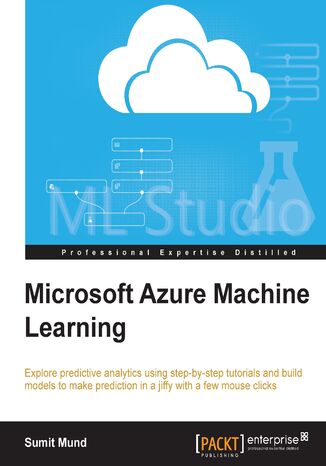
Sumit Mund
The book is intended for those who want to learn how to use Azure Machine Learning. Perhaps you already know a bit about Machine Learning, but have never used ML Studio in Azure; or perhaps you are an absolute newbie. In either case, this book will get you up-and-running quickly.
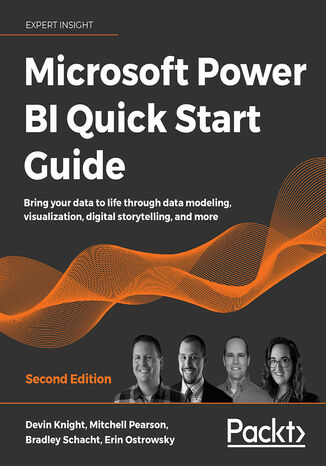
Devin Knight, Erin Ostrowsky, Mitchell Pearson, Bradley...
This revised edition has been fully updated to reflect the latest enhancements to Power BI. It includes a new chapter dedicated to dataflow, and covers all the essential concepts such as installation, designing effective data models, as well as building basic dashboards and visualizations to help you and your organization make better business decisions.You’ll learn how to obtain data from a variety of sources and clean it using Power BI Query Editor. You’ll then find out how you can design your data model to navigate and explore relationships within it and build DAX formulas to make your data easier to work with. Visualizing your data is a key element in this book, and you’ll get to grips rapidly with data visualization styles and enhanced digital storytelling techniques. In addition, you will acquire the skills to build your own dataflows, understand the Common Data Model, and automate data flow refreshes to eradicate data cleansing inefficiency.This guide will help you understand how to administer your organization's Power BI environment so that deployment can be made seamless, data refreshes can run properly, and security can be fully implemented.By the end of this Power BI book, you’ll have a better understanding of how to get the most out of Power BI to perform effective business intelligence.
MLOps with Red Hat OpenShift. A cloud-native approach to machine learning operations
Ross Brigoli, Faisal Masood
MLOps with OpenShift offers practical insights for implementing MLOps workflows on the dynamic OpenShift platform. As organizations worldwide seek to harness the power of machine learning operations, this book lays the foundation for your MLOps success. Starting with an exploration of key MLOps concepts, including data preparation, model training, and deployment, you’ll prepare to unleash OpenShift capabilities, kicking off with a primer on containers, pods, operators, and more.With the groundwork in place, you’ll be guided to MLOps workflows, uncovering the applications of popular machine learning frameworks for training and testing models on the platform.As you advance through the chapters, you’ll focus on the open-source data science and machine learning platform, Red Hat OpenShift Data Science, and its partner components, such as Pachyderm and Intel OpenVino, to understand their role in building and managing data pipelines, as well as deploying and monitoring machine learning models.Armed with this comprehensive knowledge, you’ll be able to implement MLOps workflows on the OpenShift platform proficiently.
Anubhav Singh, Rimjhim Bhadani
Deep learning is rapidly becoming the most popular topic in the mobile app industry. This book introduces trending deep learning concepts and their use cases with an industrial and application-focused approach. You will cover a range of projects covering tasks such as mobile vision, facial recognition, smart artificial intelligence assistant, augmented reality, and more.With the help of eight projects, you will learn how to integrate deep learning processes into mobile platforms, iOS, and Android. This will help you to transform deep learning features into robust mobile apps efficiently. You’ll get hands-on experience of selecting the right deep learning architectures and optimizing mobile deep learning models while following an application oriented-approach to deep learning on native mobile apps. We will later cover various pre-trained and custom-built deep learning model-based APIs such as machine learning (ML) Kit through Firebase. Further on, the book will take you through examples of creating custom deep learning models with TensorFlow Lite. Each project will demonstrate how to integrate deep learning libraries into your mobile apps, right from preparing the model through to deployment.By the end of this book, you’ll have mastered the skills to build and deploy deep learning mobile applications on both iOS and Android.
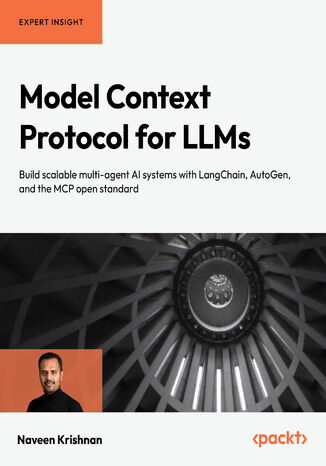
Naveen Krishnan
Modern LLM applications often fail due to weak context management, fragile tool integration, and poorly coordinated agents. To address these challenges, this book provides a practical blueprint for building reliable, scalable AI systems using the Model Context Protocol (MCP), an open standard for interoperable AI architectures.You'll explore why context is the missing layer in many AI deployments and how MCP formalizes it. Through clear explanations and practical examples, you'll design modular components such as resource providers, tool providers, gateways, and standardized interfaces. You'll also integrate MCP with LangChain, AutoGen, and RAG pipelines to build collaborative, context-aware multi-agent systems.You'll learn how to apply MCP to multimodal applications, personalization engines, and enterprise knowledge management solutions, while evaluating and benchmarking implementations for production readiness and implementing authentication, authorization, and scaling strategies for secure cloud deployments.Written by a data and AI solutions engineer with over 17 years of experience at Microsoft and Fortune 500 organizations, this guide combines architectural depth with hands-on implementation. By the end, you'll be able to design, build, and deploy secure, reusable MCP-based LLM systems that scale confidently in production.*Email sign-up and proof of purchase required
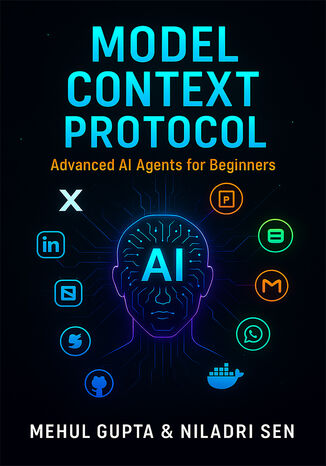
Mehul Gupta, Niladri Sen
This book offers a detailed introduction to the groundbreaking field of AI agents and Model Context Protocol (MCP). The first section delves into generative AI and large language models (LLMs), exploring how these technologies power modern AI systems. From there, the book introduces the concept of AI agents—autonomous systems capable of executing tasks with varying levels of complexity. Moving into practical applications, the book focuses on Model Context Protocol, explaining its key components and how it enables effective interaction between AI and various software tools. Each chapter offers step-by-step instructions for setting up MCP servers for popular tools like Gmail, YouTube, GitHub, and more, empowering readers to automate tasks and streamline workflows. The book concludes by addressing the future of MCP, its potential risks, and how to stay safe while using these advanced technologies. Whether you're a beginner or experienced practitioner, this guide will deepen your understanding of AI and enhance your ability to leverage cutting-edge automation in daily operations.
Moodle Gradebook - Second Edition. - Second Edition
Rebecca Barrington
This book is for teachers and administrators who have experience with Moodle. Basic knowledge of Moodle 2.x will be required, but no prior knowledge of grade functions is needed. This book will help you utilize the full functionality of Version 2.7.
Mercury Learning and Information, Roger W. Pryor
This updated edition of the book explores COMSOL 5 and MATLAB, essential modeling tools for engineers and scientists. It includes five new models and covers systems from 0D to 3D, introducing numerical analysis techniques in COMSOL 5.6 and MATLAB. Using examples from electromagnetic, electronic, optical, thermal physics, and biomedical models, the book provides fundamental concepts and step-by-step instructions for building each model. Companion files include all models and related animations.The course starts with modeling methodology and material properties, progressing through 0D electrical circuit interface, 1D, 2D, 2D axisymmetric, 2D simple and complex mixed mode, and 3D modeling. Advanced topics like Perfectly Matched Layer models and Bioheat models are also covered. Each chapter builds on the previous one, ensuring a comprehensive understanding of modeling techniques.Understanding these concepts is crucial for developing and analyzing engineering, science, and biomedical systems. This book transitions readers from basic to advanced modeling, combining theoretical knowledge with practical skills. Companion files enhance the learning experience, making this an essential resource for mastering COMSOL 5 and MATLAB.
Brian Sacash, Bhargav Srinivasa-Desikan, Reddy Anil Kumar
Modern text analysis is now very accessible using Python and open source tools, so discover how you can now perform modern text analysis in this era of textual data.This book shows you how to use natural language processing, and computational linguistics algorithms, to make inferences and gain insights about data you have. These algorithms are based on statistical machine learning and artificial intelligence techniques. The tools to work with these algorithms are available to you right now - with Python, and tools like Gensim and spaCy.You'll start by learning about data cleaning, and then how to perform computational linguistics from first concepts. You're then ready to explore the more sophisticated areas of statistical NLP and deep learning using Python, with realistic language and text samples. You'll learn to tag, parse, and model text using the best tools. You'll gain hands-on knowledge of the best frameworks to use, and you'll know when to choose a tool like Gensim for topic models, and when to work with Keras for deep learning.This book balances theory and practical hands-on examples, so you can learn about and conduct your own natural language processing projects and computational linguistics. You'll discover the rich ecosystem of Python tools you have available to conduct NLP - and enter the interesting world of modern text analysis.